

Electrical / Safety
Breakers, AFCIs and GFCIs: understand the protection
Learn what the devices do, what repeated trips are telling you, and which warning signs need prompt professional attention.
Our articles are a starting point, not a professional assessment of your home.
DraftA work in progress, prepared by the HouseIQ.pro team.Editorial and professional review are not yet complete.
The Big Picture
A breaker trip is information, not an inconvenience to defeat. Different devices watch for different faults, and a larger electrical service does not fix damaged branch wiring.
A conventional breaker protects the circuit
A branch-circuit breaker responds to excessive current, including overloads and short circuits. Think of it as a traffic limit for the wiring, not a guarantee that every appliance downstream is safe. An overload can happen when several individually ordinary loads share the same circuit. A short circuit is a fault that can draw much higher current.
The number on the handle is not an invitation to install a larger breaker when it trips. The protection must match the wiring, equipment and design. Changing that number without the necessary assessment can allow wiring to overheat. Likewise, an extension cord or power strip adds connection points, not circuit capacity. A qualified electrician can establish what actually shares the circuit.
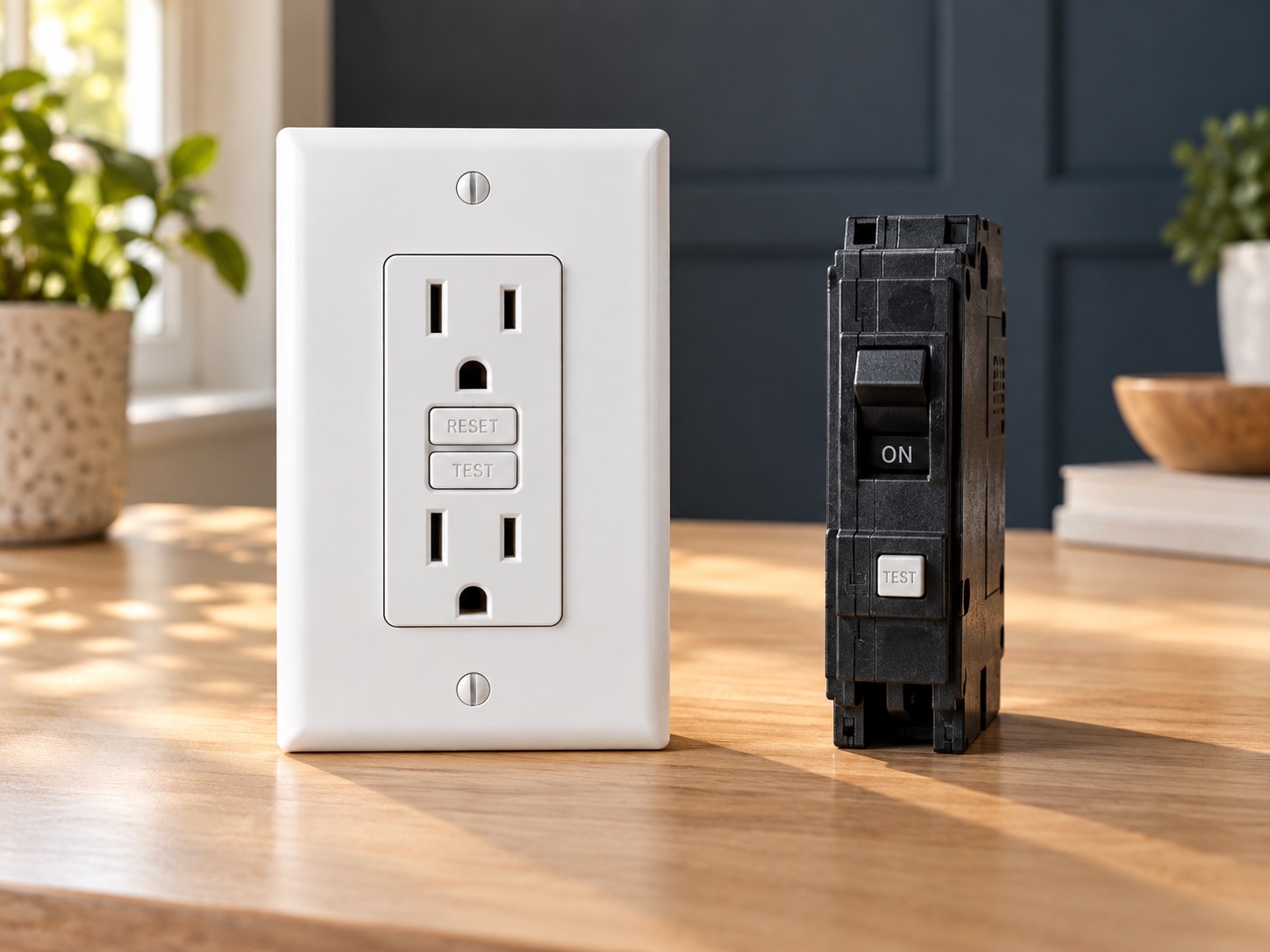
A GFCI watches for current taking an unintended path
A ground-fault circuit interrupter compares current going out with current returning. A small imbalance can indicate leakage, potentially through a person, and the device disconnects quickly. This is why GFCI protection is strongly associated with shock risks around water. It does not make electrical equipment safe to use in a bathtub or floodwater.
Protection may come from a receptacle, a breaker or another approved arrangement. An ordinary-looking receptacle can be protected by a device elsewhere, so counting TEST buttons is not a reliable inspection. Ask the electrician to identify what is protected and how to test it. A GFCI and an equipment grounding conductor serve different functions; adding one does not magically recreate missing wiring.
An AFCI watches for dangerous arcing patterns
An arc-fault circuit interrupter looks for characteristics associated with potentially dangerous electrical arcing. Damage, loose connections or stressed wiring can create a fire risk that is different from simply plugging in too many things. A circuit can therefore need arc-fault protection as well as ordinary overcurrent protection.
AFCI and GFCI are not alternate spellings for the same feature. Think of them as different alarms listening for different problems. Some devices provide both functions. “Combination AFCI” describes an arc-fault protection classification; do not assume that wording alone means GFCI protection is also included. Confirm the exact device’s listed functions with the installer rather than rely on a shortened quotation.
Where protection is required depends on the jurisdiction
Bathrooms, kitchens, outdoors and other wet or damp settings are common places to discuss GFCI protection. Living and sleeping areas are common parts of AFCI discussions. Those examples are orientation, not an installation checklist. Required locations, circuit ratings, exceptions and acceptable methods change with the adopted code and the nature of the work.
A US model-code article is not automatically the rule in a Canadian province, and a newly published edition may not yet be adopted locally. Existing installations, replacement receptacles, extended circuits and major renovations can trigger different requirements. Ask the electrician or authority having jurisdiction which rules apply to this specific project and how the completed work will be documented.
Repeated trips deserve a diagnosis
If a circuit trips, note what was operating, whether it happened immediately or after a delay, and whether it followed water exposure or recent work. Do not repeatedly reset a device hoping the problem will go away. Never hold a breaker on, bypass protection or replace it with a less protective device merely to stop the interruptions.
A routine reset or test should follow the device instructions and only be considered when the equipment and surrounding area are safe, dry and undamaged. A device that will not reset, trips again, or accompanies a worrying symptom needs professional investigation. The useful question is “What condition caused this?” A new breaker is not automatically the answer, and “nuisance trip” should be a conclusion supported by testing.
Heat, odour and damage change the urgency
Persistent buzzing or sizzling, discoloured receptacles, an overheated-plastic smell, damaged cords, loose plugs and frequent tripping are reasons to stop using affected equipment and obtain qualified help. Do not test an outlet by deliberately loading it harder. If there is smoke, active sparking, fire or immediate danger, move away and call emergency services.
Never enter standing water to reach a panel, and do not touch electrical equipment that may be wet or damaged. Turning off one switch does not prove a panel is safe internally. This article does not ask you to remove a panel cover, tighten connections or investigate energized wiring. Observation from a safe position is enough to make a useful report.
Make device testing an organized task
Locate the instructions for installed protective devices and follow their test schedule and procedure. Tell household members before interrupting power, and account for medical equipment, alarms, computers, freezers and other important loads. A failed test needs attention even if the receptacle still supplies power: delivering electricity is not proof that protection works.
Keep a simple record of the device, date, result and any follow-up. For a rental, report a failed test or damaged receptacle promptly through the building’s maintenance process, using the emergency contact for urgent hazards. Obtain permission for any alteration; landlord duties, tenant remedies and electrical licensing rules differ by location. A portable gadget should not become a way to ignore a defective permanent installation.
Capacity and safety are separate assessments
A larger service may be appropriate when new heating, cooking or vehicle charging loads are added. That is a load-planning question covered in our electrical-capacity guide. It does not resolve a loose receptacle, damaged cable or an incorrectly protected branch circuit. Conversely, an older-looking panel is not enough evidence to conclude that the entire service needs enlargement.
Ask for separate findings: existing defects that need correction, protection required for the proposed work, and available capacity for planned loads. That separation makes quotations easier to compare. It also keeps a safety repair from turning into an unexplained sales package. Model compatibility, condition and any applicable manufacturer recall should be checked by the professional.
Give the electrician observations, not a guessed diagnosis
Write down the location, symptoms, timing and affected appliances. Include photographs of labels only where they are visible without opening covers or approaching a hazard. Save invoices for recent renovations and explain any recurring pattern, such as a trip whenever two specific appliances operate together. Small factual details are more useful than assuming the breaker is weak.
At completion, ask which devices were installed, which circuits they protect, how occupants should test them, and what permit or inspection record applies. Request clear circuit identification. Keep the panel approach accessible and do not turn its working area into storage. Good access, understandable labels and a plan for responding to warning signs are worthwhile improvements even before the next renovation.
Questions worth asking
- What is causing the trip, and what evidence separates an overload from a wiring or appliance fault?
- Which circuits have overcurrent, ground-fault and arc-fault protection?
- Which local requirements apply to this work, and what test and inspection records will I receive?
Sources
- Electrical Safety Foundation Ground Fault Circuit Interrupters
- Electrical Safety Foundation Arc Fault Circuit Interrupters
- Electrical Safety Foundation Home Electrical Safety
- US Consumer Product Safety Commission Electrical Safety Month Poster
- Electrical Safety Foundation Qualified Electricians
- Leviton Is Dual Function AFCI/GFCI the Same as Combination AFCI?