

Build IQ / Smart IQ / Energy IQ
Electrical capacity: when a panel upgrade makes sense
Understand service capacity, breaker space and load management before planning heat pumps, EV charging or solar.
Our articles are a starting point, not a professional assessment of your home.
DraftA work in progress, prepared by the HouseIQ.pro team.Editorial and professional review are not yet complete.
Does electrification automatically mean 200 amps?
An EV or heat pump does not automatically turn a 100-amp service into an inadequate one. The useful question is whether the existing electrical system can safely support the proposed equipment, with the way it will be controlled and the other loads already present. BC Hydro explicitly notes that adding an EV charger often does not require a service upgrade. Some homes nevertheless need one.
Ask a licensed electrical contractor to explain the actual constraint before choosing a solution. It might be electrical capacity, room for approved breakers, equipment condition, a particular circuit, or several issues together. A neighbour’s successful installation is useful conversation, but it is not an assessment of your home. Start planning before ordering equipment so its electrical requirements can influence the choices.
A panel, a service and a circuit are different things
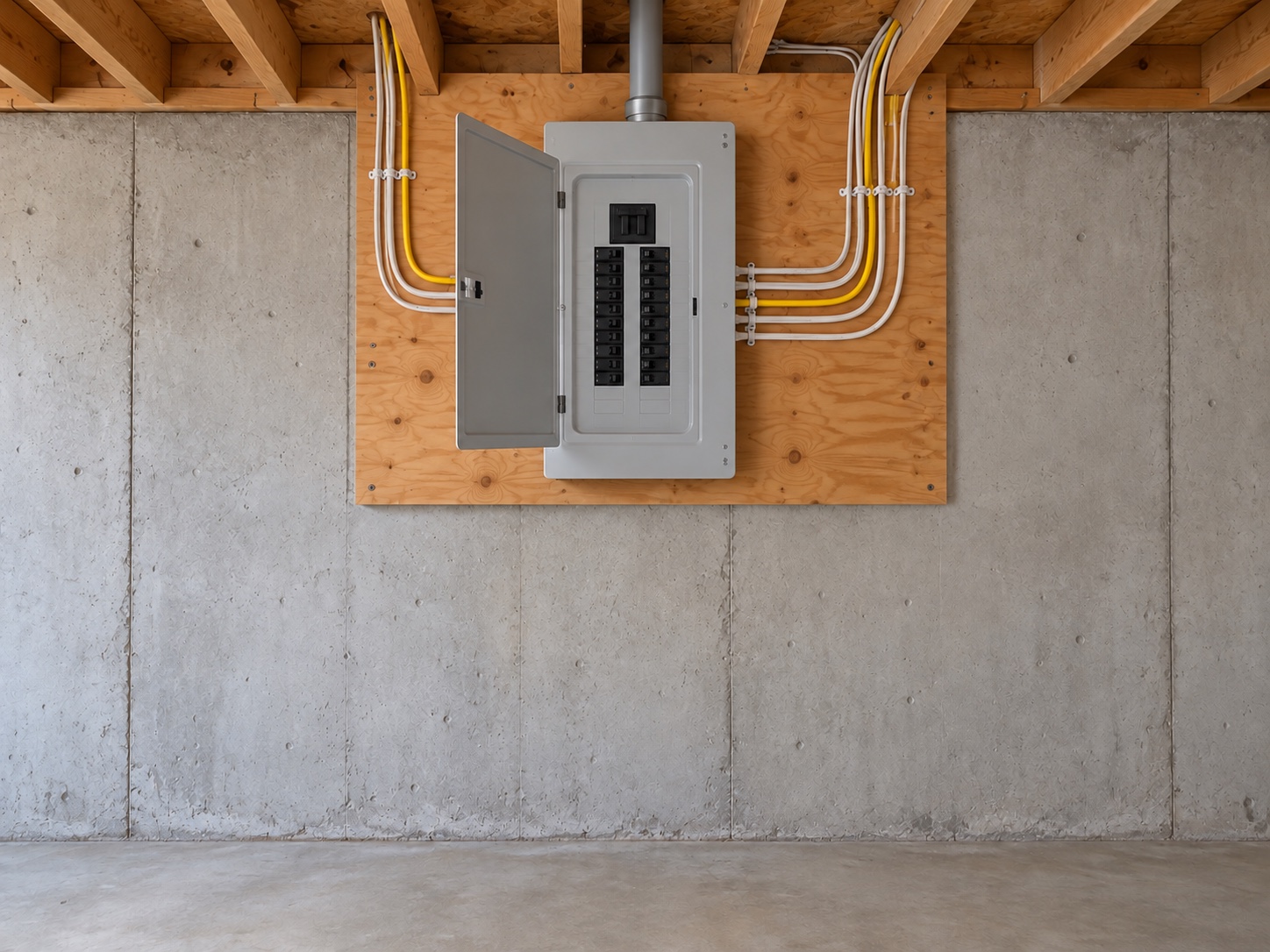
The word panel often gets used for the entire electrical system. That can make two quotes sound comparable when they describe different work. The service brings utility power to the home; the panel distributes it to circuits. Inside the panel, busbars carry current to the connected breakers. Those components have ratings and approved uses that a contractor must assess together.
An empty breaker position establishes physical space, not permission to add any size load. Likewise, adding a subpanel can provide distribution space without increasing the capacity of the service feeding it. Ask the contractor to identify which limit each proposed change resolves. A higher number on a new cabinet is not evidence that the entire supply path has been upgraded.
| Part of the system | Question for the contractor |
|---|---|
| Utility service | Can the utility connection and service equipment support the proposed demand? |
| Panel and busbars | Are the ratings, condition and connections suitable for all sources and loads? |
| Breaker space | Is there approved physical capacity for the required circuits? |
| Branch circuit | Is the individual equipment supply suitable for this exact model? |
Capacity needs evidence, including the future plan
Electrical demand concerns what the system must support at a time, while an electricity bill records energy used over a period. A modest monthly bill does not establish spare capacity for another large load. Nor is adding every breaker number a substitute for the assessment required by the local electrical rules. The contractor applies the permitted calculation or measurement method.
For its customers, BC Hydro recommends an electrician review the previous 12 months of meter data when assessing spare capacity. That is a useful example of evidence-based planning, not a universal instruction that any downloaded chart satisfies every jurisdiction. Tell the assessor about unusual vacancies, equipment that was not operating, and planned additions; historical use cannot include appliances that have not arrived yet. Ask what assumptions and seasonal conditions the conclusion covers.
Bring the complete heating proposal to the electrician
Heating decisions and electrical decisions should meet early. ENERGY STAR’s electric-ready guidance includes heat pumps, water heating, cooking and EV charging in the same planning exercise. Looking at one purchase in isolation can miss another addition that the household already intends to make. Insulation and air sealing can also change the heating and cooling work the equipment must do.
HouseIQ proposal prompt: ask the HVAC contractor for the exact indoor and outdoor equipment models, their electrical requirements, and the proposed supplementary heating arrangement. Then have the electrical contractor review that complete package. Ask specifically how auxiliary electric heat, if proposed, is accounted for and coordinated. A heat pump’s heating output is not itself an electrical-service assessment. For a Canadian winter or a Florida cooling season, the agreed equipment and controls should meet the home’s comfort needs as well as its electrical constraints.
Choose charging around the driving routine
Faster charging needs more electrical capacity, but maximum speed is not every household’s priority. BC Hydro recommends choosing the charging level and current around regular driving needs. Available time at home and the vehicle’s charging capability matter too. A charger cannot make a vehicle accept more power than its own system permits.
Bring a realistic description of normal travel and the times the car is parked. Include occasional long days, a possible second vehicle, and whether public charging is an acceptable fallback. Ask the contractor to compare a suitable lower-power option with a higher-power one before assuming the fastest charger is necessary. This is a design conversation: do not change a charger’s installed current limit or assume an existing receptacle and circuit are suitable simply because a plug fits.
Load management changes timing, not the service rating
A load-management system can make room in time for a flexible load. BC Hydro describes two common approaches: sharing a branch circuit so the EV charger pauses when another appliance runs, and monitoring household demand so charging is interrupted when necessary. The service retains its existing capacity; the controls keep selected loads from exceeding the allowed arrangement.
Imagine an evening when cooking and other household use take priority and the car resumes charging later. That can be a helpful trade if enough charging time remains before departure. It is less useful if the household regularly needs all those loads simultaneously. Request a written explanation of what is monitored, what can be delayed, and the expected effect on charging. Treat an avoided upgrade as a possible outcome of the assessment, not a promise attached to any smart switch.
Sources: [3]
A smart feature is not a safety approval
A phone app that schedules charging or displays consumption does not, by itself, demonstrate an approved load-management function. ESA’s May 2024 EV bulletin distinguishes ordinary EV supply equipment from equipment with the features needed to act as an energy-management system. It also explains why settings used to establish an installed rating need controlled access. These are reasons for professional selection and commissioning, not settings to experiment with.
For Ontario purchases, ESA requires electrical equipment to carry an appropriate recognized approval mark. Ask the installer to verify approval of the complete device and its intended use, plus compatibility with the charger and electrical installation. For another province or a U.S. state, have the contractor verify the applicable local listing and acceptance. Also ask how the chosen system responds to communications loss, a restart or a failed sensor, and which functions require an ongoing subscription.
Sometimes an upgrade is the sound choice
Load management cannot repair unsuitable equipment or create unlimited simultaneous capacity. If a compliant, workable arrangement cannot support the proposed loads, upgrading may be necessary. A household may also prefer extra capacity over repeated delays, particularly when planning several substantial additions. Separate essential corrective work from optional future provision in the quote.
ENERGY STAR distinguishes changing a panel from changing the utility service supplying it. Ask who coordinates the utility, what supply-side work is included, and what might be discovered after inspection. Request an allowance for approvals, scheduling and restoration work where relevant. No national price range can settle those site-specific costs, and a larger panel alone does not lower an energy bill.
Solar is another source, not spare nighttime capacity
Solar generation changes the electrical design because power can reach distribution equipment from more than one source. ESA’s dated inverter bulletin illustrates why busbar and conductor ratings require their own review. Do not subtract an annual solar estimate from household demand and assume the remaining number establishes service capacity. Generation, consumption and the permitted connection need a coordinated design.
Florida homeowners should check their actual utility’s requirements. FPL, for example, requires interconnection application approval before installation and operation, and requires equipment that isolates generation from the grid during an outage. Outage operation needs appropriate additional system capability. A rooftop array, a bigger panel and a battery are therefore three separate decisions. Ask the designer to explain both normal operation and the intended backup loads without assuming that solar automatically powers the home through a storm.
Make the decision easy to review later
HouseIQ planning prompt: request a short comparison of the viable options using the same appliance models and household assumptions. Include the existing-system assessment, any required corrective work, the proposed capacity or control change, and what future additions remain possible. Ask each bidder to separate equipment, electrical work, utility work and other project costs. That makes differences easier to discuss than comparing a single total.
Keep the final model numbers, operating explanation, approvals and commissioning records with the home documents. In Ontario, ESA specifically advises retaining the notification and Certificate of Acceptance for an EV installation. Elsewhere, ask which inspection and utility records demonstrate completion locally. A clear handover should tell you whom to contact if charging is repeatedly delayed, what the system is intended to prioritize, and when another home upgrade requires a new electrical review.
Questions worth taking with you
- Which part of the existing system limits this proposal: service, panel, breaker space or an individual circuit?
- What calculation or measured evidence supports the capacity assessment, and what future equipment is included?
- Would a different charging rate or approved load-management arrangement meet our needs?
- What happens when managed equipment loses communications or restarts?
- Which permits, utility approvals, inspections and handover records are included?
- How will a future heat pump, second EV, solar array or battery change the assessment?
Sources
- BC Hydro Home EV charger options
- BC Hydro How to install an EV charger at home
- BC Hydro Rebates for EV power management devices
- U.S. Environmental Protection Agency / ENERGY STAR Make Your Home Electric Ready
- Electrical Safety Authority, Ontario Electric Vehicles & Charging Systems
- Electrical Safety Authority, Ontario Recognized Approval Marks
- Electrical Safety Authority, Ontario Bulletin 86-1-6: Electric vehicle charging systems
- Electrical Safety Authority, Ontario Bulletin 64-1-4: Utility-interactive inverters
- Florida Power & Light Net Metering Guidelines