

Electrical & energy
Home EV charging: size the plan to the driving
Compare Level 1 and Level 2, understand load management, and prepare a useful electrical assessment before buying equipment.
Our articles are a starting point, not a professional assessment of your home.
DraftA work in progress, prepared by the HouseIQ.pro team.Editorial and professional review are not yet complete.
The Big Picture
The goal is to replace the energy you use while the vehicle is parked. A higher advertised charging rate is only useful when the car, supply and routine can use it.
Begin with the daily energy gap
Write down typical daily driving, occasional long days and how many hours the vehicle is normally parked at home. The charging task is usually to replace that day's energy use, not refill an empty battery every evening. A household with a short commute and a long overnight parking window has a different need from one with two vehicles and unpredictable shifts.
Use the vehicle's energy consumption and charging specifications to estimate needs, allowing for charging losses and seasonal variation. Cold weather, cabin conditioning and driving conditions can change energy demand. Keep a realistic alternative for unusually long trips or missed charging nights. This starting point makes an electrician's discussion more useful than requesting the largest circuit because a charger advertisement displays a high number.
Level 1 and Level 2 refer to the supply
In North American home use, Level 1 commonly uses 120-volt AC supply and Level 2 commonly uses 240-volt AC supply. Level 1 is slower, but it can meet some households' needs with adequate parked time and a suitable dedicated circuit. Level 2 offers a range of charging power; it is not one universal 40- or 50-amp specification.
The wall equipment is more precisely called electric vehicle supply equipment, or EVSE. For AC charging, the vehicle's onboard charger also limits how much power it accepts. A higher-capacity wall unit cannot force a car to charge above that limit. Compare the vehicle, EVSE and installation together. Public DC fast charging is a different system and should not be used as the expected performance benchmark for an ordinary residential installation.
Separate circuit amps, charging amps and energy
Amps describe current, kilowatts describe power, and kilowatt-hours describe energy delivered over time. For a simplified example, 240 volts at 24 amps is about 5.8 kilowatts. Six hours at that steady input would be about 35 kilowatt-hours before charging losses and any variation. This arithmetic explains the planning relationship; it is not a circuit design or a guaranteed battery gain.
A circuit's breaker rating is not necessarily the permitted continuous charging current. The installer must apply the relevant electrical rules, equipment instructions and settings. Do not infer conductor size or change a breaker from a charging-rate example. Ask a quote to state the proposed circuit rating, commissioned charging limit and expected vehicle limit separately. That prevents two apparently similar quotes from describing very different installations.
Spare breaker spaces do not establish spare capacity
A panel can have an empty position without having enough electrical capacity for an additional sustained load. The assessment needs the service, panel, existing loads, proposed charger and applicable calculation method. Planned changes such as a heat pump, electric water heater or second EV should be discussed now, even if they will be installed later.
Provide accessible equipment information and your driving requirements; leave panel opening and electrical investigation to a qualified electrician. Ask whether the options include a lower charging rate, approved load management or a service upgrade. Each has different cost and operational implications. The right choice depends on actual demand and local approval, not a rule that every EV requires a larger service or that every existing service can accept one.
Load management changes when or how much you charge
Static limiting sets a fixed maximum charging rate. Dynamic load management monitors available capacity and reduces or pauses charging as other household demand rises. Sharing between multiple charging units can distribute an allowed total. These are related ideas, but the equipment and permitted combinations differ. Scheduling charging for a quiet hour is not automatically an approved electrical load-management system.
Tesla's documented power-management options provide one manufacturer example, not a recommendation: its dynamic approach requires compatible monitoring hardware, and its group features have their own limits. Ask an installer how the proposed system senses demand, what happens if communications fail and which functions operate without internet service. Confirm that the complete arrangement is accepted for your installation. A phone app alone does not establish overload protection.
The parking layout matters as much as the wall unit
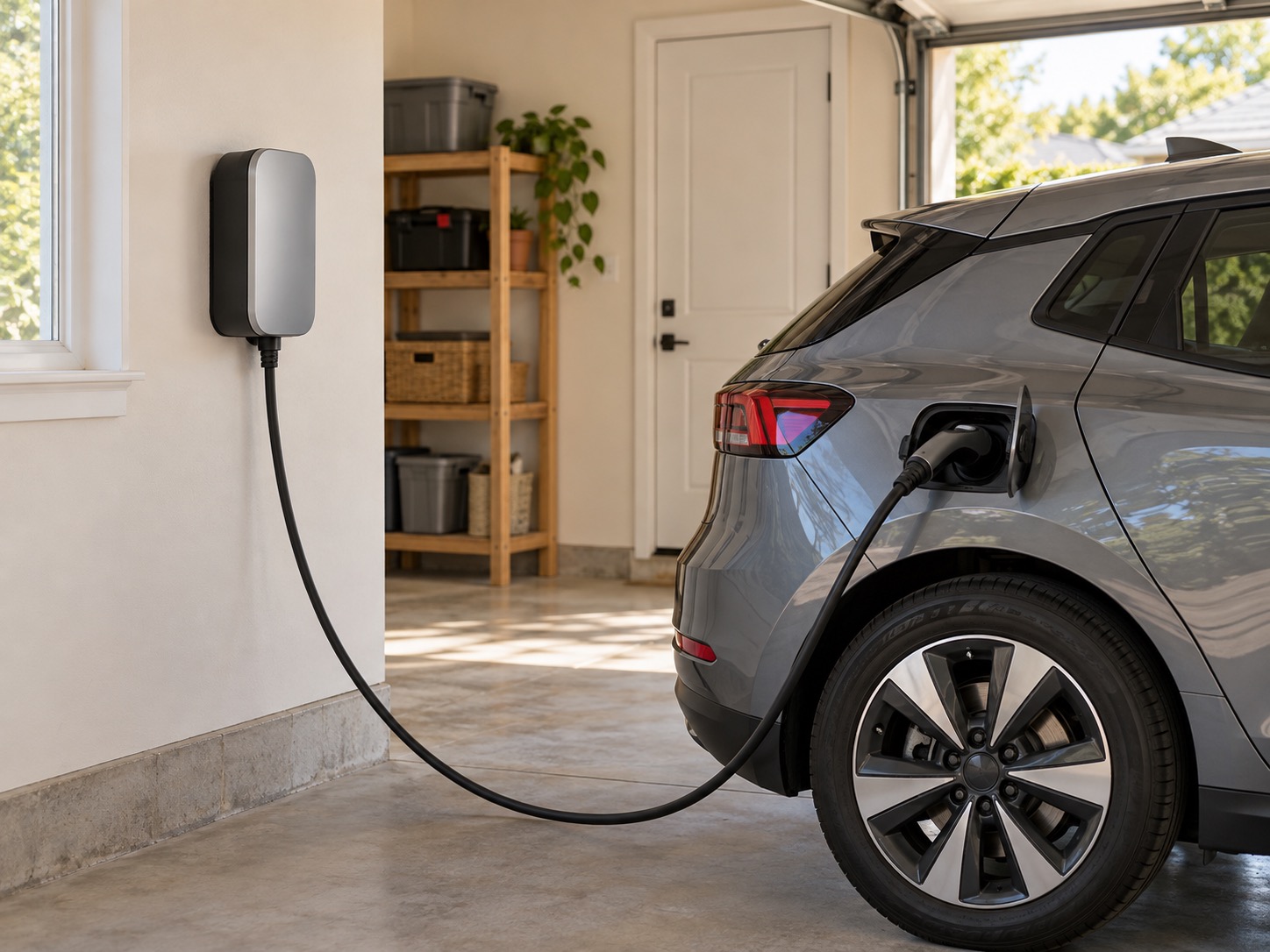
Choose a location that reaches the vehicle's charge port without stretching, crossing a walking route or relying on an extension cord. Think about both current and likely future parking positions. A cable that works when a car is backed in may be awkward when it is parked nose first. Include storage for the connector and protection from vehicle impact in the plan.
Outdoor equipment must be suitable for the environment and installed accordingly. Snow clearing, water, direct weather exposure and access to shutoffs or other equipment can affect placement. A detached garage can add a long cable route and separate supply questions. Ask the electrician to explain hardwired and receptacle-connected options for the chosen equipment; an existing outlet should be assessed rather than assumed suitable because the plug fits.
Choose compatible, approved equipment and a clear scope
Confirm the vehicle connector and any manufacturer-authorized adapter arrangement before buying. Look for appropriate independent electrical safety certification accepted locally, weather suitability, cable reach, operating temperature and support. ENERGY STAR information can help compare certified equipment and standby energy use, but a product label does not replace approval of the installation itself.
The quote should identify who obtains required permits, performs the work and arranges inspection. It should also describe any trenching, wall repair, load-management hardware or utility involvement. Renters and condominium residents need the relevant property approvals and a plan for ownership, access and billing. Compare complete installed scopes rather than only the wall unit's price. A modest charger with a straightforward route can be a different project from the same charger across a finished house.
Commission it, then keep the charging routine simple
At handover, ask for a demonstration of normal charging, cable storage, fault indications and the configured current limit. Keep the permit or inspection record, equipment model, settings documentation and support contact with the home record. Do not change installer-restricted settings to chase a faster rate. If equipment or a connection becomes unusually hot, damaged or unreliable, stop using it and obtain qualified service.
Review utility rates and vehicle scheduling so overlapping timers do not accidentally prevent charging. Track whether the car is ready when needed over ordinary weeks and the colder season. If it consistently meets the requirement, a higher rate may add little value. If it does not, revisit available time, vehicle limits and the electrical plan with the installer instead of treating repeated interruptions as normal.
Questions worth asking
- How much energy must be replaced during my normal parking time?
- What limits the charging rate: the vehicle, equipment or supply?
- Would approved load management avoid an unnecessary upgrade?
- What permissions, inspection and commissioning records are included?
Sources
- US Department of Energy, AFDC Charging Electric Vehicles at Home
- US Department of Energy, AFDC Electric Vehicle Charging Stations
- ENERGY STAR Electric Vehicle Chargers
- Tesla Wall Connector Power Management