

Interiors
Kitchen countertops: choose the surface you want to live with
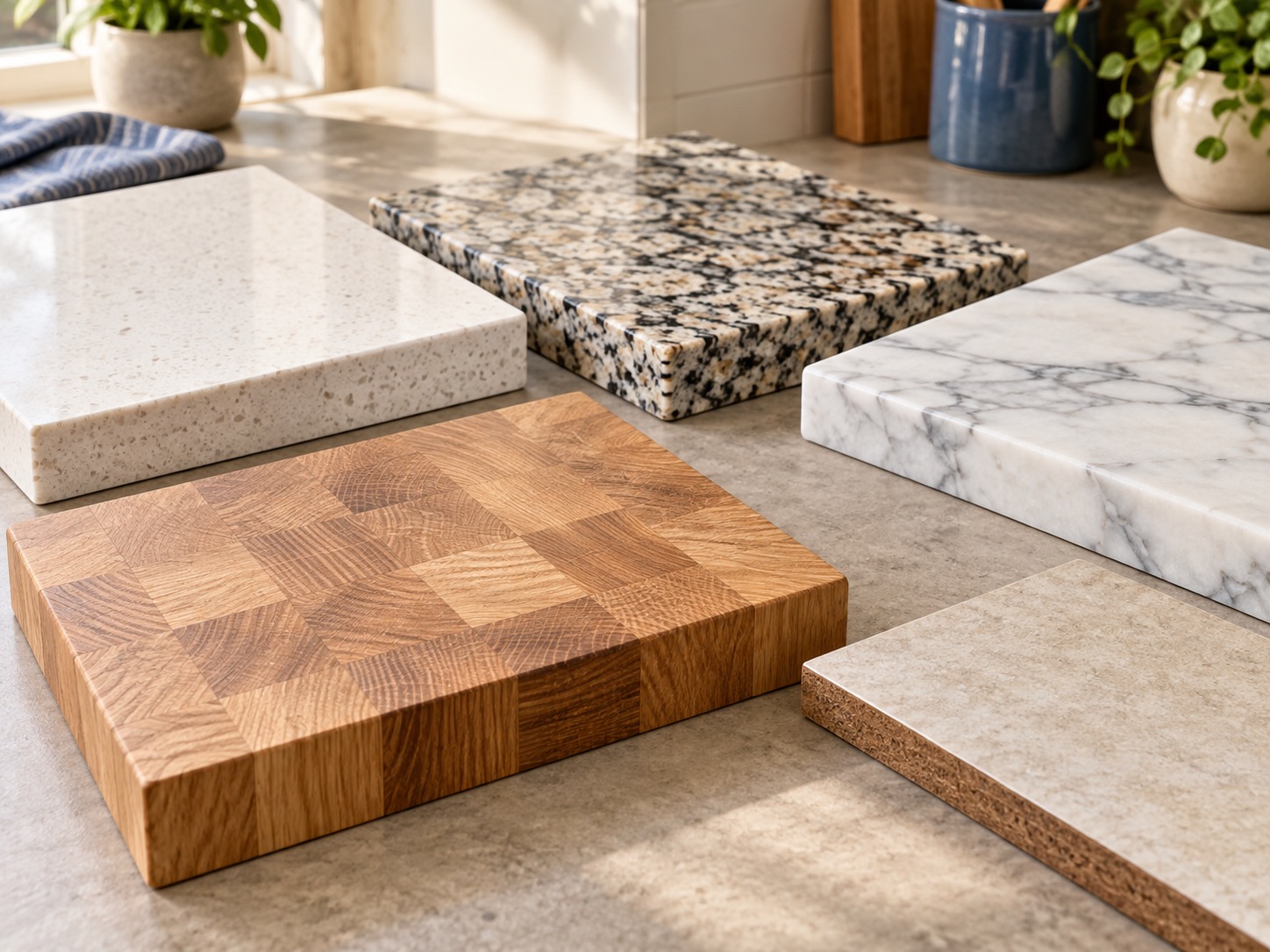
Quartz, granite, marble, wood and laminate each ask something different of the people using them. Compare the daily habits as well as the samples.
Our articles are a starting point, not a professional assessment of your home.
DraftA work in progress, prepared by the HouseIQ.pro team.Editorial and professional review are not yet complete.
The Big Picture
The best countertop fits your habits, support and maintenance expectations—not just the showroom lighting.
Start with an ordinary Tuesday
Imagine unloading groceries, putting down a hot pan, squeezing a lemon and leaving the washing-up until later. Those moments tell you more about a countertop choice than a photograph. Make three short lists: what you want it to look like, what happens on it every day, and what care you will actually do.
Bring a sample home and view it beside cabinets in daylight and evening light. Ask to see the actual slab or proposed layout when the pattern matters. A little sample can hide a large vein or a repeating pattern. Choose deliberately between a surface that stays visually consistent and one that develops signs of use.
Engineered quartz: convenient, with heat limits
Engineered quartz combines mineral material with binders and pigments. It is different from quarried quartzite, despite the similar names. Its consistent designs and low absorption can make daily cleaning straightforward. Most conventional quartz countertops do not require the impregnating sealers used for some natural stones; follow the particular manufacturer's care sheet.
Heat resistance is not an invitation to put a pan straight from the oven onto it. Use trivets and follow appliance-clearance instructions for slow cookers or countertop ovens. Sudden temperature changes can damage a surface. Scratch-resistant also does not mean knife-proof: use a cutting board. Confirm whether your chosen product is approved for outdoor sunlight rather than assuming an indoor slab belongs in an outdoor kitchen.
Granite and marble have different personalities
Granite is a natural stone with variation in minerals, colour and absorption. Marble is commonly more sensitive to acids: lemon juice or vinegar can leave a dull etched patch. Etching changes the surface; it is different from a coloured stain that has soaked in. A sealer intended to reduce absorption does not make marble acid-proof.
Some stones benefit from an impregnating sealer, and others need little or none. Ask the supplier about the exact stone and finish instead of adopting an automatic annual sealing ritual. Use a stone-compatible cleaner and protect both materials from hot cookware and impact at vulnerable edges. If a lived-in marble patina would annoy you, that is useful information before purchase.
Butcher block: warmth with a care commitment
Wood offers a different feel and can sometimes be renewed when wear is superficial. Its finish determines how to look after it. An oil-finished worktop and a film-finished decorative counter are not interchangeable cutting boards. Ask whether direct food preparation is intended, and what cleaning and renewal products the maker permits.
Standing water near a sink, a wet cloth left in place and leaking joints deserve attention. Wipe the surface dry after cleaning. Oil-finished products need replenishment according to use and the manufacturer's instructions; John Boos provides a specific care routine for its oil-finished tops. Do not apply that routine indiscriminately to every finished wood surface. A separate washable cutting board also makes cleanup and food separation simpler.
Laminate: focus on edges as well as the face
Conventional laminate countertops have a durable decorative face bonded to a supporting substrate. They offer many patterns and can be an economical way to change a kitchen, but compare the complete installed quotation rather than assuming every laminate option costs less than every stone option.
The surface can tolerate ordinary wiping while joints, cutouts and damaged edges remain vulnerable to water entry. Do not leave puddles around the sink or assume that the decorative face makes the complete assembly waterproof. Use trivets and cutting boards. Deep burns or cuts cannot simply be sanded away like wear in solid wood: the pattern is a surface layer. Ask about the repair or replacement strategy for a damaged section.
The counter needs a sound home underneath
A countertop is only part of the assembly. Before a heavy replacement is ordered, have the installer assess cabinet condition, level, fastening, support around cutouts and any overhang. A beautiful slab over a weak or water-damaged cabinet is money spent in the wrong order. Ask who is responsible for fixing that substrate and when the work happens.
Agree on seam locations, edge shape, sink mounting and the appliance openings before fabrication. Include access through doors and stairs in the discussion. Confirm plumbing disconnection and reconnection, old-counter removal, backsplash disruption and waste handling in the written scope. This avoids comparing a supply-only price with a complete, usable kitchen.
Fabrication is a specialist job
Cutting, grinding or drilling silica-containing stone can create hazardous respirable dust. Engineered stone and some natural stone both deserve attention; this is not a reason to improvise a dry cut in a garage. NIOSH identifies countertop fabrication as a serious exposure concern.
Use qualified fabricators who can explain their exposure controls, legal compliance and protection of occupied areas. Ask how they minimize work in the home and handle any unavoidable adjustment. Do not accept uncontrolled dust as a normal part of a new kitchen. Some jurisdictions restrict particular engineered-stone products, so verify what can lawfully be supplied and worked locally. Ordinary use of an intact installed counter is a different situation from generating fabrication dust.
Compare ownership, not a promised lifespan
Request quotations with the same dimensions, thickness, edges, cutouts, support work and installation scope. Record what is excluded. A lower material price can be overtaken by awkward access or cabinet repairs; a high price does not guarantee better installation. Look at repairability, the local availability of matching material and who handles a warranty claim.
There is no useful universal service-life promise for these five families. Care, impact, moisture, fabrication quality and later kitchen changes all matter. Keep the product name, colour, finish and care sheet with the home records. Renters should report lifting seams or water damage promptly and obtain permission before sealing, sanding or using a repair coating.
A practical way to make the decision
If you want minimal routine sealing, start by looking at compatible quartz or laminate options. If natural variation is the attraction, compare actual granite and marble slabs and be honest about acid marks. If warmth and renewability matter most, ask what a wood worktop's finish will demand around your particular sink. These are starting points, not a ranking of good and bad materials.
Before signing, ask the seller to walk through your three most common kitchen messes and the approved response to each. Keep one small offcut or spare sample when available. It provides a useful reference for colour and finish without experimenting on the most visible part of the counter.
Questions worth asking
- What exactly is the material and finish, and which care sheet applies?
- What cabinet repairs and support are included?
- How will fabrication dust be controlled?
- Which seams, cutouts and exclusions appear on the final drawing?
Sources
- Natural Stone Institute Care and cleaning of natural stone
- Cambria Quartz countertops
- John Boos Caring for countertops and worktops
- Formica Laminate cleaning and maintenance
- CDC / NIOSH Silica and worker health