

Energy IQ / Comfort IQ
Renter-friendly comfort and energy improvements
Choose practical improvements for a rented home: manage sunlight, understand removable films and draught stoppers, choose compatible LEDs, and assess portable heating and cooling before buying.
Our articles are a starting point, not a professional assessment of your home.
DraftA work in progress, prepared by the HouseIQ.pro team.Editorial and professional review are not yet complete.
Start with what you control
You do not need to own the building to make your home more comfortable. But the best first move depends on the problem: a chilly chair beside a window, afternoon sun across a bedroom, or lights left on in empty rooms. Each suggests a different response. Buying several “energy-saving” products at once makes it harder to discover what actually helped.
Write down who pays for electricity and heating, which controls you can use, and which systems are shared. If heating is included in rent, an improvement may help comfort without changing your monthly payment. If you pay for an added electric appliance while the building supplies heat, that appliance creates a new cost; its efficiency alone does not establish savings.
Keep a short record of the room, time, weather, thermostat setting if available, and what you notice. A thermometer can make “the bedroom is cold every morning” more specific. Share persistent problems with the landlord or building manager, especially when you cannot control the heating or cooling. This observation record is useful evidence, not a diagnosis.
Sources: [1]
Plan the removal before the installation
“Renter-friendly” describes an intention, not a deposit guarantee. Read your lease and building rules, and seek written approval where needed for adhesive strips, films, curtain hardware, window kits or other changes. Describe the exact product and location rather than asking broadly to make the home more efficient.
Photograph the original condition and agree on removal or reinstatement. A removable product can still lift paint, leave residue or affect a warranty. Keep instructions and any original parts you are expected to reinstall. If the permission or removal method is unclear, choose an action that uses existing equipment while you resolve it.
Let the season guide curtains and shades
Use existing coverings first. During a Canadian heating season, opening them for useful daytime sunshine and closing them at night can improve comfort. When unwanted sunshine is heating a room, close its coverings before that sun arrives. A west-facing Florida room and a winter reading nook may therefore call for different routines.
Try the routine for several comparable days and note comfort, glare and daylight. Keep coverings clear of heaters and air outlets, following equipment clearances. Do not hide wet window surfaces behind closed curtains: report persistent condensation or dampness. Buying heavier curtains is not a substitute for finding the cause of a moisture problem.
Window film can mean two different things
Seasonal shrink film spans the interior window trim, creating an additional air layer; it is not a coating placed directly on the glass. NRCan describes it as a temporary interior storm-window option. The tape can remove paint, and the covered window cannot open normally. Get permission, follow the kit instructions, and do not obstruct a required escape opening or needed ventilation.
Solar-control film goes on glass to change solar heat transmission. It addresses overheating or glare rather than sealing a frame draught. Reducing welcome winter sun can be a disadvantage in a heating climate. “Static cling” describes attachment, not an energy-performance rating; privacy or decorative film is not automatically an insulating or solar-control product.
Check the exact film against the window type, coatings and glazing manufacturer’s warranty. Solar absorption can increase thermal stress in glass. Even adhesive-free products have restrictions: Gila’s instructions distinguish between films, single- and double-pane glass, and application surfaces. Those instructions demonstrate why a generic “safe for all windows” claim is inadequate. Ask the window manufacturer or a qualified window professional when compatibility is uncertain.
Treat a draught without blocking needed airflow
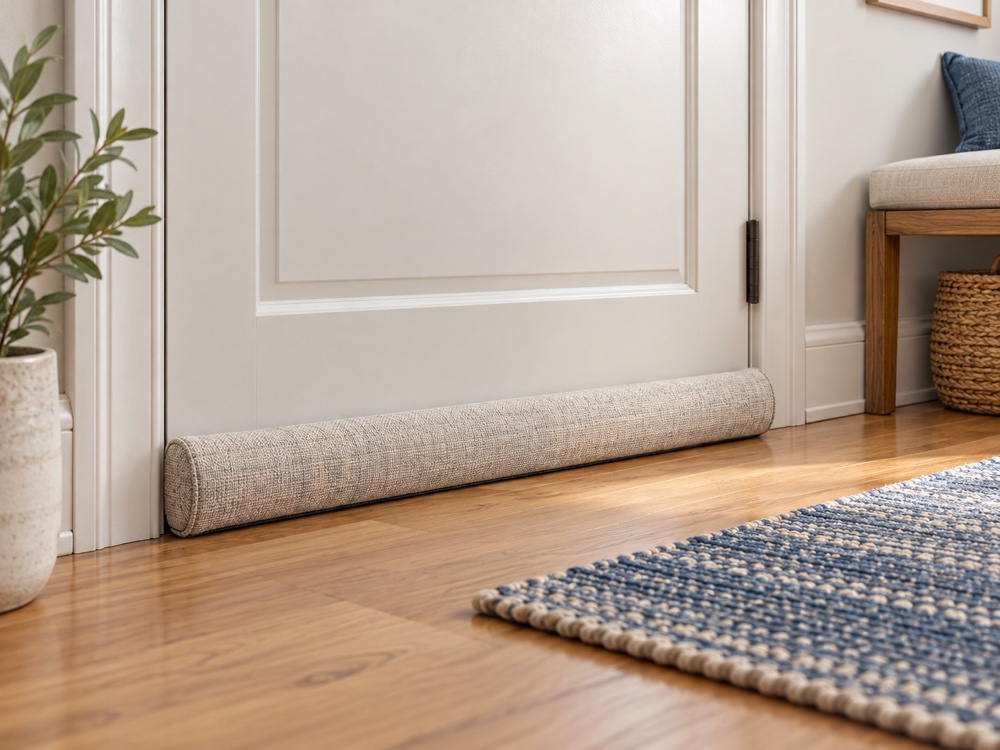
A loose draught stopper at a living-room door opening directly outdoors may be a modest comfort trial if the building manager confirms the gap is unintended leakage. Choose something that does not impede opening, closing or escape, and move it out of the way when using the door. Worn seals or a door that does not latch properly deserve a maintenance request.
Do not assume every door gap is a defect. Interior door undercuts and transfer grilles can let air return to a central heating or cooling system. Blocking them can upset room pressures and comfort. Leave ventilation openings, combustion-air paths and fire-door arrangements alone; a suite door to a shared corridor needs building-specific guidance. Removable draught control belongs at a verified leak, not wherever air seems to move.
Sources: [4]
Make lighting a small, measurable improvement
Start with a frequently used lamp that still has an inefficient bulb. For an approved replacement, match the base and physical fit, then compare lumens for brightness and watts for electricity use. Choose a colour temperature you enjoy; a lower Kelvin number generally looks warmer. Buying one bulb first lets you judge the light before changing a whole room.
Read both the fixture marking and bulb packaging. Confirm the maximum permitted actual wattage, suitability for an enclosed fixture where relevant, and compatibility with any dimmer. “Dimmable” is not a promise that every dimmer will work. Stay with straightforward, accessible bulb changes permitted by the landlord; fixture, ballast or wiring conversions need the appropriate owner-approved professional.
For an illustrative calculation, replacing a 60-watt bulb with a hypothetical 9-watt LED of suitable brightness saves 51 watts while lit. At four hours daily for 30 days, that is 6.12 kilowatt-hours: 51 × 4 × 30 ÷ 1,000. These are invented usage assumptions, not a savings promise. Apply your own marginal electricity rate; fixed bill charges will remain.
For electronics, enable sleep settings and switch off nonessential equipment when unused. A correctly rated switched power strip can help with a suitable group of entertainment devices. Keep refrigerators, medical equipment, alarms, required networking and other essential or safety devices outside that routine. Check device instructions before cutting power; a tiny standby load may not justify buying another gadget.
Check what a portable “heater and cooler” actually does
A heat pump moves heat: cooling carries it outdoors, while heating reverses the process to bring heat indoors. Electric resistance heating instead turns electricity directly into heat. Before comparing portable products, confirm whether heating uses a heat-pump cycle, resistance elements, or both. A heating button and a large cooling-capacity number do not answer that question.
Hoses matter too. In cooling mode, a typical single-hose portable sends room air outdoors, so replacement air must enter from elsewhere; that can bring unwanted heat and humidity. A dual-hose design provides a separate outdoor intake for the heat-rejection side and can reduce this pressure effect. Neither design establishes the comfort or running cost of a particular installation.
Read the exact model manual before buying. Confirm separate heating and cooling ratings, permitted outdoor and indoor temperatures, hose and window-kit arrangements, condensate handling in each mode, and electrical requirements. A thermostat’s selectable temperature range is not the outdoor operating limit. Do not assume a portable unit can heat through a Canadian winter or dispose of all condensate during humid Florida weather.
Verify that the landlord permits the window arrangement and that it preserves security and required escape. Follow the manufacturer’s outlet requirements; an unsuitable outlet is a landlord/electrician issue, not a reason to improvise adapters or wiring. Do not redirect exhaust into another room or building cavity. A permanent mini-split involves a different installation and permission decision.
Compare purchase cost, noise, space, drainage work and expected electricity use with the problem you want solved. Portable does not automatically mean inexpensive to run, easy to accommodate or more efficient than the system already serving the home.
Choose a small plan you can evaluate
Pick one no-cost habit and, if justified, one compatible product. For a sunny bedroom, begin with the existing shade routine; for an often-used table lamp, try one LED. Record the date and the result. Ask whether the room improved, whether the change was convenient, and whether any new problem appeared.
Keep successful changes and revisit the rest. A lower bill during milder weather does not prove that one product caused the reduction. If discomfort persists, send the landlord your observations, photographs and a specific request to assess the cause. That is often a better next investment of effort than adding another temporary fix.
Questions worth taking with you
- Which comfort problem matters most, and which settings or equipment can I control?
- Who pays for the energy affected by this change?
- Is this exact product permitted, compatible with the surface or fixture, and practical to remove?
- For a portable unit, what does its manual specify for heating technology, temperatures, hoses, drainage and power?
- What observation would show that this change helped, and what needs a landlord maintenance assessment?
Sources
- U.S. Department of Energy Energy Saver: Tips on Saving Money and Energy in Your Home
- Natural Resources Canada Keeping the Heat In — Section 8: Upgrading windows and exterior doors
- Eastman Performance Films / Gila Home Window Film FAQs
- U.S. Department of Energy / Pacific Northwest National Laboratory Transfer Grilles — Building America Solution Center
- ENERGY STAR / U.S. Environmental Protection Agency The Bright Choice: Renovate with ENERGY STAR LED Lighting
- ENERGY STAR How Does a Heat Pump Work?
- Whynter ARC-14SH Dual Hose Portable Air Conditioner with Heat — product information and FAQs