

Safety & security
Radon: test the home, then choose a measured solution
Read long-term results correctly and understand how soil-gas mitigation differs from ordinary ventilation.
Our articles are a starting point, not a professional assessment of your home.
DraftA work in progress, prepared by the HouseIQ.pro team.Editorial and professional review are not yet complete.
The Big Picture
You cannot judge a home’s radon level from its appearance or neighbourhood. A valid test establishes the problem; follow-up testing verifies the fix.
Radon follows pathways from soil into a building
Radon is a radioactive gas produced naturally as uranium breaks down in the ground. It has no smell or colour to warn you that it is accumulating. Soil gas can enter through foundation cracks, construction joints, service penetrations and other openings. Pressure differences between the house and soil can draw it inward. The useful question is how much reaches occupied air over time.
This is not only a granite-region or cold-climate issue. Geology influences potential, but neighbouring houses can have different results because their foundations, air leakage and operation differ. Slab-on-grade homes can also be affected. A dry, attractive basement is not evidence of low radon, and a musty smell is not a radon detector. Testing is the way to distinguish concern from measurement.
Measure an average, not an interesting afternoon
Radon levels change with weather, ventilation and household operation. An electronic monitor can make those changes visible, but a high hour or a low day is not the same as a long-term result. Think of it like tracking seasonal heating use: one mild afternoon cannot represent the year. Save the averaging period with every reading so the number retains its meaning.
Health Canada recommends long-term testing for at least three months. Its residential measurement guide calls for at least 91 days during the heating season and recommends tests lasting 3–12 months. Short tests used in some U.S. transactions have their own protocols and follow-up requirements. Use the applicable national and local guidance rather than mixing a short-test method with a long-term interpretation.
Choose a test that can support a decision
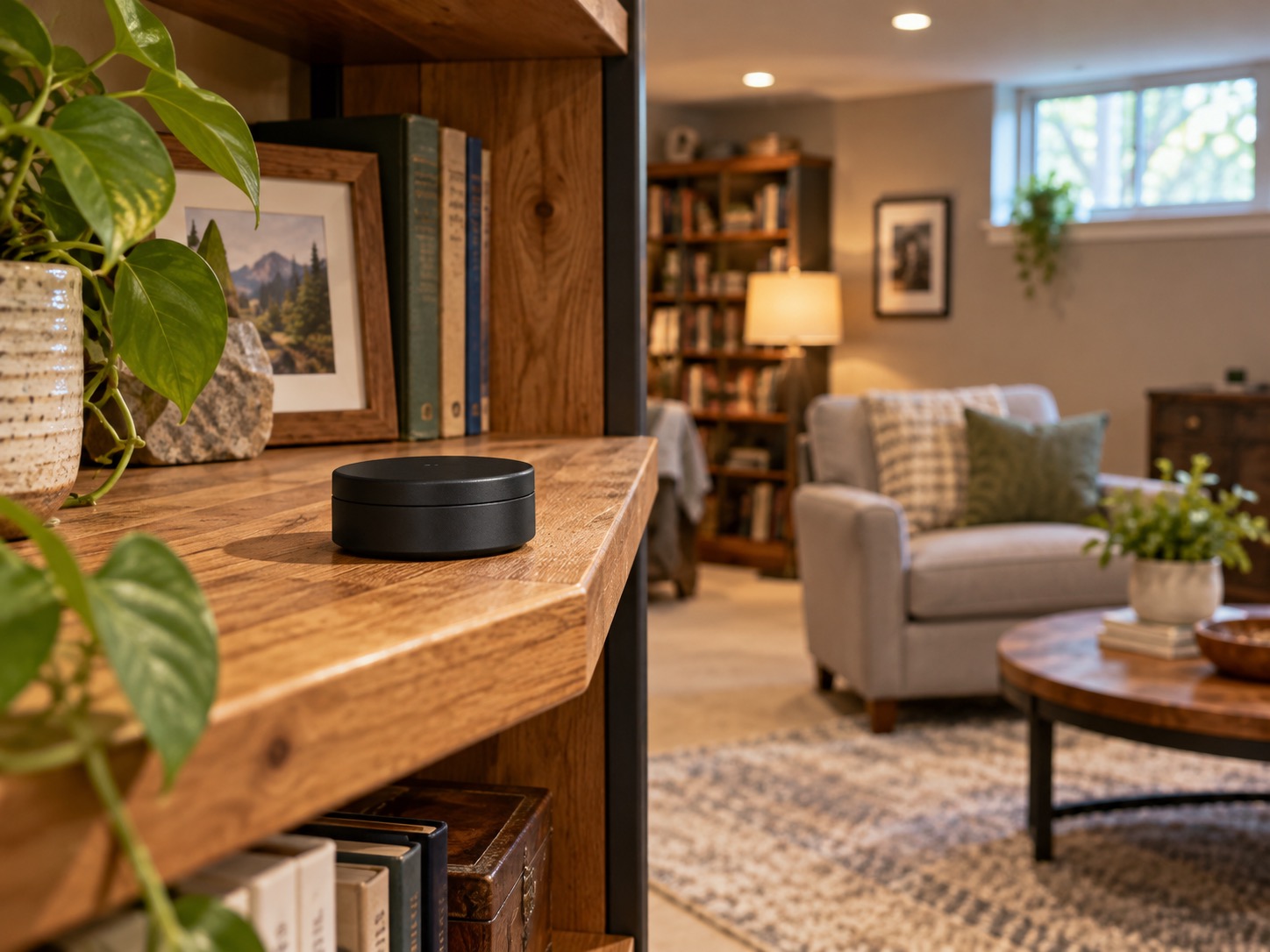
A passive test device is exposed for the prescribed period and then sent for analysis. An electronic radon monitor measures repeatedly and may display averages and trends. Both require correct placement and use. An ordinary air-quality monitor does not necessarily measure radon; look for an explicit radon measurement function and evidence of performance, rather than assuming every indoor sensor does the same job.
For electronic monitors, Health Canada recommends models that have passed C-NRPP performance testing. Check data-storage capacity before a long test: losing older readings can undermine the intended average. Keep the device instructions, start date, serial number, room description and laboratory report or exported data. These records make the result useful to a mitigation contractor, future owner or anyone reviewing a later test.
Put the test where people spend time
Follow the test provider's placement instructions, including clearances from walls, windows, heat sources and other objects. A convenient corner is not automatically a representative location. In Canadian guidance, the target is a normal occupancy area on the lowest lived-in level, generally where a person spends more than four hours daily. A future basement bedroom is worth considering before construction conceals access to the slab.
Keep living normally during a long-term test. Do not move the device between floors to search for a more reassuring result. Record unusual events such as extended vacancy, major ventilation changes or construction and ask the provider whether they affect interpretation. In shared or multifamily buildings, a single test does not establish conditions in every unit; use a building-specific testing plan.
Keep Canadian and U.S. action guidance separate
Canada's guideline is 200 becquerels per cubic metre, written Bq/m³; Health Canada advises action when a home's result exceeds that level. In the United States, EPA recommends fixing homes at 4 picocuries per litre, written pCi/L, or more, approximately 150 Bq/m³. EPA also advises considering reduction between 2 and 4 pCi/L. These are different national action frameworks, not interchangeable display settings.
No action threshold means that exposure below it is risk-free. Read the report's units, duration and instructions together, and discuss the timing of action with a qualified professional. Do not compare a Canadian long-term result with a U.S. headline while ignoring units. If a result is incomplete, borderline or inconsistent with another test, resolve the measurement question rather than selecting the preferred number.
Active suction intercepts soil gas below the floor
A common mitigation approach is active sub-slab depressurization. A professional creates a controlled suction point beneath the slab and uses a fan and pipe route to discharge soil gas outdoors. The aim is to draw that gas into the system before it enters living space. It is not simply a bathroom fan blowing basement air outside.
Different foundations need different designs. Multiple slab sections, crawlspaces, sump arrangements and additions can affect how suction communicates beneath the building. A sealed membrane may form part of a crawlspace approach. Ask the contractor how the proposed system addresses all relevant foundation areas, where the exhaust will terminate and how condensate, noise, access and ongoing operation will be handled. The drawing should match your house, not a generic sales illustration.
Sealing and ventilation have supporting roles
Sealing major entry routes can help a mitigation system work, but sealing alone is not a dependable universal fix. Hidden openings remain, and cracks can change. Opening windows may temporarily change a reading without providing a practical year-round solution. Increased ventilation also affects comfort, heating or cooling demand and pressure relationships, so it needs a considered design.
An existing radon rough-in does not prove that a home has effective mitigation. Ask whether it is passive or active, whether a fan is installed and operating, and what post-installation testing showed. A pipe label, fan hum or pressure indicator can help identify system status, but none replaces a radon measurement. Keep the professional's operating instructions with the equipment record so a future occupant understands its purpose.
The job ends with verification and a maintenance plan
Request a written scope from a qualified radon mitigation professional, including testing after installation and what happens if the agreed performance is not achieved. In Canada, Health Canada recommends a C-NRPP-certified mitigation professional. In the United States, consult state guidance and qualified provider listings. Clarify electrical work, permits and responsibility for repairs around the installation before accepting a quote.
After installation, follow the applicable testing protocol and the contractor's instructions. Learn what the system's normal indicator reading looks like and whom to call if it changes or the fan stops. Retest as recommended and after major changes that could affect radon entry or ventilation. Keep the original result, system description, follow-up results and service records together: that history makes continuing protection much easier to manage.
Questions worth asking
- Does this test follow the protocol for my jurisdiction?
- What dates and units does the result represent?
- How will the system address each foundation area?
- Who verifies the result after installation?
Sources
- Health Canada About radon
- Health Canada Testing your home for radon
- Health Canada Guide for radon measurements in residential dwellings
- Health Canada Reducing radon levels in your home
- US EPA What is EPA’s Action Level for Radon and What Does it Mean?
- US EPA Consumer’s Guide to Radon Reduction