

Roofs & drainage
Roofing materials: compare the system beneath the colour
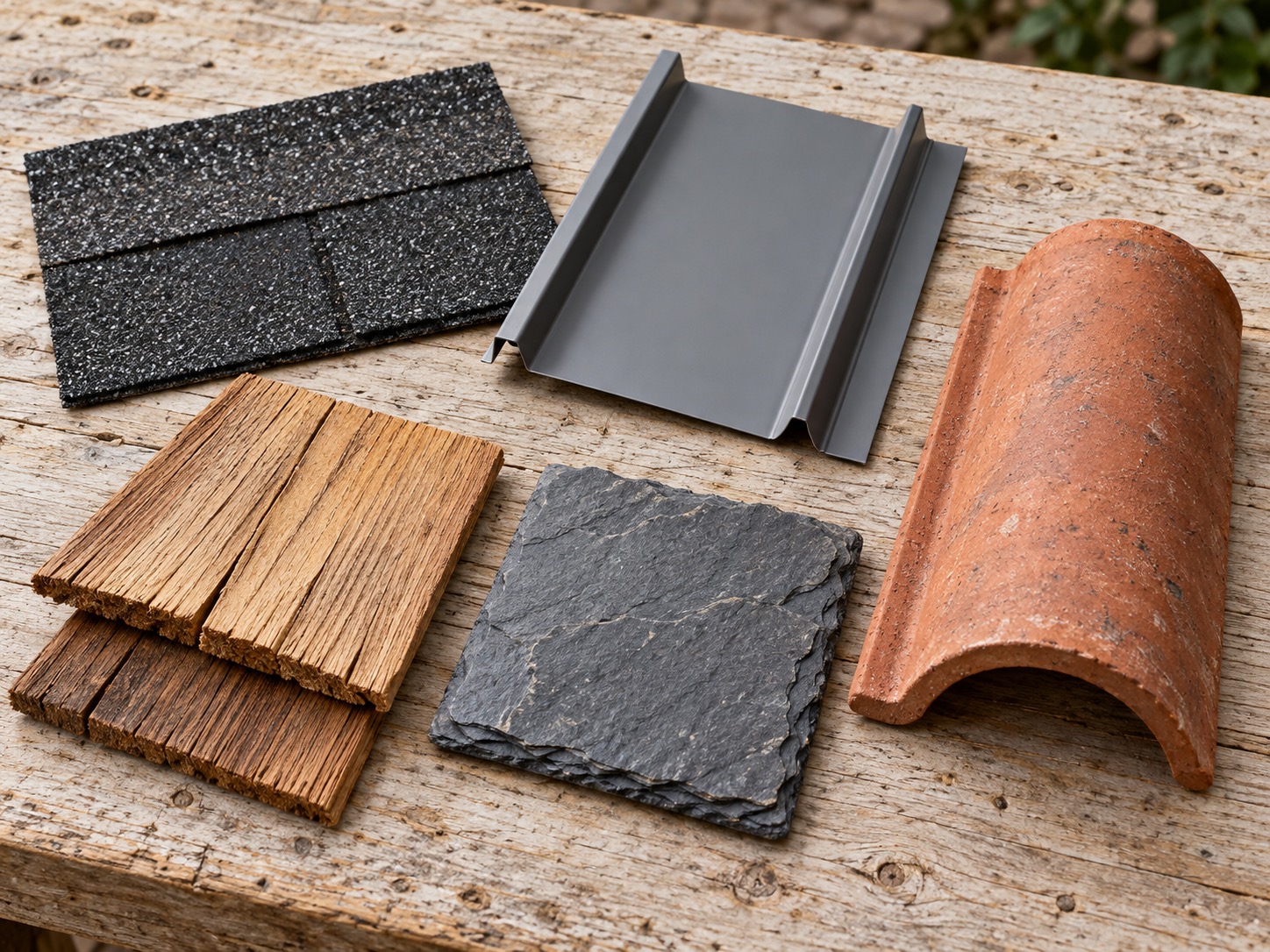
Asphalt, metal, cedar, slate and clay tile bring different demands for support, detailing, care and repair.
Our articles are a starting point, not a professional assessment of your home.
DraftA work in progress, prepared by the HouseIQ.pro team.Editorial and professional review are not yet complete.
The Big Picture
Buy a roof system that fits the house and climate, with a realistic repair plan—not just a material with an impressive lifespan claim.
The visible covering is only one part
Roof shopping often begins with colour samples, but the expensive surprises tend to live underneath them. The supporting deck, water-control layers, flashings, ventilation details and connections all contribute to performance. A premium covering over damaged sheathing is like a new coat over a soaked shirt: the appearance changes while the problem remains.
Ask whether a proposal includes removal of the existing covering, inspection of the deck, unit pricing for concealed repairs and replacement of vulnerable flashings. Clarify waste removal, protection of planting and access to the property. Compare the same scope across bidders before comparing their totals. A cheaper quote may simply leave more work undefined.
Asphalt shingles: familiar does not mean interchangeable
Asphalt shingles offer a broad choice of profiles and colours and are familiar to many roofing trades. Individual product lines differ in construction, wind and impact ratings, fastening requirements and warranty terms. Architectural thickness is a visual feature, not proof that every heavier-looking shingle is more resilient in every storm.
The correct starter, fastener location, edge detailing and installation conditions are important parts of the system. Select the product for the roof slope and local exposure. PNNL documents enhanced wind-resilience approaches, but those are not instructions to copy a nail count onto an unrelated product. Ask the roofer to identify the exact manufacturer instructions and applicable local requirements used in the quote.
Metal: seams, coatings and movement matter
Metal roofing includes standing-seam panels, exposed-fastener profiles and smaller shaped units. They are not one interchangeable category. Ask how the chosen system accommodates expansion and contraction, what parts are exposed to weather, and how future repairs or roof-mounted equipment will be handled. Flashings and fasteners must be compatible with the metal.
Salt exposure makes product selection especially important. A finish warranty may exclude particular coastal distances or conditions; ask for the actual terms rather than accepting a general corrosion claim. On snowy sites, include a plan for sliding snow over occupied areas. The metal alone does not settle rain-noise expectations either: the complete roof and ceiling assembly affects what people hear indoors.
Cedar: a material that needs opportunities to dry
Wood shingles are generally sawn to a more uniform form; shakes have a more textured appearance and different product and installation requirements. Species, grade, exposure and detailing affect performance. The natural look is attractive, but wood needs a drying-friendly assembly and maintenance that prevents persistent debris and moisture accumulation.
The National Park Service describes how retained moisture, moss, shaded conditions and ultraviolet exposure contribute to wood-roof deterioration. A roof under overhanging trees has a different maintenance story from an open, sunny roof. Verify fire classification and local restrictions before selecting wood in a wildfire-exposed area. Do not assume a preservative treatment or a product name makes a complete roof assembly fireproof.
Slate: durable stone, repairable pieces
Natural slate can serve for a long time, but slate type, thickness, weathering and the condition of the supporting system matter. A few slipped or broken pieces do not necessarily mean an entire historic roof needs replacement. Equally, an impressive age does not prove the fasteners or concealed deck remain sound.
Use a roofer with slate experience to distinguish localized damage from widespread deterioration. Walking carelessly on slate can break it, and replacing a flashing may require removing and reinstating surrounding pieces. If converting from a lighter covering, arrange a structural assessment of the added weight before ordering materials. Keep spare matching pieces where practical and document the source for future repairs.
Clay tile: the tile and the roof below it
Clay tile offers distinctive colour and profile and can be durable when the product suits its exposure. Freezing conditions make the tile's suitability important; not every tile sold for a warm location is appropriate everywhere. Wind attachment and edge details also depend on the specific system and jurisdiction.
A tile roof is not a platform to walk on casually. Broken units can result from impact or careless access, and concealed water-control layers may need attention even when much of the tile remains usable. Confirm structural capacity for the proposed weight, availability of matching replacement units and who can service the roof. Ask what a future underlayment repair would involve, including removal and reuse of sound tiles.
Match the hazard rather than a marketing label
For a storm-exposed site, ask for the complete assembly's documented wind requirements, not a claim that a particular material never blows off. For wildfire exposure, discuss roof fire classification together with edges, openings and debris accumulation. Hail resistance and wind resistance describe different challenges. A rating is useful evidence, not a promise of no damage.
For intense sun, ask about the selected finish and measured reflectance if cooling performance is a goal. Dark and light versions of a product can behave differently. In freezing regions, include ice-dam risk, snow retention and flashing performance. Your shortlist should reflect the actual house: a coastal bungalow and a sheltered inland townhouse do not have identical priorities.
Compare ownership costs without pretending to predict the future
There is no honest universal installed price or guaranteed service life for a material name. Roof area, pitch, access, demolition, hidden repairs, flashing complexity, local labour and structural changes can dominate the bill. A warranty may cover a manufacturing defect while excluding labour or unrelated water damage, and its coverage may reduce with age.
Request itemized quotes and compare an expected maintenance and repair plan alongside the initial cost. Ask how a damaged area is repaired, whether matching stock will be available, and whether specialist access equipment is likely. A long-lived covering makes most sense when the components beneath it and the installation quality support that ambition. Budget for inspections and repairs instead of treating the warranty term as a replacement calendar.
Make inspection safer and more useful
Check from the ground after major weather for displaced units, new debris, damaged edges and changed drainage. Record indoor stains with dates and weather conditions. Have professionals investigate active leaks promptly; the wet spot indoors may be some distance from the entry point. Keep away from loose material or sagging ceilings and obtain urgent help where there is a structural concern.
Do not pressure-wash, coat or apply a cleaning chemical to a roof simply because it is advertised as suitable for roofs. Confirm the exact material manufacturer's method and use a contractor equipped for safe access. On older properties, unknown roofing layers may require hazardous-material assessment before disturbance. Good maintenance starts with knowing what is actually installed.
Questions worth asking
- What exactly is included beneath the visible roof covering?
- What local exposure or structural condition limits these material choices?
- What do the warranty and future repair process actually cover?
Sources
- US National Park Service Preservation Brief 4: Roofing for Historic Buildings
- PNNL Building America Solution Center Asphalt Shingle Roofs
- US National Park Service Preservation Brief 29: The Repair, Replacement, and Maintenance of Historic Slate Roofs
- US National Park Service Preservation Brief 30: The Preservation and Repair of Historic Clay Tile Roofs
- US National Park Service Preservation Brief 19: The Repair and Replacement of Historic Wooden Shingle Roofs
- PNNL Building America Solution Center Managing Snow Loads on Roofs and Decks