

Safety
Smoke alarms, CO alarms and extinguishers: build a complete plan
Understand the different jobs of detection, warning, escape and small-fire equipment.
Our articles are a starting point, not a professional assessment of your home.
DraftA work in progress, prepared by the HouseIQ.pro team.Editorial and professional review are not yet complete.
The Big Picture
Working alarms provide warning; a practised escape plan turns warning into action. An extinguisher is an additional tool for limited situations, never a reason to delay escape.
Smoke and carbon monoxide need different detection
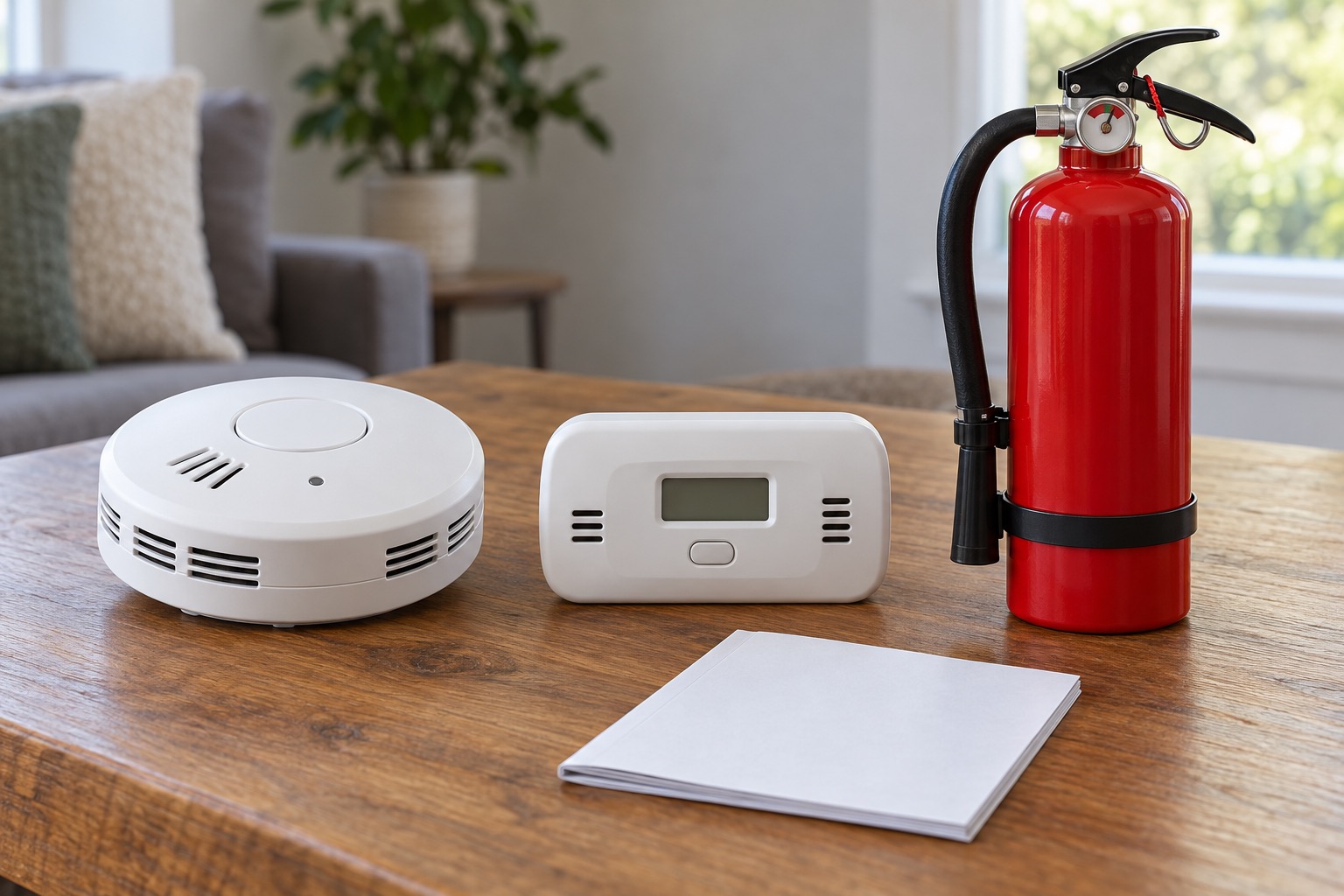
A smoke alarm warns of smoke associated with fire. A carbon monoxide alarm detects CO, a poisonous gas that cannot be reliably identified by smell or sight. A smoke-only alarm does not become a CO alarm because it is near a furnace. A combination device can perform both functions, but its documentation must explicitly say so.
Make a room-by-room inventory rather than counting identical white discs. Write down model numbers, manufacture or replacement dates and whether each device detects smoke, CO or both. If you cannot identify an old device, ask the manufacturer or fire service rather than inferring its function from its shape. This modest exercise often reveals why a home that appears well supplied with alarms still needs a more deliberate plan.
Photoelectric and ionization are smoke-sensing technologies
Photoelectric sensors use light in a sensing chamber; smoke particles scatter light toward a detector. Ionization sensors detect a change in a small electrical current when particles enter their chamber. NIST explains that photoelectric designs tend to respond well to larger particles from smouldering fires, while ionization designs tend to respond quickly to particles from flaming fires. Both can detect both kinds of fire; neither description is a guarantee of response in every real event.
Photoelectric and ionization alarms use different sensing methods and respond differently to fire conditions. The U.S. Fire Administration recommends both technologies, either in separate alarms or a dual-sensor smoke alarm, while also directing residents to check local requirements. Do not assume the word combination means dual smoke sensing: it may instead mean one smoke sensor combined with a CO sensor.
Read the actual specification when comparing boxes. Ask which smoke technology is used, whether CO detection is included and whether the device is approved for the required application. A low price for one function is not a like-for-like comparison with a model providing two. If local rules require a particular type, start there. Learning the terminology helps you ask precise questions rather than substitute a shopping preference for the required protection.
Map locations using local rules and the model instructions
U.S. Fire Administration guidance places smoke alarms in bedrooms, outside sleeping areas and on every level, including basements. CPSC guidance calls for CO alarms on every level and outside sleeping areas. Those are useful U.S. reference points. The precise requirements for your property, including Canadian provincial or municipal rules, must be confirmed locally.
A combination alarm belongs only where its installation instructions satisfy both functions. Do not assume one centrally located unit covers every bedroom and floor. Ceiling shape, nearby cooking equipment, air movement and the permitted mounting position affect the layout. Take a simple floor plan to the local fire service or qualified installer and mark sleeping spaces and existing alarms. Ask them to resolve unusual ceilings, additions and converted rooms instead of copying distances from an unrelated product.
Make sure the warning reaches the people
Interconnected alarms can sound together when one detects a problem. Compatibility matters: a device advertised as wireless may communicate with an app, other alarms, or both, and those are different capabilities. Confirm the required interconnection method and compatible models before replacing a single unit. Hardwired work belongs with a qualified electrician.
Consider what happens with bedroom doors closed and household members asleep. Hearing loss may call for suitable strobes, vibration or other approved alerting equipment. Plan for children, visitors and anyone who needs assistance. Ask who will help whom and whether that person could be elsewhere in the house. A telephone notification is useful supplementary information, but it should not be treated as a substitute for the required local warning.
Test the device, then read what the signal means
Use the manufacturer's test procedure and maintenance schedule; USFA recommends monthly smoke-alarm testing. Record the result and replacement due date. Battery arrangements differ: some units accept replacement batteries, while sealed units require replacement of the device at end of life. Do not apply one battery rule to every alarm. Smoke and CO sensors may also have different service lives.
Keep a short reference for the actual model's alarm, low-battery and end-of-life signals. Repeated unwanted alarms need prompt investigation of the device, location and environment. Never disable protection to make the noise stop. Renters should report defects promptly through the appropriate maintenance channel and follow local responsibilities. A dated list helps a new owner or property manager distinguish a recent replacement from a unit that merely looks clean.
An ABC label describes fire classes, not every emergency
In the North American classification used by USFA, A covers ordinary combustibles, B flammable liquids and C energized electrical equipment. A multipurpose ABC extinguisher can address several common household fire types, but it is not an all-purpose guarantee. Cooking-oil applications and other special hazards can require different equipment. Ask the fire service about the type, rating and handling size for your household.
There is no single placement instruction that this article can apply to every floor plan. Discuss accessible locations near escape routes and relevant hazards, without placing equipment where fire would block access. Mount and maintain it according to its instructions and applicable rules. A unit buried behind cleaning supplies is not ready equipment. Arrange training before an emergency rather than learning from the label under stress.
Decide in advance when the only job is leaving
USFA limits extinguisher use to situations including a small contained fire, a clear escape route, protection from toxic smoke and an operator able to use the equipment, after others are alerted and the fire service is called. If there is doubt, leave and call emergency services from safety. Do not move toward a growing fire to retrieve an extinguisher or belongings.
For a CO alarm or suspected CO poisoning, get outside to fresh air and contact emergency services; do not remain indoors searching for the source. Tell responders about anyone missing or needing assistance. Keep these actions separate from routine device troubleshooting. The family plan should be simple enough to follow when people are startled, tired or unable to see clearly.
Make the escape plan a household habit
Draw the home and identify escape options, keeping doors and windows usable. Agree on an outside meeting place and practise with everyone. Explain the plan to overnight visitors and revisit it when rooms change use. In an apartment or condominium, learn the building's fire procedures and follow fire-service directions; a detached-house plan should not be copied blindly into a high-rise.
During a practice walk-through, notice practical obstacles: a window that has not opened for years, a corridor used for storage or a gate that nobody can unlock quickly. Resolve those issues before an emergency. Keep the equipment inventory and drill date together in the home record. The useful result is a system people understand: early warning, a workable exit and no confusion about where to meet.
Questions worth asking
- Which alarm locations and interconnection rules apply to this building?
- Does each model detect smoke, CO, or both?
- Can everyone follow the escape plan and receive the warning?
Sources
- U.S. Fire Administration Smoke Alarms
- U.S. Consumer Product Safety Commission Carbon Monoxide Information Center
- U.S. Fire Administration Choosing and Using Fire Extinguishers
- U.S. Fire Administration Home Fire Escape Plans
- National Institute of Standards and Technology How Do Smoke Detectors Work?