

Roofs & drainage / Plumbing & water
Sump pumps: moving groundwater out and planning for failure
Understand the basin, discharge and backup plan before a storm tests them together.
Our articles are a starting point, not a professional assessment of your home.
DraftA work in progress, prepared by the HouseIQ.pro team.Editorial and professional review are not yet complete.
The Big Picture
A sump pump is one link in a drainage system. It needs water to reach its basin, a working power source and a clear, lawful place to send the water.
Follow the water to the basin
A sump is a collection basin. Foundation or under-floor drains may bring groundwater to it, and a pump lifts that water to a discharge point. The arrangement differs among homes: some drains surround the building, some serve only part of it, and some basins collect water more locally. Knowing which arrangement you own is more useful than assuming the whole basement is protected.
The pump is like the last worker in a relay. It cannot remove water that a crushed or blocked drain never delivers, and it cannot stop every leak through a wall or window well. Start a simple drawing showing the basin, known drain connections, discharge route and outlet. Mark uncertain connections for investigation rather than filling in the gaps by guesswork.
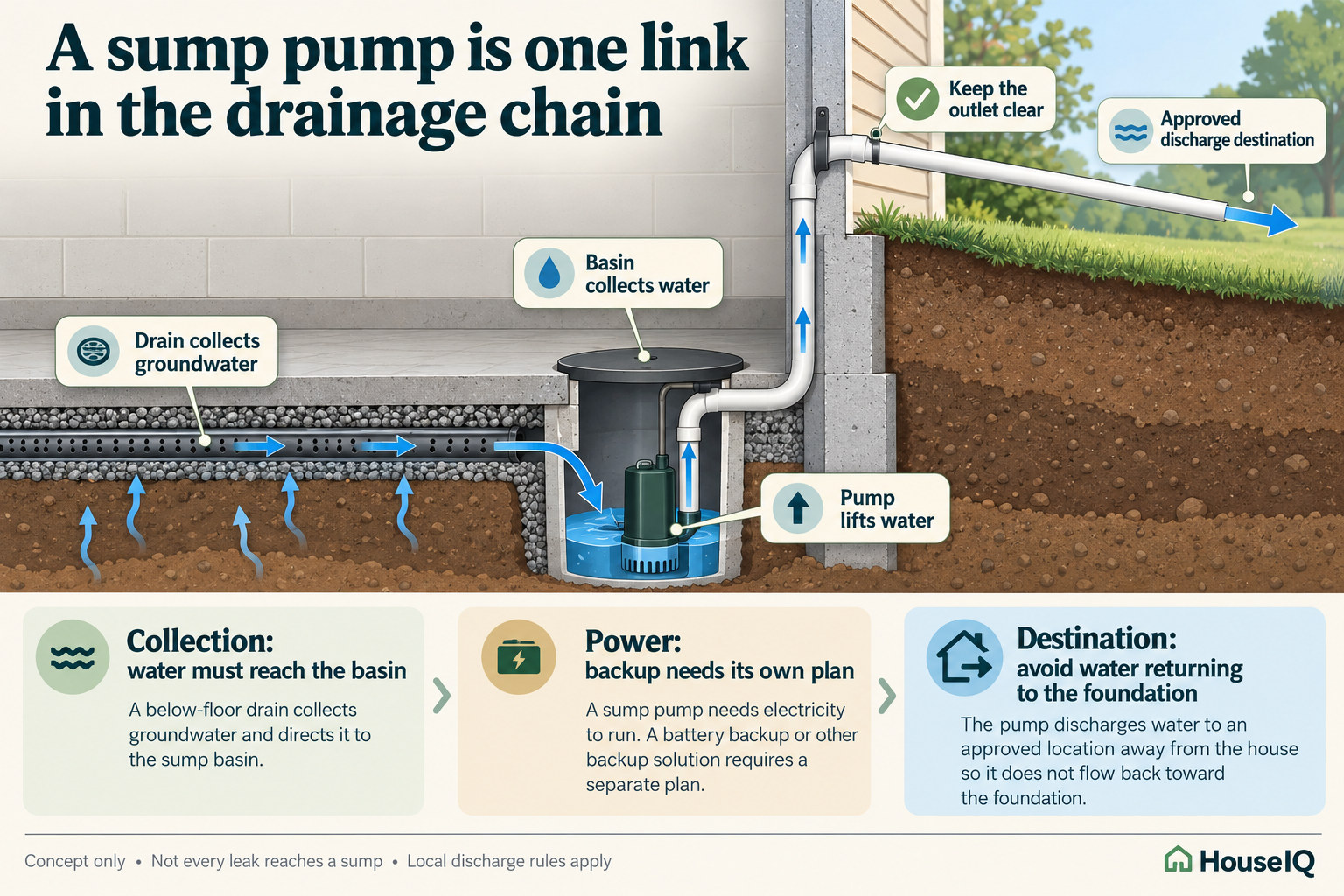
Concept only. Not every leak reaches a sump. Controls, electrical supply, check-valve details, seals and backup equipment are omitted. This is not a sewage-ejector or backwater-valve diagram; local discharge rules apply.
A groundwater sump is not a sewage ejector
Do not connect toilets, sinks or other sanitary waste to a groundwater sump. A sewage ejector is a different system with its own enclosure, venting and discharge requirements. A backwater valve addresses another problem again: sewage flowing backward through a connected drain. Neither a sump nor a backup battery automatically provides that protection.
If water is coming through a floor drain, first establish whether it is sewage backup, groundwater or another source. Odour and appearance alone cannot prove that floodwater is clean. Keep people and pets away from contaminated water and arrange professional help. Choosing equipment before identifying the water source risks paying for protection against the wrong problem.
Match the pump to the actual lift
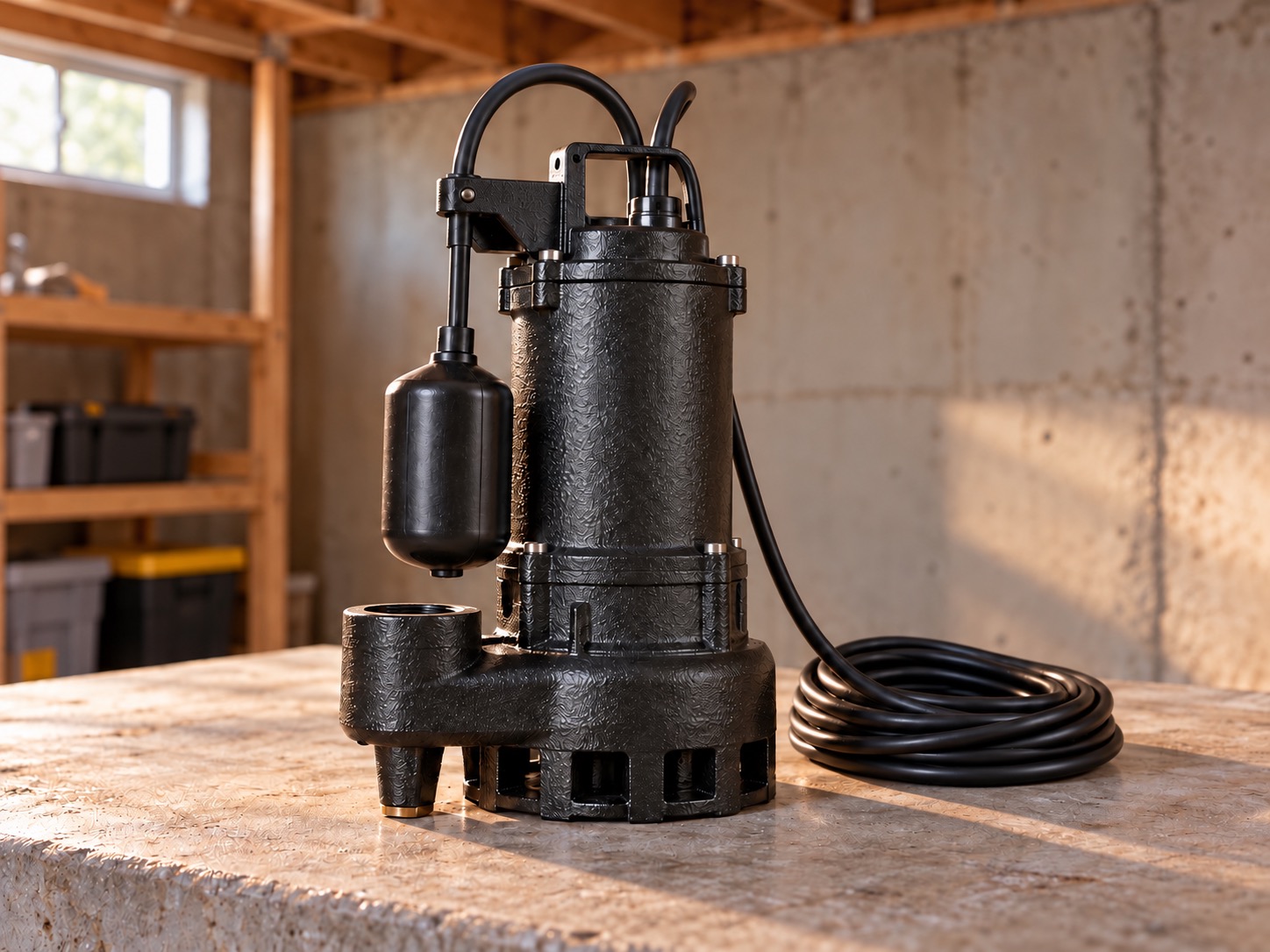
Submersible pumps sit in the basin; pedestal pumps keep their motor above it. The right choice depends on basin dimensions, access, noise, service needs and the intended duty. The float or sensor must move or operate as designed, without fouling a wall, pipe or cable. A crowded basin can defeat otherwise good equipment.
Ask for capacity at the installation’s actual pumping head, which includes vertical lift and pipe resistance. A headline maximum flow measured under easier conditions is not the flow your house necessarily receives. The installer should consider incoming water, pipe sizing and the pump’s operating range together. A larger motor alone is not a complete design, and it does not clear a frozen outlet.
The outlet is part of the protection
Water should leave to an approved location where it cannot simply soak back toward the foundation. A short hose dumping beside the wall can create an exhausting loop: pump out, seep back, pump again. Review the whole route for restrictions, freezing and places where discharged water could make a walking surface slippery.
Do not assume a sanitary sewer connection is allowed. Municipal policies differ, and some have narrowly defined seasonal permissions. Obtain the actual local rule. Avoid sending discharge onto neighbouring property or a septic drainfield. The destination needs to function during the same wet conditions that make the pump run, not only on the dry afternoon when it was installed.
A battery backup buys time, not certainty
A separate battery-powered pump can operate when the main pump or mains supply fails. It needs its own correctly set activation control, suitable battery and charger, and a discharge arrangement that works when needed. Two electric pumps on the same unavailable mains supply do not provide the same outage protection.
Runtime depends on battery condition, pumping load and how often the pump runs. A claim based on intermittent cycles is not continuous operation for that many hours. Ask for the assumptions behind the estimate, the battery test procedure and replacement criteria. Include an alarm so a failure is noticed. If it sends messages through the home router, consider whether the router and internet connection will survive the outage too.
Water-powered backup has prerequisites
A water-powered backup uses the energy in a pressurised supply to eject sump water. It consumes supplied water while operating and needs that supply to remain available. A home dependent on an unpowered well pump does not gain dependable outage protection from an arrangement that loses its driving water at the same time.
Before considering one, have the plumber and water authority confirm that it is permitted, that pressure and flow are adequate, and that the required backflow protection can be installed and maintained. Never improvise a potable-water connection to a sump. Compare usable pumping capacity and discharge volume, including the driving water. It is an option for some homes, not a universal substitute for a battery system.
Test before the weather changes
Read the manufacturer’s procedure and arrange a demonstration if the system is unfamiliar. From a dry, safe position, inspect the visible outlet and look for obvious blockage, ice or disconnected piping. A controlled water test can demonstrate that the float activates the pump and that the water level falls; hearing a motor hum alone proves very little. Do not reach into an energised basin or handle wet electrical equipment.
Test the backup and alarms according to their instructions as well as the primary pump. Record the result, battery condition and any unusual noise or cycling. Keep the lid, seals and radon-related details intact after service. Repeated rapid cycling or continuous running deserves diagnosis rather than an arbitrary float adjustment.
Pair the equipment with a failure plan
Keep storage raised where practical and retain the installer’s contact, model information and maintenance schedule. When the alarm sounds, first stay safe. Do not enter standing water where electricity may be present, and do not wade to a switch or plug. Contact emergency or utility services where conditions warrant, then a qualified contractor to isolate and assess the problem.
A backup cannot promise a dry basement during every flood, particularly when water enters faster than the drainage system can collect or discharge it. Review insurance terms separately rather than assuming a pump creates coverage. For renters and shared buildings, report alarms and leaks promptly and establish who is responsible for testing. The best plan names both the equipment and the person who will respond.
Questions worth asking
- Where does this basin collect water from?
- What capacity is available at this home’s actual pumping head?
- What still works during an outage, and who receives the alarm?
Sources
- North Dakota State University Extension Sump Pumps
- South Dakota State University Extension Flooding and Sump Pumps
- US DOE / PNNL Footing Drain Pipe
- Liberty Pumps Model 441 battery backup system
- Liberty Pumps SumpJet Water-Powered Backup System Installation Manual 5824000K (2026)