

Plumbing & water
Water treatment: softeners, conditioners and drinking-water filters
Hardness, taste and contaminants are different problems. Choose the treatment that addresses the one you actually have.
Our articles are a starting point, not a professional assessment of your home.
DraftA work in progress, prepared by the HouseIQ.pro team.Editorial and professional review are not yet complete.
The Big Picture
A softener changes hardness. A filter or membrane addresses particular substances. No single device should be assumed to make every water supply safe.
Name the problem before choosing equipment
A white crust on a tap, a chlorine taste and a health-related contaminant result are three different reasons to investigate water. Start by writing down the concern and finding evidence. For a public supply, read the supplier’s current water-quality report and ask about hardness. A private well needs a testing plan appropriate to its location, construction and possible sources of contamination.
A kitchen demonstration, colour change or total-dissolved-solids meter is not a complete drinking-water safety assessment. Clear water can contain substances you cannot see, and mineral-rich water is not automatically unsafe. Ask for a written treatment objective: what substance, at what incoming concentration, should be reduced to what result? That makes competing proposals much easier to compare.
Hardness is mainly a mineral issue
Calcium and magnesium contribute to water hardness. They can form scale on heated surfaces and leave deposits on fixtures; soap can also be less effective in hard water. The practical consequences depend on hardness, water use, temperature and equipment. Do not assume every deposit means pipes are about to fail or that all hard-water homes need whole-house treatment.
Think of hardness management as controlling the chalky residue, not sterilising the water. A softener is not a general disinfectant. Photograph recurring deposits and record the hardness result with its units. Milligrams per litre reported as calcium carbonate and grains per US gallon are different scales; compare like with like when a salesperson sizes a system.
A salt-based softener swaps ions
Inside an ion-exchange softener, resin holds hardness minerals and exchanges them for sodium or, in suitable systems, potassium. Regeneration restores the resin using a concentrated salt solution, producing a waste stream that must be discharged appropriately. The salt is part of the process, not a filter screen catching grit. A sediment filter has a different job.
Size and settings should follow measured hardness and actual household demand. Ask about service flow, capacity at the proposed salt setting and regeneration water, rather than comparing only the largest capacity on the brochure. Demand-based regeneration can avoid unnecessary cycles, but an incorrectly programmed efficient controller still wastes resources. Record the settings after commissioning so later changes are deliberate.
Salt-free conditioning is not the same as softening
Products sold as salt-free conditioners may aim to change how scale forms while leaving calcium and magnesium in the water. They should not be expected to deliver the same measured hardness reduction as ion exchange. The phrase salt-free softener can therefore obscure the most useful question: does this device remove hardness, or is its claim about deposits on equipment?
Ask for independent evidence for the precise scale-control claim under water conditions similar to yours, along with limits for iron, temperature, flow and other relevant properties. Do not extend evidence for one technology to every magnetic, electronic or media-based product. If your objective is softer water for washing, a scale-control claim alone does not establish that result.
Match the certification to the substance
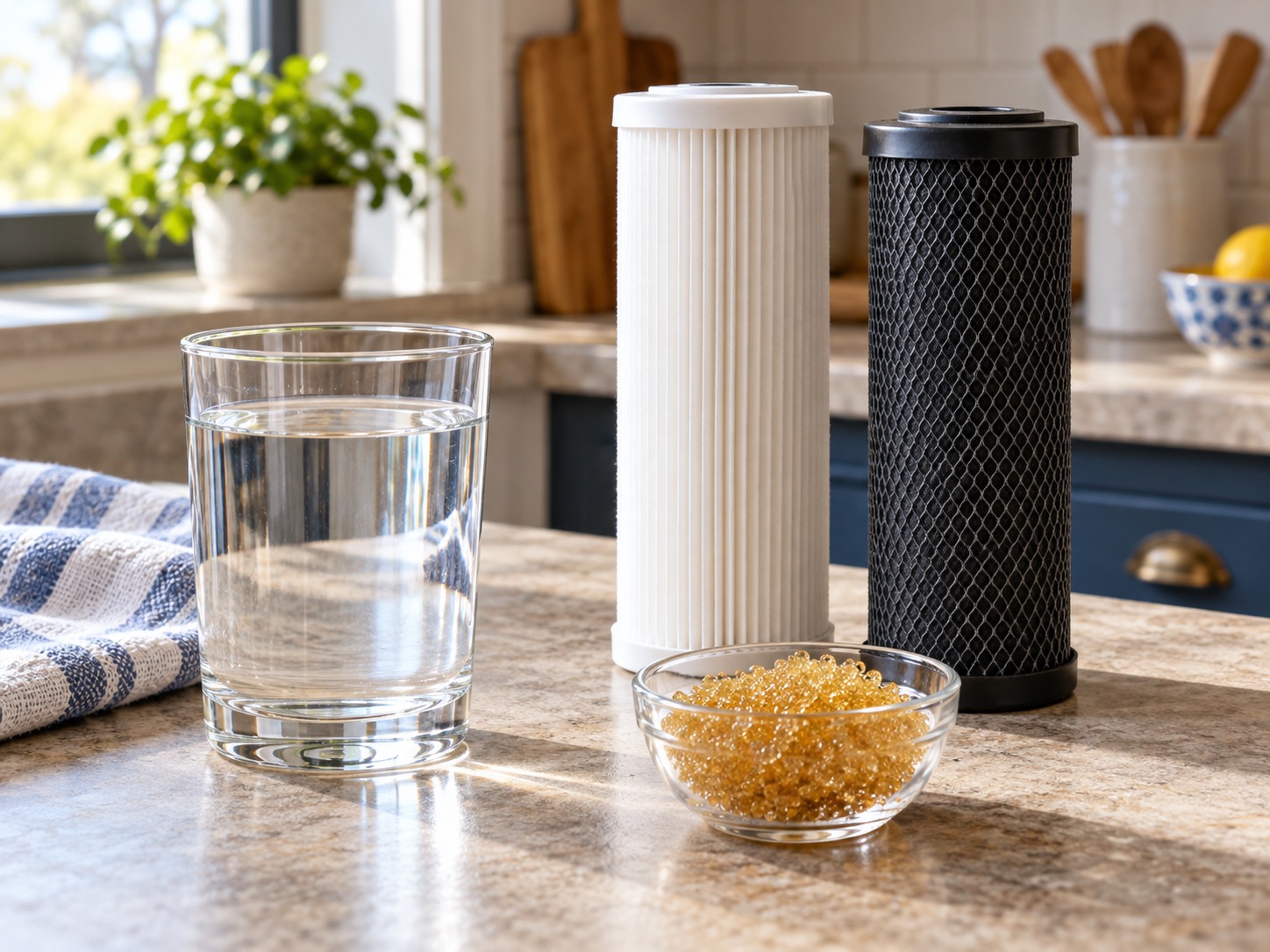
A sediment cartridge can catch particles; activated-carbon products can address particular tastes, odours or contaminants depending on their design. Neither description alone tells you that lead, arsenic, microbes or another specific concern will be controlled. NSF’s certified-product resources distinguish reduction claims by contaminant and system type. Check the exact model and replacement cartridge together.
Read the rated capacity, flow and incoming-water limits. Certification for a material’s safety is not the same as certification for every removal claim. A useful shopping question is: show me the listing that covers my identified concern, at the conditions of my supply. Keep that evidence with the receipt rather than relying on a broad badge or a phrase such as purified water.
Reverse osmosis creates two water streams
RO uses pressure and a membrane to produce treated water and a more concentrated reject stream. A kitchen point-of-use system treats water for that outlet; it does not soften every shower or protect all household equipment. Membranes and supporting filters need maintenance, and the system’s particular certified claims determine what it can be relied upon to reduce.
Reject water matters in the comparison. EPA’s WaterSense programme now includes point-of-use RO systems with efficiency and performance requirements, but does not recommend RO for every situation. A simpler certified filter may address the actual concern with less water use. Ask for the expected treated-water rate and waste ratio at your pressure and temperature, not just ideal laboratory figures.
Treat only as much water as needs treatment
Whole-house treatment and a drinking-water tap can be complementary. One may manage hardness for fixtures while another addresses a drinking-water concern. They can also be unnecessary additions if the supply already meets the household’s needs. Review whether outdoor watering should bypass softening and whether the kitchen requires a separate arrangement, rather than assuming every outlet belongs on one treatment line.
Sodium added by softening depends on the hardness removed. People with a medically prescribed sodium restriction should discuss their drinking-water arrangement with their clinician and water professional. Local wastewater authorities may limit softener discharges. Ask about permitted brine disposal, an appropriate drain connection and protection against backflow before selecting equipment.
The maintenance plan is part of the purchase
Filters have finite capacity; a pleasant taste is not a reliable replacement indicator for every contaminant. Keep a schedule based on the manufacturer’s time and volume limits, and follow sanitising and flushing instructions. Check accessible housings and connections for leaks. A device hidden under the sink can quietly become both neglected treatment equipment and a water-damage source.
Before agreeing to a system, total the cartridges, membranes, salt, testing and service it needs. Ask who will verify the result after installation and what happens during a boil-water advisory or other supply incident. Follow public-health instructions during an incident rather than assuming a household device makes them irrelevant. Renters should obtain permission for permanent plumbing changes and identify who owns ongoing maintenance.
Questions worth asking
- What measured problem are we treating?
- Which exact certified claim covers it?
- What will maintenance, wastewater and follow-up testing involve?
Sources
- North Dakota State University Extension Water Softening (Ion Exchange)
- NSF Contaminant Reduction Claims Guide
- US EPA Point-of-Use Reverse Osmosis Systems
- Ontario Landlord and Tenant Board Maintenance and Repairs