

Energy IQ / Comfort IQ
Water heaters: heat pump, tankless or conventional?
How hybrid water heaters save electricity, why the room matters, and how to compare storage, tankless and fuel choices around your household's actual needs.
Our articles are a starting point, not a professional assessment of your home.
DraftA work in progress, prepared by the HouseIQ.pro team.Editorial and professional review are not yet complete.
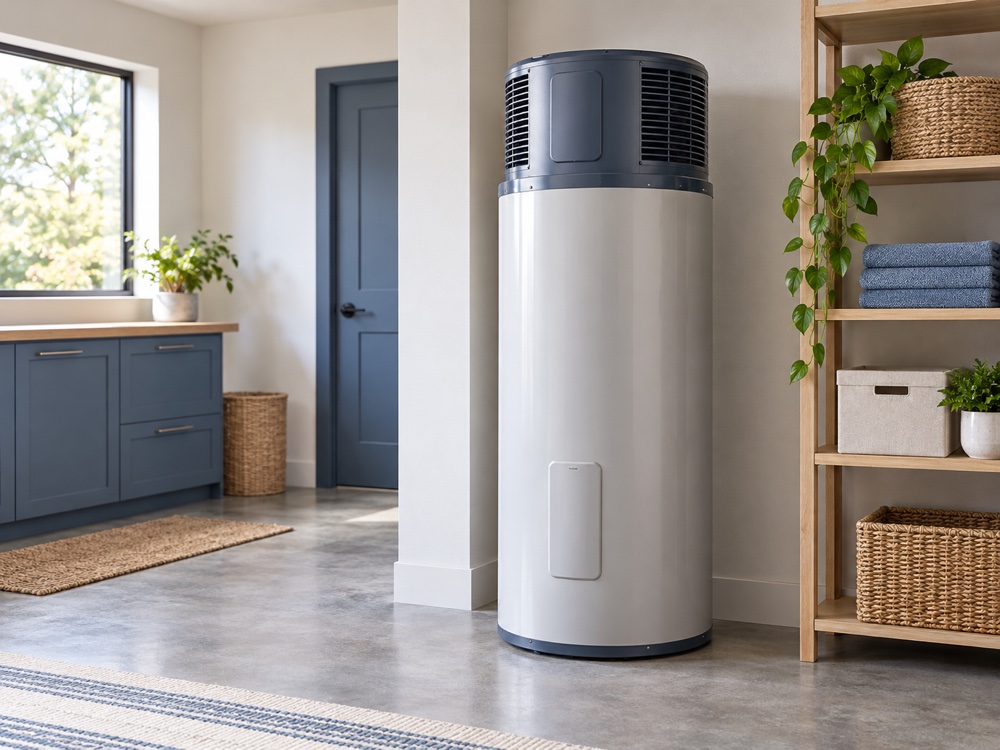
A tank that gathers heat from the room
A conventional electric tank makes heat with resistance elements. A heat pump water heater uses electricity to move heat from surrounding air into stored water. That distinction explains how it can deliver more heat to the water than the electrical energy it consumes: part of the heat comes from the room.
Many integrated models are called hybrid because they also contain resistance elements. Heat-pump-only operation emphasizes efficiency; hybrid operation can bring in the elements when needed. Electric-only operation gives up the heat pump's advantage. Mode names and control behaviour vary, so understanding the selected mode belongs in the handover conversation.
Sources: [1]
Compare the service you need before comparing equipment
Storage and tankless describe how hot water is supplied. Electric resistance, a heat pump and gas describe how it is heated. These are separate choices. A compact tankless appliance may solve a floor-space problem, while a storage tank provides a reserve for a busy period. Neither description, by itself, establishes the best operating cost.
| Type | How it supplies hot water | Main planning question |
|---|---|---|
| Electric resistance tank | Elements heat a stored reserve. | How much electricity will the household use? |
| Hybrid heat pump tank | Heat from air warms storage; elements can assist. | Do the room and demand suit heat-pump operation? |
| Gas storage tank | A burner heats stored water. | What are the fuel, combustion-air and exhaust requirements? |
| Gas tankless | A burner heats water as it flows. | Can it serve simultaneous demand at the required temperature rise? |
| Electric tankless | Powerful elements heat flowing water. | Can the electrical system support its demand? |
How much electricity could a hybrid save?
Start with the baseline. ENERGY STAR's illustrative savings table estimates 3,760 kWh a year for a four-person household replacing a standard electric water heater with a certified heat pump model. Its two-person example is 1,880 kWh. Those are published comparison examples, not measurements from your home or promises for every model and climate.
Ask a quote to name the existing heater, proposed model, assumed hot-water use and expected electricity consumption. A gas-to-electric change needs both fuel bills considered; an electric-resistance comparison cannot predict its dollar savings. Use your own rates and installation quotation, rather than carrying a national example's payback into a local decision.
Sources: [3]
Efficiency and hot-water delivery are different ratings
Uniform Energy Factor, or UEF, is an efficiency rating from a standardized test. ENERGY STAR explains that comparisons belong within the same hot-water-use category, or usage bin. The test controls conditions such as air temperature, water temperature and draw timing. A higher comparable UEF indicates better tested efficiency; it does not mean more hot water or guarantee an identical percentage reduction in your bill.
For storage heaters, first-hour rating describes delivery during the first hour, starting with a heated tank. It includes reheating during use, so it can exceed tank volume. Recovery describes replenishing the supply afterward. Ask which operating mode supports the quoted performance and what happens during repeated heavy use.
Sources: [4]
Tankless capacity depends on the incoming water
Tankless sizing needs the combined flow of fixtures used together, expressed in litres or gallons per minute, and the temperature rise between incoming and delivered water. A unit's headline maximum flow is incomplete without that temperature rise. Colder incoming water requires more heating for each litre, reducing available flow at a given heating capacity. Ask for a winter-condition selection, especially in Canada, rather than choosing from bathroom count alone.
Sources: [2]
Space means available air as well as physical dimensions
An integrated heat pump needs a usable air path, not simply room for the tank. Check the exact model's permitted ambient temperatures, air volume, inlet and outlet arrangement, ducting options and service clearances. A general 700- or 1,000-cubic-foot rule cannot represent every product or configuration. A small enclosed cupboard may need a different equipment or air-path design.
For example, the Rheem ProTerra specification sheet cited here lists a 37–145°F (about 3–63°C) ambient operating range for that product family and distinguishes open-room, louvered and ducted arrangements. This illustrates why a model's documents matter; it is not a recommended room-temperature range for all heat pump water heaters. Have the installer check the room's seasonal extremes and the unit's behaviour outside its heat-pump operating envelope. A cold garage is not automatically suitable because the house is in a generally mild region.
Sources: [5]
An air duct and a combustion flue do different jobs
Gas appliances need an appropriate combustion-air and exhaust arrangement. A heat pump water heater does not burn fuel, so it does not produce a gas burner's combustion exhaust. Its optional air ducting moves air used by the heat pump. These systems are not interchangeable.
For a gas replacement, have the contractor assess existing venting and any remaining fuel-burning appliances. Request a documented plan for the complete conversion; deciding what happens to a former flue is not a homeowner sealing task.
In a Canadian basement, count the heating interaction
Removing heat from a heated room can add work for the space-heating system. That matters when comparing whole-home results with the water heater's electricity savings alone. The amount and cost depend on the room, airflow, weather and heating system.
A CMHC research highlight published in December 2014 examined two heat pump water heaters in an Ottawa test-house basement. Water-heating electricity fell compared with electric resistance, but increased gas-furnace energy offset the winter reduction in the whole-house energy balance. The researchers cautioned that the house, simulated use and mechanical setup limited transfer to other homes. This older experiment explains an interaction; it is not an annual forecast for today's equipment or every Canadian basement.
Sources: [7]
Room cooling can be useful, but it has limits
The cooler air around an operating heat pump water heater may be welcome in a warm garage or utility room in Florida, South Carolina, Georgia or parts of Texas. Treat that as a possible local benefit, not a promised reduction in the home's air-conditioning bill. A garage and the conditioned house are different spaces, and state boundaries do not define their temperatures.
The appliance can also collect moisture from air. Efficiency Maine makes a useful distinction: operation follows hot-water demand, not humidity. It therefore complements rather than replaces a dehumidifier. An empty seasonal home using little hot water should not rely on this appliance to control whole-home moisture.
Leave room in the plan for everyday ownership
Ask where condensate will go, whether fan and compressor sound will be noticeable near bedrooms, and how filters and service points will remain accessible. These details can change whether an apparently convenient location works well in daily life.
Have an electrical professional check the selected unit's supply requirements against available capacity. Lower annual electricity use does not establish the required circuit size: backup elements also matter. If load management is proposed, ask how it affects hot-water availability. Get these decisions resolved in the quotation, along with maintenance responsibilities.
An example: the busiest hour changes the comparison
Imagine a household comparing replacements before its existing tank fails. Ordinary weekdays involve showers spaced apart. Visiting family brings several back-to-back showers, followed by laundry. Its question is not simply which heater has the best efficiency number. It needs to understand how each option handles that occasional busy period.
A useful proposal would compare a hybrid tank's first-hour delivery and recovery, including expected element use, with tankless delivery at winter inlet-water conditions. It would also check the actual room. A tank that physically fits beside a bedroom may introduce an unwanted sound; an efficient model in a cold enclosure may spend more time using resistance heat than anticipated.
This is an illustrative decision process, not a sizing calculation. Bring a simple account of normal and busy-day use to the assessment. Ask the contractor to explain the tradeoff in terms you can recognize: enough hot water, acceptable room conditions, and a transparent estimate of energy and ownership costs.
Questions worth taking with you
- What baseline, hot-water use and room conditions support this savings estimate?
- How will this exact model serve our busiest hour and recover afterward?
- Which manufacturer requirements govern air, temperature, ducting and service access here?
- How will condensate, sound, electrical capacity and any existing combustion venting be handled?
- What heating or cooling interaction should we expect in this particular room?
Sources
- ENERGY STAR / U.S. Environmental Protection Agency How it Works — Heat Pump Water Heaters (HPWHs)
- A. O. Smith What Size Water Heater Is Right for You?
- ENERGY STAR / U.S. Environmental Protection Agency Save More with ENERGY STAR Certified Heat Pump Water Heaters
- ENERGY STAR / U.S. Environmental Protection Agency What is Uniform Energy Factor and Why Does it Matter?
- Rheem Manufacturing Company Professional Prestige ProTerra Hybrid Electric Heat Pump Specifications
- ENERGY STAR / U.S. Environmental Protection Agency What Goes into the Cost of Installing a Heat Pump Water Heater?
- Canada Mortgage and Housing Corporation / Canadian Centre for Housing Technology The Impact of Heat Pump Water Heaters on Whole-House Energy Consumption
- Efficiency Maine Heat Pump Water Heaters