

Cooling & air
Air filtration: match MERV, HEPA, carbon and UV to the job
Understand what each technology removes, what it leaves behind, and why airflow matters as much as the filter label.
Our articles are a starting point, not a professional assessment of your home.
DraftA work in progress, prepared by the HouseIQ.pro team.Editorial and professional review are not yet complete.
The Big Picture
Choose the pollutant first, then a compatible system that moves enough air at a noise level you will actually use.
Start with the source of the problem
A filter is a useful tool, but indoor air is not one problem with one solution. Cooking particles, pollen, cleaning-product vapours, moisture and soil gases behave differently. Before shopping, describe the concern: dust settling on furniture, smoke entering from outdoors, a persistent smell, or a damp room. Record when it happens and which rooms are affected. That observation is more useful than asking for the strongest purifier.
EPA places source control and ventilation ahead of supplemental air cleaning. For example, capturing cooking emissions at a hood that exhausts outdoors tackles them close to their source. During poor outdoor air conditions, ventilation decisions need different care. A particle filter does not repair a combustion fault, stop a water leak or replace radon testing.
MERV 8, 11 and 13 describe particle capture
MERV is a filter test rating, not a measure of how clean your whole house will become. It describes capture across particle-size ranges. Higher ratings generally capture more of the smaller particles in those ranges. MERV 8 is commonly associated with larger household particles; MERV 11 improves capture of smaller particles; MERV 13 adds substantially better fine-particle performance. Different allergens ride on particles of different sizes, so an allergy label alone is an incomplete specification.
EPA's table gives MERV 13 minimum efficiencies of 50% for 0.3–1 micrometre particles, 85% for 1–3, and 90% for 3–10. Those figures are filter-test values. Air bypassing the frame, rooms with poor circulation and limited fan runtime all change the result in a home.
A better filter still needs enough airflow
Think of a filter as a road tollbooth: how much it captures and how easily traffic passes are separate questions. MERV does not specify the pressure drop of every product. Filter area, depth, pleat design, airflow and accumulated dirt matter. A larger media cabinet may offer a suitable upgrade, but its compatibility needs assessment rather than assuming that any thicker filter will fit.
Ask an HVAC professional to check the equipment's permitted resistance, actual airflow and total external static pressure with the proposed filter. A restrictive filter can worsen an already constrained return system. Match the specified size, fit it without gaps, follow its airflow arrow and retain the model number. Do not stack filters or substitute a HEPA element into a furnace unless the system is designed for it.
HEPA is useful when you need a room-level tool
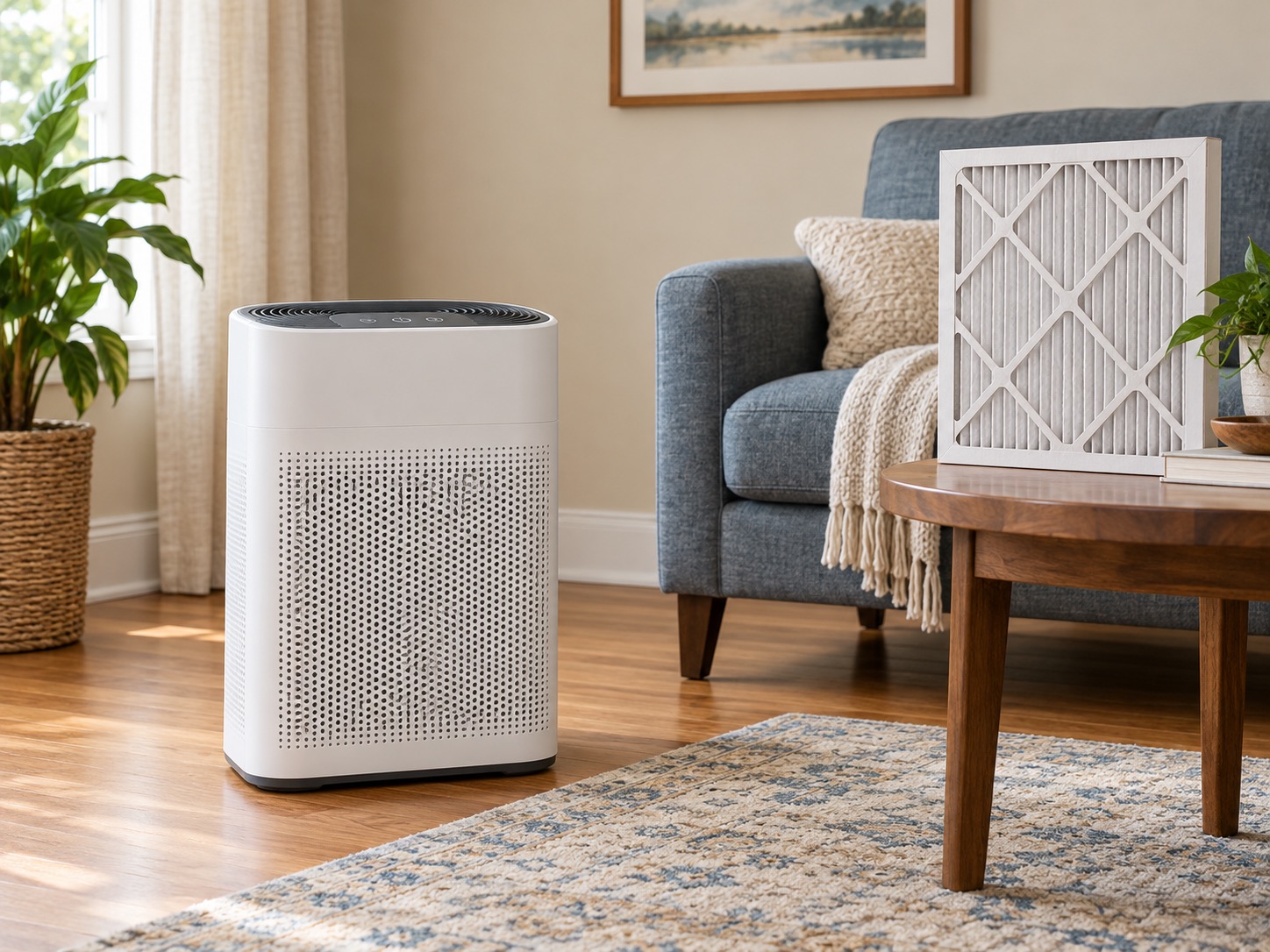
HEPA describes high particle-capture efficiency: EPA identifies at least 99.97% at a 0.3 micrometre test size. That does not mean a portable unit removes 99.97% of everything from the room. The cleaner must draw room air through the filter, and it needs time and enough airflow. A closed bedroom and an open living area are different sizing jobs.
Compare clean air delivery rate, or CADR, with room size, ceiling height and the speed you can tolerate. A large advertised room area may use a different air-change assumption from another brand. Check replacement-filter availability and noise before choosing. Place the unit with the clearances in its manual; hiding it behind a sofa defeats the reason for buying it. Keep the intake and outlet unobstructed.
Carbon deals with selected gases, not every smell
Activated carbon and other sorbents can capture certain gases on their internal surfaces. This is a different task from trapping particles in a pleated filter. A thin dark pad in a purifier is not equivalent to a substantial gas-treatment bed. Performance depends on the contaminant, media quantity, contact time and how much capacity remains. A particle CADR does not tell you gas-removal performance.
Ask which specific gases were tested, under what conditions, and how replacement is determined. Persistent odours still call for source investigation: a damp cupboard, sewer-gas entry or stored solvents needs its own solution. Do not use an odour improvement as proof that air is safe. Carbon filtration is not a substitute for carbon-monoxide alarms or correcting faulty fuel-burning equipment.
UV-C needs a defined purpose and protected installation
UV-C is radiation used in some germicidal systems. It does not act like a particle filter, and a glowing lamp is not evidence of whole-home disinfection. Exposure time, intensity, airflow and installation determine performance. A lamp aimed at an HVAC coil has a different job from a system designed to treat moving air. Ask for evidence tied to the actual application, rather than a broad claim about eliminating illness.
UV-C systems require manufacturer-specified exposure precautions; some lamps can also generate ozone. Use properly enclosed equipment maintained by qualified people, never an exposed lamp in an occupied room. EPA warns against ozone generators sold as air cleaners: ozone is a lung irritant, and concentrations compatible with occupied spaces do not reliably solve indoor pollution problems.
The everyday settings decide the practical result
A quiet cleaner that runs consistently can be more useful than an impressive unit left off. Write down the intended location and daily operating schedule. For central filtration, air is cleaned only when it passes through the system. Longer fan operation changes electricity use and can affect humidity behaviour in some cooling systems, so ask how the control settings should work with your equipment.
Inspect filters at the manufacturer's interval and replace as needed for actual loading. Renovation dust, pets and smoke events can change that interval. A filter that looks pale is not necessarily unrestricted, and a dark filter does not quantify health risk. Keep a simple log of replacements, operating problems and unusual events so a technician can connect symptoms with changes in the house.
Build a small, testable plan
Separate the purchase decision into three questions: what are we trying to reduce, where does it occur, and how will we know the equipment is operating correctly? For a bedroom particle concern, that might mean a correctly sized portable cleaner and a usable nighttime setting. For a central system, it might mean a compatible higher-efficiency filter plus an airflow check. Neither example guarantees symptom relief.
Cheap indoor sensors can reveal trends, but their readings depend on the sensor and pollutant; one green light does not certify healthy air. If occupants have persistent symptoms, seek medical advice while investigating the building. If the problem involves dampness, combustion, strong chemical exposure or recurring unexplained odours, obtain targeted professional assessment instead of collecting more air-cleaning gadgets.
Questions worth asking
- Which pollutant are we trying to control?
- Will this filter preserve the required system airflow?
- What CADR and noise level apply at the speed I will use?
- What does this device leave untreated?