

Comfort IQ / Build IQ / Energy IQ
Dehumidification: why a cool home can still feel damp
Understand why a comfortably cool home can still feel damp, what dedicated dehumidification can do, and why dry room air cannot guarantee dry walls.
Our articles are a starting point, not a professional assessment of your home.
DraftA work in progress, prepared by the HouseIQ.pro team.Editorial and professional review are not yet complete.
Can cooling alone manage humidity? Sometimes.
Ask whether this home's cooling system removes enough moisture across its actual operating conditions. PNNL's ventilation guidance explains that a properly sized air conditioner or heat pump controls humidity in many homes. Others need more moisture removal than cooling provides.
A thermostat that responds only to temperature does not necessarily call for cooling when humidity rises. This helps explain the familiar complaint: the temperature looks right, but the room feels clammy. It is a reason to investigate the whole moisture picture before buying equipment.
Sources: [2]
Two jobs share the cooling coil
Sensible cooling lowers air temperature. Latent cooling removes water vapour by condensing it into liquid. An air conditioner's indoor coil can do both when its surface is below the air's dew point—the temperature at which condensation begins. The collected water must then leave through the equipment's condensate system.
Relative humidity, or RH, expresses how close air is to saturation at its current temperature. Cooler air can have a higher RH even when no water has been added; warming that same air can lower its RH without removing any water. That is why a humidity percentage needs its accompanying temperature, and why turning the thermostat down is not a complete moisture strategy.
Why mild, rainy days can be revealing
An oversized cooling system may satisfy the thermostat quickly and shut off before removing enough moisture. Even a properly selected system can encounter weather with little need for temperature reduction but a continuing moisture load. PNNL identifies cloudy, humid conditions and homes with low sensible cooling loads as particular challenges.
Illustrative scenario: a household is comfortable during a hot afternoon but notices dampness through several mild, rainy days. The cooling runs less, yet humidity remains elevated. That pattern gives the assessor something to investigate; it does not prove the air conditioner is broken or establish which size dehumidifier to buy.
Ask for a review of measured conditions, equipment capacity, airflow and controls before assuming a larger air conditioner will help.
Sources: [1]
What dedicated dehumidification adds
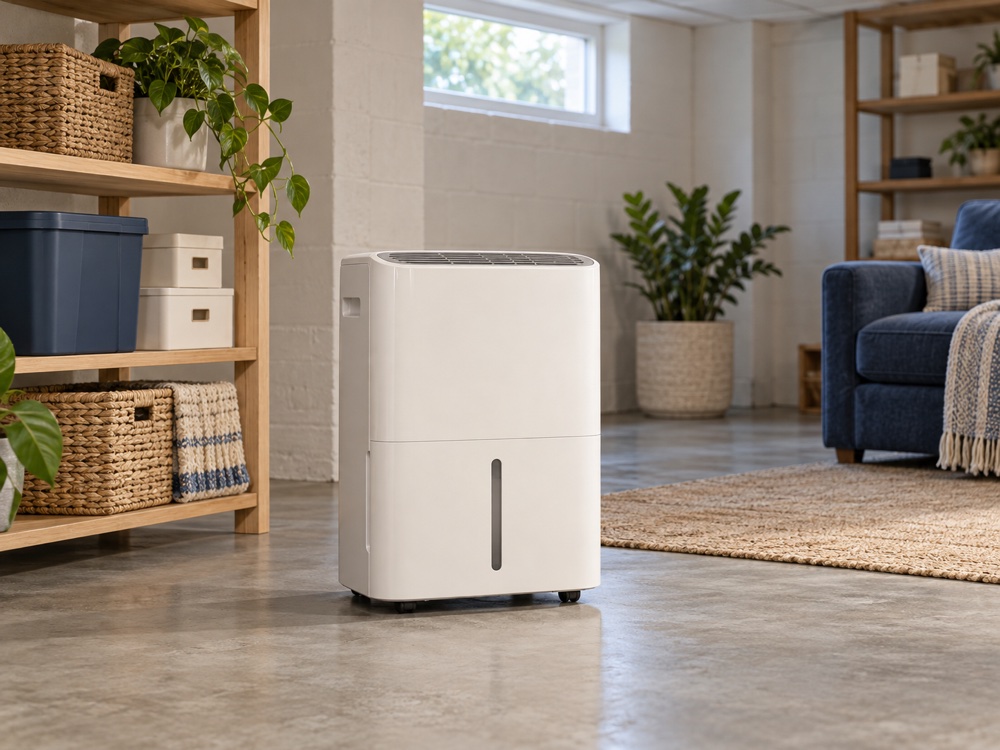
A refrigerant dehumidifier removes water from passing air and returns warmer, drier air to the space. It adds sensible heat while doing the moisture-removal job. Its humidity control can therefore respond when drying is needed without requiring the room to become colder. It still uses electricity; the added warmth also matters to comfort and cooling-system operation.
ENERGY STAR distinguishes portable units, usually serving a room or space, from whole-home units that use ducts to serve one or more rooms. A portable unit is not automatically a whole-house solution. A ducted system needs appropriate sizing, air distribution and installation to serve the intended spaces.
For a whole-home proposal, request a clear explanation of the controls, which spaces are served, maintenance access and condensate management. Have a qualified HVAC professional address installation and drainage. A product label cannot tell you whether those details will work in your home.
Sources: [3]
Pints per day is a test rating
Capacity describes water removed over 24 hours under specified test conditions. It is not the collection bucket's size, a promise of daily water collection, or a guarantee of coverage for a particular floor area. ENERGY STAR explains that temperature changes in the portable-dehumidifier test procedure changed reported capacities, even for comparable equipment.
Compare ratings on the same basis and ask how the proposed unit performs at your expected indoor temperature and humidity. Actual moisture load includes more than square footage. The efficiency measure, Integrated Energy Factor, reports litres of water removed per kilowatt-hour under the test method; a higher value means greater rated efficiency. It does not establish the correct capacity.
HouseIQ comparison prompt: ask each installer to state the design assumptions in writing so you can compare proposals on equal terms. Include the expected operating conditions, rooms served, control strategy and how performance will be checked after installation. Keep that explanation with the equipment model and maintenance instructions for future reference.
Sources: [4]
Will it prevent mold inside wall cavities?
It can help reduce indoor moisture, but it cannot guarantee this. EPA's building guidance separates liquid-water control from condensation control. Rain entering an opening, a plumbing leak, humid air reaching a cold hidden surface, or materials that remain wet can create a problem beyond the room air a dehumidifier treats. Wall assemblies also differ in their ability to dry.
A satisfactory living-room RH reading does not establish the moisture condition inside a wall. Neither does collecting a full bucket prove the underlying source has been resolved. Persistent staining, wetness, a musty smell or known water damage deserves assessment, even if the displayed humidity looks reassuring.
EPA advises considering an experienced professional for suspected hidden mold because disturbing affected materials can release spores. This article does not recommend opening wall cavities or treating concealed mold yourself.
Use measurements to build a pattern
EPA's general residential mold guidance recommends keeping indoor RH below 60%, ideally 30–50% if possible. These are prevention guidelines, not a guarantee that every surface or concealed space is safe. A suitable operating target still needs to account for the home and the equipment.
HouseIQ observation plan: record temperature and RH together, with the room, time and weather. Follow the meter's placement instructions and note whether a reading was beside a supply vent or immediately after a shower. Compare recurring conditions in the affected room with a normally comfortable room. Include what the cooling system was doing and whether the pattern followed rain or an extended absence.
A few dated observations are more useful to the person assessing the home than a single unexplained percentage. Report leaks and persistent moisture promptly to the owner or property manager if you rent.
Sources: [6]
Fit humidity control into the air-quality plan
Humidity control is one part of indoor air quality. PNNL places source control first and treats ventilation, filtration and moisture management as related decisions. Bathroom and kitchen exhaust can remove moisture near its source; outdoor air brought into a humid home may also add a drying load.
An energy recovery ventilator, or ERV, transfers some moisture as well as heat between incoming and outgoing air. With humid outdoor air and drier indoor air, that exchange can reduce the incoming moisture load. It is not a substitute for dedicated dehumidification when more drying is needed. Discuss how ventilation and drying will work together instead of changing ventilation schedules to chase a humidity reading.
Sources: [2]
Make a separate plan for an empty home
UF/IFAS's seasonal-home guidance treats Florida's humidity, equipment condition and property oversight as connected concerns. It recommends an air-conditioning check before an extended departure and checking what a managed community will maintain. The home still needs attention when no one is there to notice a change.
For your away plan, agree who checks the property, what conditions trigger a visit, and who can arrange help. Ask how the installed controls behave during reduced cooling demand and what happens if equipment stops. Record the agreed settings and contacts. No single thermostat setting in a general article can establish that your particular home will stay dry.
Sources: [7]
Questions worth taking with you
- What evidence distinguishes excess indoor water vapour from a leak or a wet building assembly?
- Does the cooling system meet both the temperature and moisture loads, including mild, humid weather?
- What assumptions support the proposed dehumidifier's capacity and which rooms will it serve?
- How will ventilation, cooling and humidity controls coordinate?
- What measurements and follow-up will show that the original problem has improved?
- Who will respond to a moisture concern during a long absence?
Sources
- Pacific Northwest National Laboratory / U.S. Department of Energy Whole-House Dehumidification
- Pacific Northwest National Laboratory / U.S. Department of Energy Whole-House Ventilation Strategies for New Homes
- ENERGY STAR Dehumidifiers
- ENERGY STAR Dehumidifier Testing and Capacity
- U.S. Environmental Protection Agency Moisture Control Guidance for Building Design, Construction and Maintenance
- U.S. Environmental Protection Agency A Brief Guide to Mold, Moisture and Your Home
- University of Florida IFAS Extension Closing Your Seasonal Home (FCS3154/HE887)