

Comfort IQ / Energy IQ / Build IQ
Ductwork: sealing leaks and delivering comfort
Understand leakage, insulation and airflow balance before paying for duct improvements—or a larger heating and cooling system.
Our articles are a starting point, not a professional assessment of your home.
DraftA work in progress, prepared by the HouseIQ.pro team.Editorial and professional review are not yet complete.
How much energy is really lost?
ENERGY STAR says that in a typical house about 20–30% of the air moving through ducts is lost through leaks, holes and poor connections. That is an airflow estimate for typical systems, not a measurement of your ducts. It is also not a claim that sealing will remove 20–30% from your whole utility bill.
The energy consequence depends on where that air goes, how much the system runs, the temperature and moisture conditions around the ducts, and the rest of the home. A disconnected supply in a hot attic and a small leak inside a conditioned basement are different problems. Ask for a diagnosis and a stated estimate of likely benefit, with the assumptions shown, before accepting a percentage-based sales promise.
Sources: [1]
Supply and return form one air-moving system
Supply ducts deliver heated or cooled air to rooms. Return paths bring room air back to the equipment. Leaks on the supply side can lose conditioned air before it reaches its destination. Leaks on the return side can draw air from surrounding attics, crawlspaces or other unintended places into the system, adding an unwanted heating, cooling or moisture load.
This helps explain why a room problem is not always a thermostat problem. The equipment may be producing suitable air while the distribution network delivers too little of it. Conversely, a return problem can affect the whole system. A worthwhile inspection covers both sides and their connections, rather than concentrating only on the most visible supply register.
Sealing, insulating and balancing do different jobs
Sealing closes unintended air pathways. Insulation slows heat transfer through the duct wall. Balancing adjusts distribution so individual rooms receive the intended airflow while the equipment retains the airflow it needs. These improvements can complement one another, but one does not prove the others are complete.
For example, a newly insulated duct can still leak at a disconnected joint. A tightly sealed branch can still be too restrictive, damaged or poorly routed to serve its room. And a room can receive its intended supply air yet lack a satisfactory return path when the door closes. Ask which of these mechanisms the proposed work addresses and how each result will be checked.
| Work | Evidence that matches the job |
|---|---|
| Seal leakage | A documented inspection and appropriate leakage assessment before and after |
| Improve insulation | Suitable insulation and moisture protection, with condition and coverage recorded |
| Balance distribution | Room airflow and return-path findings compared with the design |
What mastic and foil tape actually do
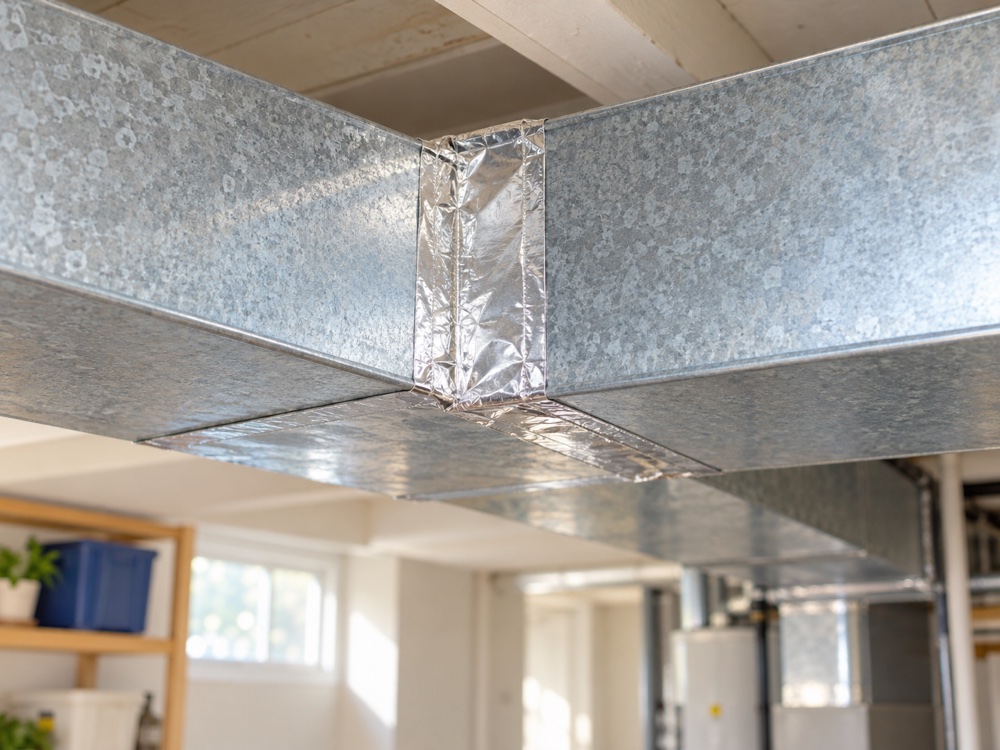
Mastic is a duct sealant used to make appropriate joints and gaps airtight. Suitable metal-backed tape is another sealing material for specified duct applications. Ordinary fabric-backed household “duct tape” is not the durable substitute its name suggests; ENERGY STAR warns against relying on it. The right material still depends on the duct construction and the product’s approved use.
Ask the contractor to identify the product, substrate compatibility and connections included in the work. A neat-looking outside wrap does not establish that the air-carrying connection underneath is secure or sealed. Broken, crushed or disconnected sections need appropriate repair, not merely a coating over the symptom. Where an aerosol sealing method is proposed, ask what mechanical defects and accessible connections require separate attention.
Why attic ducts deserve particular attention
A duct outside the conditioned enclosure exchanges heat with its surroundings. During cooling, heat can enter the cooled air through the duct wall; during heating, useful heat can leave. Insulation reduces that transfer. Where warm, humid air reaches a sufficiently cold surface, condensation can form—a moisture problem as well as an energy issue.
Florida and the other southern states in this topic include homes with ducts in very demanding attic conditions. Canadian homes may instead have ducts running through basements, interior chases or unconditioned spaces. Establish the actual enclosure boundary and duct location. For a renovation, discuss whether ducts can be kept inside that boundary. Do not simply bury existing cooling ducts in attic insulation: moisture behaviour and the complete duct assembly need a designed solution.
What a duct test should help you understand
A professional duct assessment can include a dedicated leakage test, inspection of connections and damaged sections, and measurements of system performance. ENERGY STAR specifically recommends leakage testing when evaluating ducts for a new HVAC installation. Ask what was tested, what the reported measurement means, and whether the assessment identifies leakage into unconditioned areas.
Request a written starting point and a comparable completion result. A result described only as “passed” is less useful for future decisions than one that also identifies the method, system boundaries, acceptance basis and remaining inaccessible work. A whole-house blower-door assessment answers a different primary question about the enclosure; do not assume its presence means the duct system received a separate leakage evaluation.
Leakage results do not establish the delivered airflow at every room. Ask for that information separately. A photograph of repaired connections documents work, but it cannot replace the operational checks needed to show how the system now performs.
Bedrooms need a route back, too
When a bedroom receives supply air but its closed door restricts the return path, pressure can build relative to the hall. PNNL explains that inadequate return paths can contribute to drafts, temperature differences and poor circulation. The problem can be easy to miss during a daytime visit when all the doors are open.
Ask the assessor to include normal closed-door conditions. Solutions may involve a dedicated return, a transfer grille or a jump duct, depending on the design. Sound privacy, light transfer and fire separations also belong in that discussion. Do not cut a door or wall based on a generic gap-size rule. The useful outcome is an adequately sized, appropriate return path verified for that room.
Sources: [6]
Balancing is more than closing the comfortable rooms
A technician can compare room airflow with the design and evaluate how ducts, grilles, filters and the blower work together. Existing balancing dampers may allow useful fine adjustments. But PNNL cautions that dampers do not correct major duct-sizing errors; excessive restriction can leave the equipment with insufficient airflow and cause operating problems.
Closing many registers to force air into one uncomfortable room is therefore a poor substitute for diagnosis. Ask about total airflow, external static pressure and room delivery, with the findings compared against the equipment requirements. Heating and cooling can place different demands on distribution. If automatic zoning is proposed, treat it as a separate engineered control arrangement with its own minimum-airflow needs, rather than a collection of remotely closable vents.
Make the improvement reviewable
Have the proposal identify the complaint, its likely cause, the repair scope and completion checks. For a hot upstairs room, for example, the record might distinguish duct leakage from restricted flow and solar gain. Those findings should explain why the selected work is expected to help. A larger air conditioner is not evidence that the distribution problem has been resolved.
After duct work, the professional should confirm appropriate airflow and address combustion safety where fuel-burning appliances are present. ENERGY STAR includes these checks in its contractor guidance because changing air pathways can affect the wider home. Keep before-and-after results, product information and unresolved items together for the next service visit.
You can help without entering an attic or opening equipment: record which rooms are uncomfortable, the time of day, outdoor conditions and whether doors were open. Share visible water stains, unusual odours or new airflow noise with the contractor. For a rental, report the observations to the owner and agree on access and alterations before work begins.
Questions worth taking with you
- Where are the ducts relative to the conditioned enclosure?
- Which problem is measured: leakage, heat transfer, restricted flow or room pressure imbalance?
- What materials and repairs are included, and what remains inaccessible?
- Will completion records include leakage, airflow, closed-door and relevant safety checks?
Sources
- US Environmental Protection Agency, ENERGY STAR Duct Sealing
- US Environmental Protection Agency, ENERGY STAR Hire a Professional Contractor for Duct Improvement Projects
- US Environmental Protection Agency, ENERGY STAR Duct Sealing with ENERGY STAR
- US Department of Energy Energy Saver: Tips on Saving Money and Energy in Your Home
- US Environmental Protection Agency, ENERGY STAR HVAC Quality Installation
- Pacific Northwest National Laboratory Transfer Grilles
- Pacific Northwest National Laboratory Pressure Balancing Supply and Return Ducts in Existing Homes
- Natural Resources Canada Keeping the Heat In — Section 2: How your house works