

Outdoors / Structure
Deck care: clean the surface, check the structure
A fresh stain can improve appearance. It cannot repair a weak ledger, a rotten joist or a loose guard.
Our articles are a starting point, not a professional assessment of your home.
DraftA work in progress, prepared by the HouseIQ.pro team.Editorial and professional review are not yet complete.
The Big Picture
A deck is an outdoor structure first and a finished surface second. Keep care and safety checks on separate lists.
Separate appearance from load-bearing condition
A deck can be faded yet structurally serviceable, or freshly coated with serious problems underneath. Treat cleaning and staining as one job and assessing supports, connections, guards and stairs as another. They overlap, but completing the first does not prove that the second is sound.
Begin with the deck's history if available: permits, drawings, age, repairs, material names and previous coatings. If you have just bought the home, arrange a qualified deck assessment rather than assuming a new-looking surface means a recent rebuild. NADRA recommends regular inspection and emphasizes the expertise needed to evaluate deterioration and changing safety requirements.
Understand the path from your feet to the ground
Deck boards pass weight to joists, then to beams, posts and foundations. On an attached deck, a ledger and its connection to the house may carry part of the load. Guards, handrails and stairs have their own connections and safety roles. A weakness anywhere in that chain can matter even when most boards look good.
The ledger area also needs effective water management so the house and deck connection do not stay wet. A bead of surface caulk is not evidence that concealed flashing and attachment are correct. The American Wood Council's guide illustrates why support and connections require coordinated design; its prescriptive details are not a universal repair recipe for every existing deck.
Make observations without stress-testing the deck
From a safe, accessible position, look for sagging, separation at the house, leaning posts, rusted connectors, obvious decay and displaced stairs. Notice loose guards during ordinary use, but do not lean hard on them to prove whether they hold. Photograph changes and arrange assessment when something is new or unexplained.
Do not crawl beneath an unstable deck, remove supports, pry at connections or jump on boards as a test. A homeowner check cannot certify capacity or code compliance. Visible movement, a failing guard, substantial decay or connection separation means stop using the affected structure and keep others away while a qualified professional determines the next step.
Clean with the least aggressive effective method
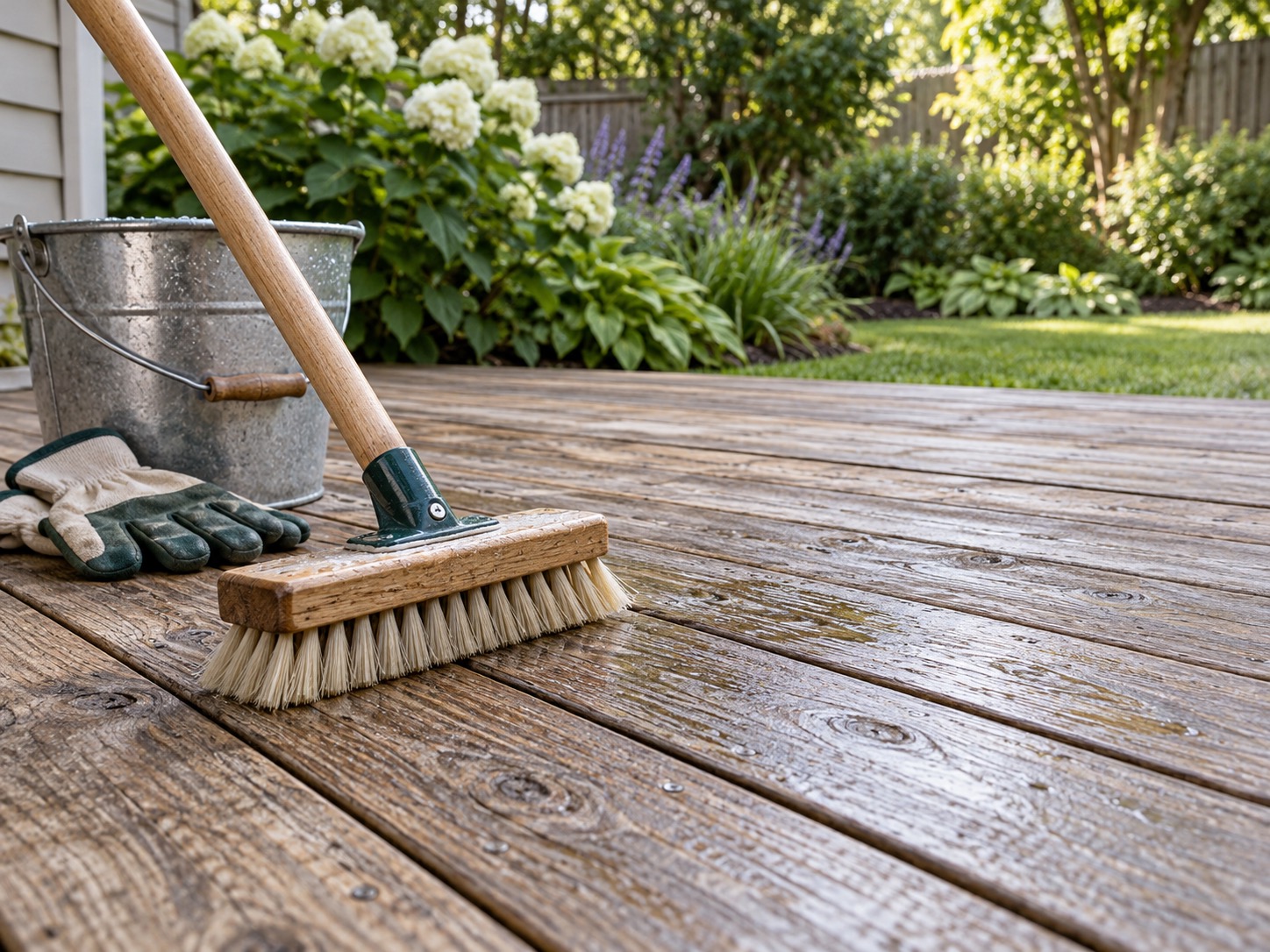
Remove leaves and debris that hold moisture, especially where boards meet edges and objects. Keep walking surfaces free of slippery buildup and use a cleaner approved for the actual decking. Begin with the gentler method described by the maker rather than assuming more pressure will produce a better result.
Composite products and generations differ. Trex, for example, gives different guidance for some newer boards and older uncapped material. That is a useful reminder to find the product name before borrowing a neighbour's pressure-washer setting. Aggressive washing can damage a surface, and sanding composite may be prohibited. Protect nearby plants, follow cleaner directions and never mix cleaning chemicals.
Stain and sealer are choices within a system
Clear finishes, semi-transparent stains and solid-colour coatings offer different appearances and renewal work. More pigment changes how much grain remains visible; the product must also be approved for a horizontal walking surface. A coating intended for a fence is not automatically suitable for deck boards.
Identify the existing finish before adding another. Peeling film, dirt or incompatibility can defeat a new coat. Follow the chosen manufacturer's cleaning, preparation, wood-moisture and weather requirements, including drying and return-to-use times. Do not cover suspected decay with a thick resurfacing product. A finish can slow weather exposure; it cannot put lost strength back into damaged wood.
Use condition and exposure to set the schedule
There is no single honest answer to how often every deck needs staining. A shaded damp corner behaves differently from a sun-baked stair tread, and a coating's instructions matter. Check the surface through the year, after significant storms and before a busy outdoor season. Look for changes in wear and water behaviour alongside dirt or biological growth.
Record what product was used, the preparation, date and conditions. A small maintenance log makes the next decision easier and avoids guessing between incompatible finishes. Do not automatically recoat the whole deck just because a calendar date arrived; investigate peeling or rapid failure so the same problem does not repeat.
Pay attention to water traps and hardware
Planters, mats and stored items can keep a patch wet or hide wear. Move manageable objects periodically when it is safe and compatible with the surface, and keep intended drainage paths open. Ask about staining or material compatibility before placing rubber-backed mats or containers on composite boards.
Corrosion at a structural connector is different from a cosmetic rust mark on a loose accessory. Fasteners and connectors must be suitable for the timber treatment and exposure; coastal environments add another consideration. Do not substitute an ordinary screw for a specified structural fastener or tighten unfamiliar connections as a cure for movement. Have the attachment and surrounding wood assessed together.
Changes in use can change the structural question
A hot tub, roof enclosure, heavy planter group or large gathering is not merely a decorating choice. Before adding unusual permanent loads, have the deck assessed for that use. Do not infer capacity from the fact that it has held ordinary patio furniture for years.
Keep exits and stairs clear and maintain useful lighting. Follow appliance and local requirements for grills, heaters and other ignition sources; a protective mat does not override clearances. Watch for snow, ice and falling branches without going onto an unsafe structure to remove them. Ask a professional how significant loads or damage should be managed when access itself is hazardous.
Ask for repairs that address the cause
A repair proposal should identify the problem, the affected components and what will be exposed or replaced. Replacing a rotten board without addressing persistent wetting can leave the next board with the same future. A structural connection repair may need access to the house wall and its water-control layers, not just new hardware visible from outside.
Ask who will obtain any required permits, what local standards govern the work and how concealed condition changes will be handled. Request completion photographs and keep the materials record. Renters should report defects promptly and avoid using suspect areas; structural repair belongs with the responsible owner and qualified trades, under the applicable local requirements.
A short routine is easier to keep
Make two recurring notes in the home calendar: one for routine surface care, another for checking changes and arranging professional inspection. After cleaning, write down anything worth watching rather than relying on memory. A small crack that is unchanged and a connection that has opened since last season are different conversations.
Before entertaining, check that access is clear, lighting works and there are no unresolved safety concerns. If the deck's history or structural condition is uncertain, resolve that before filling it with people. The point of maintenance is to enjoy the space with informed confidence, not to turn a can of stain into a certificate of safety.
Questions worth asking
- What is the decking product and existing finish?
- Has the ledger, framing, support and guard system been assessed?
- Does the proposed repair fix the water source or only its symptoms?
- Does a change in use need structural review or a permit?
Sources
- North American Deck and Railing Association Deck safety
- North American Deck and Railing Association Check your deck consumer checklist
- American Wood Council Prescriptive residential wood deck construction guide, DCA 6
- Trex Care and cleaning guide