

Build IQ / Comfort IQ / Energy IQ
House wraps and WRBs: rain control and wall drying
Separate rain protection, air sealing and vapour diffusion, then read perm ratings in the context of the entire wall.
Our articles are a starting point, not a professional assessment of your home.
DraftA work in progress, prepared by the HouseIQ.pro team.Editorial and professional review are not yet complete.
A WRB is part of the wall's rain protection
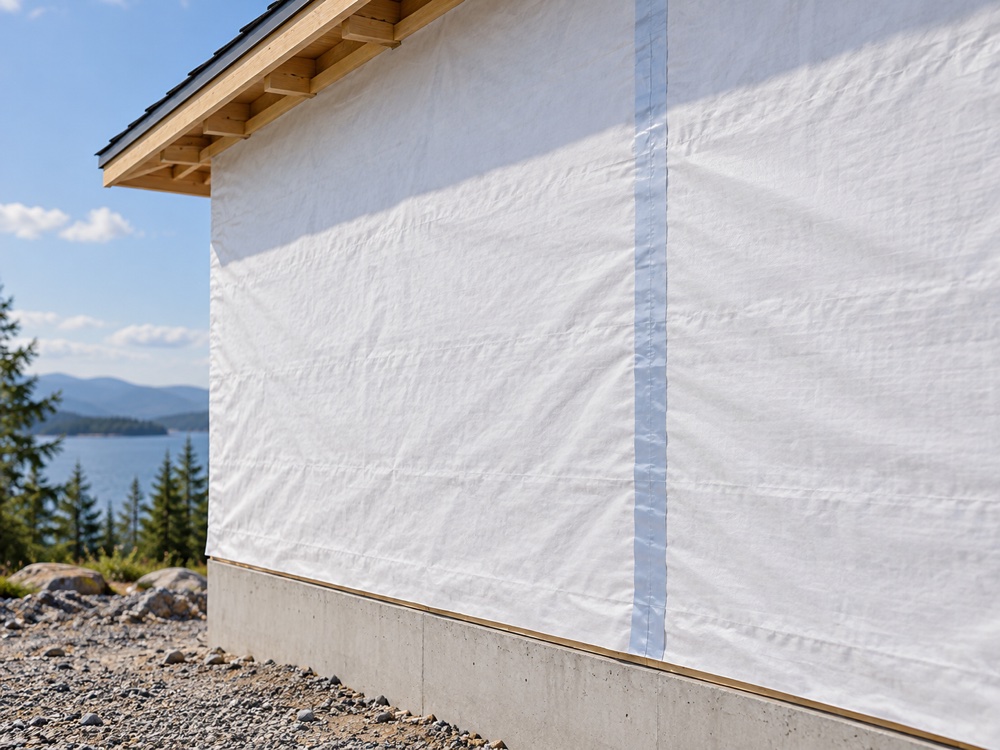
The initials WRB are used for water-resistive or weather-resistive barrier. In this article, the main job is managing rain that passes the exterior cladding. Siding joints and other interruptions can admit water, so a wall needs a connected surface behind them that leads it toward a safe outlet. A house wrap is one way to provide that surface, not the only way.
Other systems use a suitable coating, an adhered membrane or sheathing with an integrated water-control layer. Connections at windows, doors, wall penetrations and the base of the wall make the material useful as a drainage plane. When a quote names a WRB, ask the contractor to show those connections. The product covering the largest area is only one part of the rain-control system.
Sources: [1]
Rain, moving air and vapour diffusion are different jobs
Liquid rain, moisture carried by leaking air, and water vapour diffusing through a material follow different paths. An air barrier limits pressure-driven air movement through gaps. A vapour retarder limits diffusion through materials. A WRB manages liquid water behind the cladding. One product may do more than one job, but the complete assembly has to satisfy each function separately.
This is why “breathable” can be confusing. A vapour-permeable membrane may resist air leakage while allowing vapour diffusion. That does not mean outdoor air should flow through the wall to ventilate your home. Ask whether a quoted product is being used as a water-control layer, an air-control layer, a vapour-control layer, or a documented combination, and how it connects to the rest of each system.
A perm rating describes a tested layer
Water-vapour permeance describes how readily vapour passes through a layer under a vapour-pressure difference. Higher permeance means less resistance to diffusion under the stated conditions; lower means more resistance. It is not a measure of rain leakage, air leakage or insulation value. Nor is it the same as permeability, a material property that accounts for thickness. Product literature sometimes uses the terms loosely, so check what was measured.
For Canadian and U.S. comparisons, retain the units. A U.S. perm is approximately 57 ng/(Pa·s·m²), or nanograms per pascal-second-square-metre. Thus 10 perms is roughly 570 in those SI units, not 10. This rounded conversion is sufficient to recognize equivalent figures; the laboratory method and its conditions still need to match before the products are compared.
Dry-cup and wet-cup results are not interchangeable
ASTM E96/E96M describes gravimetric testing: measuring changes in mass as vapour moves through a specimen under controlled conditions. Its two basic approaches use a desiccant or water, commonly called dry-cup and wet-cup tests. Published product tables often identify Procedure A or B. Keep that procedure, temperature, humidity conditions and specimen description alongside the reported number.
The standard's public explanation cautions that a result from one method or set of conditions does not predict the result under another. Two numbers can differ because the testing conditions differ, not simply because one material is better. Ask whether the figure describes a thin facing, a complete board, a coating at a stated thickness, or the proposed multilayer assembly. A product comparison needs the same question asked of both products.
Sources: [5]
Use vapour classes as descriptions, not a shopping score
A common U.S. classification groups vapour retarders by dry-cup permeance: Class I at 0.1 perm or less, Class II above 0.1 through 1, and Class III above 1 through 10. These ranges help explain a specification. They do not establish what your province, state or municipality requires, and a wet-cup number should not be casually placed into a dry-cup classification.
The phrase “non-permeable” is also shorthand. Materials described as vapour-impermeable generally have very low permeance, not a promise of literally zero passage. More permeable is not automatically better in every position: designers may need to limit inward vapour drive while preserving another drying route. Ask why the selected resistance suits the assembly instead of requesting the highest or lowest number available.
Sources: [6]
Tyvek HomeWrap illustrates a separate sheet layer
DuPont describes Tyvek HomeWrap as a nonwoven polyethylene sheet that resists liquid water and air penetration while permitting vapour passage. Its current product table lists 56 perms for ASTM E96 Method A and 54 perms for Method B. These are the manufacturer's figures for that named product, checked for this draft; they should not be assigned to every product carrying the Tyvek name.
The wrap is normally considered alongside the sheathing and other wall layers. A vapour-open sheet cannot remove the diffusion resistance of the board beneath it or a low-permeance insulation facing outside it. DuPont also notes that adding another wrap layer restricts vapour passage more than one layer. Ask for the exact product sheet and the proposed layer arrangement, rather than assuming that a familiar logo settles the drying question.
Sources: [7]
ZIP System illustrates an integrated layer
Huber describes ZIP System wall sheathing and tape as an integrated air- and water-resistive system. Its wall-sheathing product page reports 12 perms under ASTM E96 Procedure B in a column specifically headed as vapour transmission of the WRB layer. That scope matters: it is not a stated permeance for every complete wall made with ZIP panels, insulation, finishes and cladding.
Comparing that facing value directly with a loose-wrap value cannot rank two completed walls for drying. The systems have different surrounding layers and connections. For either approach, ask what provides structural support, rain drainage and air continuity, and obtain the applicable details. The practical choice involves the full assembly and execution; neither the integrated format nor a higher advertised perm number proves a universal advantage.
Sources: [8]
Drying direction comes from conditions and the whole path
Vapor diffusion responds to a difference in water-vapour pressure. That depends on moisture conditions and temperature; it is not simply a rule that vapour always moves outward. To understand a wet layer's drying potential, the designer considers the layers between it and each side, along with the conditions on those sides. A permeable WRB can support an outward route without guaranteeing that the rest of that route is open.
In a Canadian heating season, outward vapour drive may be a concern. During Florida cooling conditions, inward drive may matter. Seasons, air conditioning, indoor humidity and sunshine on wet cladding can change the picture. A proposal should explain how wetting is limited and drying remains possible through the year. A two-arrow sketch of a typical wall is more useful than declaring all Canadian or all Florida walls the same.
Drainage space and vapour openness solve different problems
A drainage space lets liquid water leave behind the cladding. A space designed for ventilation can also help remove moisture from its surfaces. Those functions are related but not identical, and their detailing depends on the cladding and exposure. The term rainscreen should lead to a discussion of the actual space, its outlets and its connections, rather than being treated as another name for house wrap.
Brick and other absorbent claddings can store rainwater. When sun heats a wet cladding, moisture can be driven toward the wall behind it. The designer may address that load through drainage, ventilation and the vapour characteristics of the layers. A high-perm wrap alone cannot substitute for those decisions, and a drying plan cannot compensate for a continuing leak.
Changing one layer calls for a fresh wall review
For a renovation, ask the professional to identify the existing layers before specifying a new membrane or exterior insulation. Interior polyethylene, paint, wall coverings, sheathing and insulation facings can all affect the result. Low-permeance layers on both sides deserve particular attention because they may restrict drying. That observation calls for assessment of the actual wall, not automatic removal of a layer that may serve another required function.
Request a short written explanation of the proposed wall's rain, air and vapour strategy. It should name compatible products, show the transitions and describe relevant limitations during construction. Keep those documents with photographs before the wall is covered. If a substitution is proposed later, ask whether the performance and drying assumptions still hold; matching a product category is not enough to establish equivalence.
Questions worth taking with you
- Which layer manages rain, which controls air leakage, and which limits vapour diffusion?
- Does this perm value describe the facing, complete product or entire assembly, and under which test conditions?
- Where can the moisture-sensitive layers dry during heating and cooling seasons?
- How do existing interior finishes, sheathing and exterior insulation change that drying path?
- What drainage space and flashing details suit this cladding and rain exposure?
Sources
- U.S. Department of Energy / Pacific Northwest National Laboratory Drainage Plane Behind Exterior Wall Cladding
- Natural Resources Canada Keeping the Heat In — Section 2: How your house works
- Natural Resources Canada Keeping the Heat In — Section 3: Materials: insulation, house wrap barriers and weatherstripping
- U.S. National Institute of Standards and Technology NIST Special Publication 811 — Guide for the Use of the International System of Units (SI), 2008 edition
- ASTM International ASTM E96/E96M-24 — Standard Test Methods for Gravimetric Determination of Water Vapor Transmission Rate of Materials
- Building Science Corporation · Joseph Lstiburek BSD-106: Understanding Vapor Barriers
- DuPont Tyvek HomeWrap
- Huber Engineered Woods ZIP System Wall Sheathing
- Building Science Corporation · Joseph Lstiburek BSD-105: Understanding Drainage Planes