

Energy IQ / Build IQ
Drain-water heat recovery: saving some of a shower’s warmth
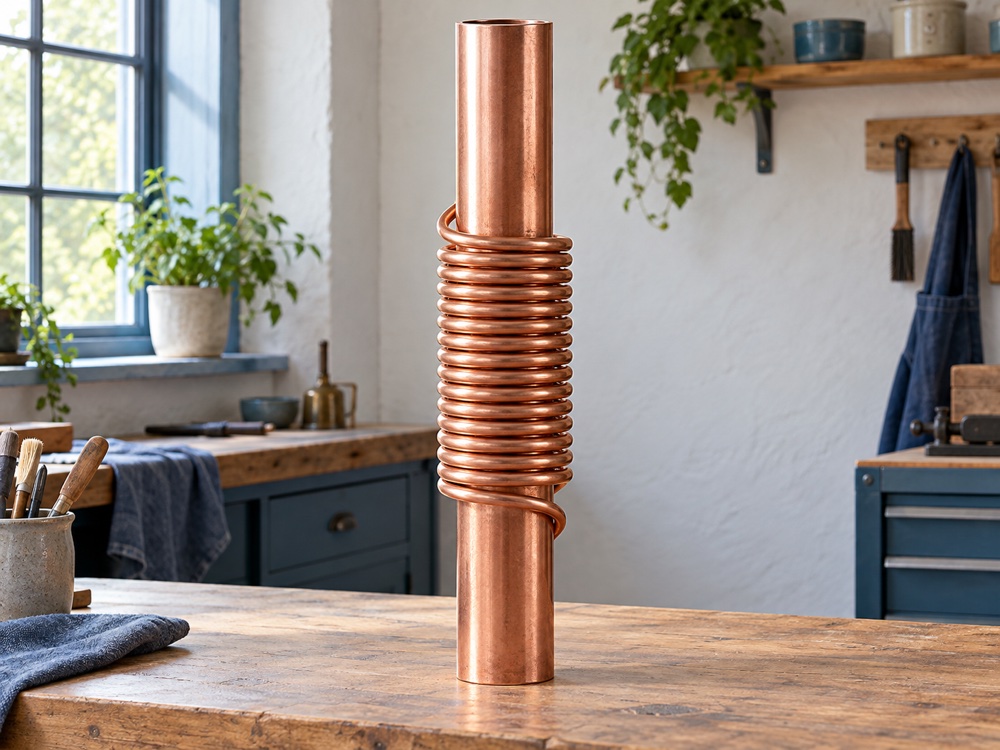
A copper heat exchanger can preheat incoming water with heat from the shower drain. Its value depends on simultaneous use, the plumbing layout and the cost of making hot water.
Our articles are a starting point, not a professional assessment of your home.
DraftA work in progress, prepared by the HouseIQ.pro team.Editorial and professional review are not yet complete.
What is being recovered?
Warm water still contains useful heat when it leaves a shower. A drain-water heat recovery unit, often shortened to DWHR, transfers some of that heat to incoming fresh water before the water heater finishes warming it. The heater then has less work to do. This is a reduction in the heating load, rather than a new source of electricity or a replacement for the heater.
The two water streams remain separate. Used shower water continues toward the sewer or septic system, while potable water travels through its own passage. NRCan describes a simple copper arrangement with no moving parts. It is not a filter that makes shower water drinkable, and it does not by itself reduce the volume flowing from the showerhead.
Sources: [1]
Why the familiar design is a vertical copper pipe
In a vertical drain, falling water tends to spread along the inside wall as a film. That places the warm water close to the heat-transfer surface. In the common coil-wrapped design, fresh water flows through copper tubing around the outside of the drain section. Heat crosses the metal walls; the waters do not need to mix or stop moving for that exchange to occur.
RenewABILITY’s Power-Pipe description illustrates this double-wall construction and the use of counterflow, with the streams travelling in opposite directions. It also describes separately engineered horizontal applications. That distinction matters: a vertical unit’s rating does not establish what it would achieve laid sideways. The exact model, orientation and available space belong in the design, rather than treating any copper coil around a drain as equivalent.
Sources: [2]
Why showers are the strongest match
A passive exchanger works best while warm drain water and incoming cold water are flowing at the same time. A running shower naturally creates that overlap. A bath usually fills first and drains much later; without a simultaneous fresh-water flow through the exchanger, much of that opportunity is missing. Appliances that fill and drain at different times create a similar limitation.
Manitoba Hydro therefore highlights showering households and accessible basement layouts. Count the showers that would actually drain through the proposed unit, not simply everyone living in the house. A frequently used upstairs bathroom may offer a better opportunity than several rarely used fixtures elsewhere. More shower use can increase recovered energy, but taking longer showers to improve an equipment payback would defeat the conservation goal.
Sources: [3]
Where does the preheated water go?
The potable-water routing changes the result. One arrangement preheats water going to the heater; another supplies preheated water to both the heater and the shower’s cold-side connection. The latter is often described as an equal-flow configuration because, during that shower, the fresh-water flow through the exchanger can approximately match the drain flow. Other fixtures operating at the same time complicate that balance.
Manitoba’s plumbing provisions distinguish equal-flow from unequal-flow configurations and address both efficiency and pressure loss. These are useful terms for discussing a proposal, not instructions to alter the plumbing. Ask the designer to show the intended connections, explain how the shower valve and heater will operate, and check the available pressure. A thermally attractive unit still needs to deliver acceptable flow.
Sources: [4]
A recovery rating is not your household saving
A heat exchanger’s effectiveness describes how much of the available heat-transfer opportunity it captures under specified conditions. It is not the fraction of your entire water-heating bill that disappears. The home also uses hot water at fixtures that may not drain through the unit, during events with poor flow overlap, and with temperatures different from the test.
In Canada, CSA B55.1 concerns measurement of efficiency and pressure loss, while CSA B55.2 concerns the units themselves; Manitoba’s current provisions reference both. Obtain documentation for the exact model and ask which test conditions and configuration its rating represents. A proposal should translate that performance into an annual estimate for your household. Multiplying the whole water-heating bill by a headline recovery percentage skips that translation.
Cold incoming water helps—but the house still matters
A larger temperature difference between warm drain water and cold supply water provides more opportunity for heat transfer. A Canadian STEP study at the Archetype Sustainable Houses in Vaughan observed greater recovered energy under colder conditions. Its result supports the mechanism; its old prices and particular draw schedule do not establish today’s payback for another home.
That is why seasonal inlet-water temperatures belong in an estimate for Ontario, Manitoba or any other province. Well water and municipal supply can behave differently. A milder location can still have worthwhile shower use and a favourable installation, while a cold-climate house with little simultaneous demand may recover little. Also distinguish a similar percentage effectiveness from a similar quantity of heat: the available temperature difference changes the energy behind the percentage.
Sources: [5]
The value of recovered heat depends on the heater
A kilowatt-hour of useful heat is not always a kilowatt-hour of purchased electricity. A resistance heater converts electricity directly to heat, while a heat-pump water heater moves heat from surrounding air. The latter may supply several units of heat for each unit of electricity, depending on operating conditions and the use of its backup element. Avoided heat therefore needs to be valued at the heater’s actual incremental energy cost.
For gas or other fuels, the calculation likewise needs the fuel price and the relevant heating efficiency. Fixed account charges do not disappear because the heater works less. If a water-heater replacement is planned, evaluate the exchanger alongside that future heater: an improvement that lowers the cost of producing hot water can lengthen the separate recovery unit’s financial payback even though it still saves heat.
A transparent payback example
Suppose, purely for comparison, that an installed exchanger costs CAD $1,800 and recovers 900 kWh of useful heat annually. Those are invented inputs, not an installation quote or a prediction for a high-use family. If each avoided kWh of heat is worth $0.20, the annual saving is $180 and simple payback is 10 years. The table changes only that assumed value of heat.
The lowest-cost heat scenario shows why a large household alone cannot promise a short payback. At $0.20 per recovered kWh, halving annual recovery to 450 kWh would also halve savings to $90 and double payback to 20 years. These simple calculations exclude financing, maintenance, future prices and equipment life. Ask for conservative and optimistic cases using the complete installed price, rather than a purchase-only cost.
| Avoided cost per kWh of heat | Annual saving | Simple payback |
|---|---|---|
| $0.20 | $180 | 10 years |
| $0.10 | $90 | 20 years |
| $0.05 | $45 | 40 years |
Sources: [7]
Check the physical fit before comparing promises
A suitable vertical drain section below the shower, sufficient height and an accessible path for the potable-water connections make the project easier to assess. In a finished basement, opening and restoring surfaces may materially change the quote. A new build or planned renovation is an opportunity to coordinate the layout before those surfaces are closed. Have a licensed plumber evaluate drainage, pressure, access and the exact product’s requirements.
Include approvals, labour, fittings and restoration in the written price. Confirm the warranty and any inspection or maintenance requirements with the manufacturer instead of assuming that no moving parts means no future attention. Renters need the owner’s agreement; condominium owners also need to establish who controls the drain stack. Local authorities determine the applicable requirements, so a rule from one province is not a Canada-wide answer.
Make it part of a sensible water-heating plan
Begin with your actual shower routine and any planned changes, including a more efficient showerhead or fewer people living at home. Those changes can reduce the heating load before recovery is considered. Record the proposed model, which showers it serves, the plumbing configuration, estimated annual recovered heat and the energy-price assumptions in one place. This makes competing proposals much easier to compare.
DWHR addresses heat leaving through a drain. Recirculation addresses the wait for hot water to reach a fixture, and a more efficient heater changes how the heat is supplied. They solve different problems and their savings should not simply be added as unrelated percentages. A good proposal explains how the measures interact and what comfort, conservation and cost outcomes are realistic for your home.
Questions worth taking with you
- Which regularly used showers would drain through the exchanger?
- Does the model’s tested configuration match the proposed plumbing?
- What annual recovered heat and marginal energy cost support the savings estimate?
- Does the installed price include access, restoration and required approvals?
Sources
- Natural Resources Canada Drain water heat recovery
- RenewABILITY Energy Inc. The Power-Pipe Technology
- Manitoba Hydro How to reduce water use and save money
- Government of Manitoba Manitoba Plumbing Code, M.R. 80/2023
- Toronto and Region Conservation Authority / Sustainable Technologies Evaluation Program Evaluation of Residential Drain Water Heat Recovery Unit
- U.S. EPA / ENERGY STAR How it Works — Heat Pump Water Heaters (HPWHs)
- Natural Resources Canada Water Heater Guide