

Energy IQ / Comfort IQ / Build IQ
Home energy audits: what to expect and how to use the results
Understand the tools, questions and reports that turn a home's comfort problems into a practical improvement plan.
Our articles are a starting point, not a professional assessment of your home.
DraftA work in progress, prepared by the HouseIQ.pro team.Editorial and professional review are not yet complete.
Begin with the decision you need to make
An energy audit is an investigation of how a home uses and loses energy. Its value is the explanation it gives you: why one room is uncomfortable, where energy is going, and which improvements deserve attention. The visit itself does not reduce consumption. The benefit comes from using its findings to choose and complete suitable work.
Tell the assessor what you hope to decide. Perhaps the furnace is nearing replacement, a renovation will expose a wall, or the upstairs stays uncomfortable despite a reasonable thermostat setting. Share your budget and timing too. A detailed assessment should help you choose among real options; it need not become a shopping list of every possible upgrade.
Choose the service as carefully as the assessor
In Canada, an EnerGuide evaluation is delivered by a registered energy advisor through a service organization. Use NRCan's directory to verify the organization you contact. Registration describes participation in the rating system; advisors are independent businesses, and NRCan does not endorse a particular contractor or product. Ask whether the advisor also sells installation services and how recommendations are separated from sales.
In the United States, credentials can indicate different training and testing skills. Ask for the assessor's current residential qualifications and experience with homes like yours, then confirm any program-specific approval. A general credential and a rebate program's contractor listing answer different questions. Request a written scope covering tests, report, fee, exclusions and follow-up discussion before booking.
Bring a short history of the house
Prepare a year's energy bills if available, including each fuel used, and note unusual periods such as vacancies or major changes in occupancy. A bill contains both usage and price information; describe whether the concern is higher consumption, higher rates or both. Photos or notes about condensation, uncomfortable rooms and when problems happen can make the visit more focused.
Mention upcoming roof, siding or equipment work, even if it is not primarily an energy project. Ask what the assessor needs to access and arrange clear, safe access without entering hazardous spaces yourself. For a seasonal Florida home, explain the occupied and vacant periods. For a Canadian home, describe winter discomfort as well as summer overheating. These are useful questions to investigate, not diagnoses.
Expect measurements, observations and questions
An EnerGuide advisor collects information about insulation, windows, doors, airtightness, heating, cooling, water heating and ventilation. Measurements feed an energy model. The advisor also explains the evaluation and consent process, and photographs relevant building components for records. Ask what is being observed directly and what must be estimated because construction is concealed.
Agree on how fuel-burning appliances will be managed during testing. A blower door changes building pressure and can affect their safe operation. Follow the qualified assessor's instructions rather than experimenting with fans or appliance controls. Tell them about fireplaces and any known safety or access concerns before the appointment. If testing cannot proceed safely or a space cannot be inspected, ask how that limitation will appear in the report.
Sources: [1]
The blower door measures leakage under test conditions
A blower door uses a fan fitted into an exterior doorway to create a controlled pressure difference. A calibrated system pairs that fan with pressure measurement to quantify airflow. The assessor can also investigate where air is moving. A leakage number and a location investigation are complementary: knowing the total does not, by itself, identify the most practical repairs.
Ask the assessor to explain the reported units, test pressure and building boundary. Keep the original results for a meaningful comparison after work. This is a controlled test, not a direct measurement of how much outdoor air enters on every ordinary day. The report should connect the result with the house and proposed improvements instead of treating a lower number as the only goal.
A thermal camera adds clues, not a verdict
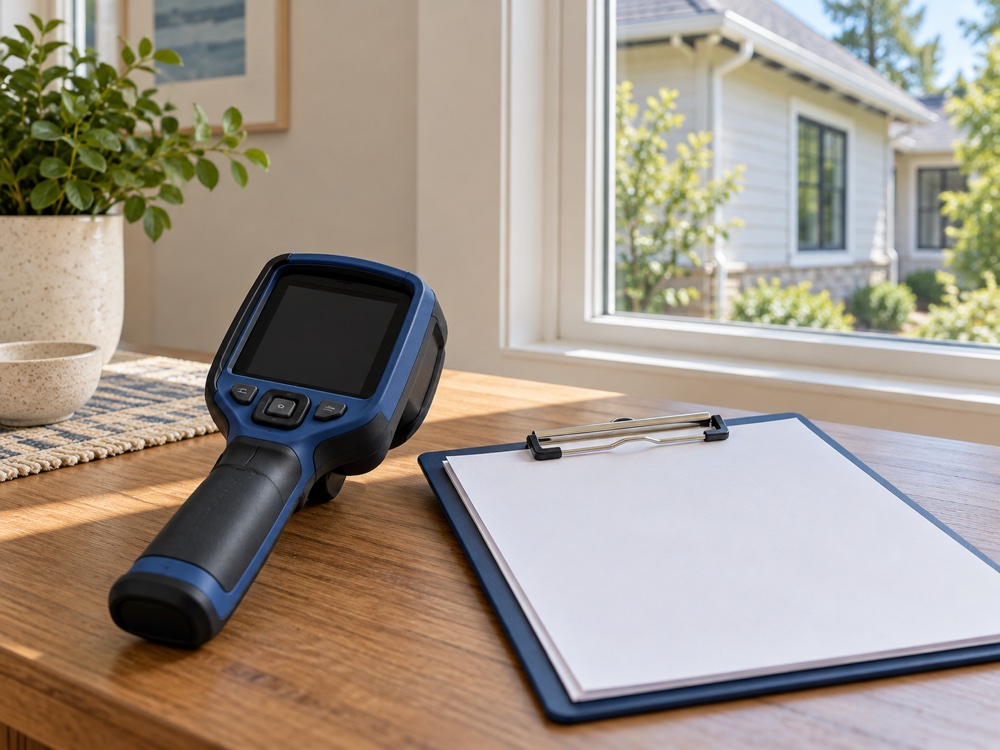
Infrared imaging records surface-temperature differences. Used alongside a blower door and other observations, it can help locate air leakage and possible insulation gaps. Ask whether imaging is included, what conditions are needed for useful results, and whether the assessor will provide ordinary photos alongside thermal images so that each location is understandable later.
An unusual pattern is a reason to investigate. Ask what evidence supports the proposed cause and what uncertainty remains; do not turn a coloured image into an automatic instruction to replace a window or open a wall. HouseIQ's useful question is: what additional observation would confirm this interpretation? That question keeps the discussion focused on the building rather than the appearance of the picture.
Read the report before focusing on the score
An EnerGuide evaluation produces a rating and label, a Homeowner Information Sheet and a Renovation Upgrade Report. The current rating expresses estimated annual net energy consumption in gigajoules per year; lower is better on that scale. It uses standardized operating assumptions so houses can be compared. It is not a promise that your utility bills will match the rating.
Read the component descriptions and advisor's comments, not just the headline number. Weather, household operation and atypical loads can explain differences between the model and bills. Check that the house described is recognizably yours. The upgrade report shows recommended improvements and estimated energy effects; ask for clarification if the proposed package does not address the comfort problem that prompted the visit.
Sources: [3]
Turn recommendations into an order of work
A useful sequence considers dependencies. An assessment before a heating or cooling replacement can identify envelope improvements that change the equipment capacity needed. Discuss planned insulation and air sealing with the equipment designer rather than sizing the replacement solely from the old unit. Ask which conclusions are firm and which need a specialist's assessment or a contractor's detailed quote.
Separate energy estimates from your own priorities. A measure might have modest projected bill savings yet address an important comfort issue, or make sense while another renovation provides access. Request an explanation of the assumptions behind costs and savings. Treat the report as a basis for comparing proposals, including the work needed to finish the job, rather than a guaranteed price or payback schedule.
An audit can support a rebate; it does not guarantee one
Program rules are separate from the assessment process. As checked on 8 October 2026, Canada's Greener Homes Grant is closed, and new Greener Homes Loan applications are closed. Booking an EnerGuide evaluation does not reopen those programs. Other support must be checked through its own current terms, location, applicant requirements and deadlines.
Ontario's Home Renovation Savings assessment stream illustrates the timing issue: it requires an initial assessment before work, at least two qualifying upgrades, and a follow-up assessment. Its assessment rebate depends on successful program completion. This is an example of one stream, not a rule for every Ontario measure or another province. Obtain program confirmation before assuming an assessment or purchase will be reimbursed.
Make the report useful after the visit
Book a short conversation to walk through the findings. Ask the assessor to identify the strongest opportunities, unresolved observations and recommended next specialist. Keep the report, test results, photos and subsequent quotes together. When proposals use different assumptions, return to that common record and ask each contractor to explain the difference in scope.
After improvements, arrange the verification required by your program or agreed assessment scope. A follow-up test can document the changed building, while your own record of comfort and energy use adds a different perspective. Note weather, occupancy and operating changes before comparing bills. The aim is an improvement you can understand and evaluate, with a clear record of what was done and what still needs attention.
Questions worth taking with you
- Which tests and reports are included, and what would require an additional service?
- How will the assessor distinguish measured facts from assumptions about concealed construction?
- What do the leakage result and thermal images mean for the particular comfort concern I described?
- Which work should happen before equipment sizing or another planned renovation?
- What current program must approve the assessor or project, and what must happen before work begins?
- How will completed work be checked, and who will explain the results?
Sources
- Natural Resources Canada EnerGuide energy efficiency home evaluations
- Natural Resources Canada Find service organizations for existing homes
- Natural Resources Canada After your EnerGuide home evaluation
- U.S. Department of Energy Consumer Guide to Home Energy Assessments
- Pacific Northwest National Laboratory / U.S. Department of Energy Blower Door Test
- Public Service Commission of Wisconsin Energy Audits
- New York State Energy Research and Development Authority The Complete Guide to Home Energy Assessments
- Natural Resources Canada Eligible retrofits and grant amounts — closed Canada Greener Homes Grant
- Enbridge Gas / Save on Energy Home Renovation Savings — Energy assessment required upgrades