

Interiors / Materials
Wood, laminate or vinyl: choose a floor for the room
Compare the surface you see, the layers underneath and the moisture conditions that decide whether a floor performs well.
Our articles are a starting point, not a professional assessment of your home.
DraftA work in progress, prepared by the HouseIQ.pro team.Editorial and professional review are not yet complete.
The Big Picture
Choose a floor like a pair of shoes: appearance matters, but it has to suit where it will be used. The best-looking plank cannot compensate for a damp, uneven or unsuitable base.
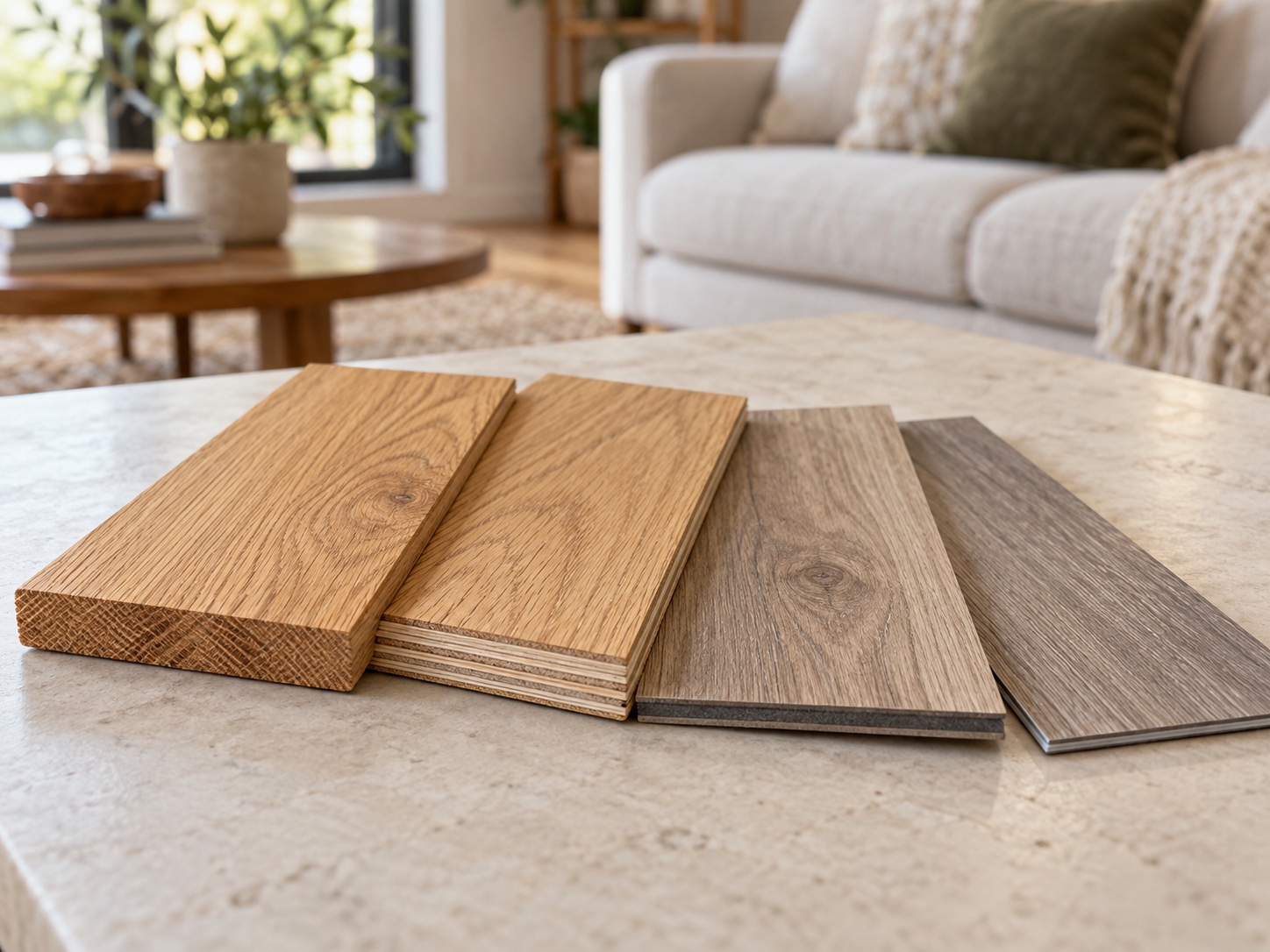
Similar grain patterns can hide very different products
Solid hardwood is wood through its thickness. Engineered wood has a real wood wearing surface over supporting layers. Laminate generally uses a printed decorative layer over a wood-based core. Luxury vinyl plank uses a decorative design and protective surface over a vinyl-based construction; rigid-core versions add further material choices. The same oak colour name can therefore describe products with very different repair options.
Ask to see a cut sample and the technical sheet rather than choose from a photograph alone. Look at the edge, joint and usable surface. “Engineered” does not mean fake wood, and “luxury” is not a performance test. The useful comparison is the exact product, its construction and the conditions for which its maker approves it.
Solid wood offers a renewable surface—with limits
A solid wood floor can often be sanded and refinished, giving it a route to renewal rather than automatic replacement. The available thickness above the joint, past sanding, damage and species all affect what is possible. A professional should evaluate an existing floor before you assume another aggressive sanding is safe.
Wood also changes dimension with moisture conditions. A floor that suits a stable living room is not automatically right for a damp basement or a routinely wet room. Ask about expected indoor conditions and how the installation accommodates movement. If you like the possibility of refinishing, include the future disruption and finish choices in the decision; renewability is valuable when you actually intend to use it.
Engineered wood is real wood in a layered structure
The layered construction can reduce dimensional movement compared with solid wood, and some products are approved for below-grade rooms or particular heated-floor systems. This is useful flexibility, not immunity to water damage. Check the exact installation method, subfloor conditions and temperature limits instead of applying the claim to every engineered plank.
The top wood layer also varies. Some floors allow refinishing; others have too little usable material for the work you have in mind. Ask the seller to state the refinishing options in writing. If two samples look similar but have very different prices, wear-layer construction, finish, board dimensions and installation requirements may explain part of the difference.
Laminate can be practical, but read the water claim
Laminate can provide a convincing wood appearance with a hard wearing surface and a click-together installation. It may suit a household prioritizing appearance and everyday wear within a modest budget. Product quality and price overlap other categories, so compare actual quotations rather than assume laminate is always the cheapest installed option.
Water-resistant or waterproof marketing needs careful reading: which exposure, for how long, and with what edge sealing or installation details? A wood-based core and a decorative surface are not a licence to ignore leaks. Laminate is generally replaced rather than sanded back like solid wood. Read cleaning instructions too; Shaw’s guidance, for example, warns against steam cleaning its laminate.
A water-resistant plank does not waterproof the room
Luxury vinyl plank can be useful where spills are likely, and it comes in flexible and rigid constructions. A thicker or stiffer product is not automatically superior for every floor. Wear resistance, indentation resistance, joint strength, support underneath and the permitted installation all matter. Ask what the stated wear layer measures and what the warranty actually covers.
Even if the plank itself is described as waterproof, water can reach edges, walls, cabinets and the substrate. Moisture can remain trapped under a floor that still looks intact. That is why an unresolved basement leak is a building problem before it is a shopping problem. Treat a flood or plumbing leak as a reason to investigate beneath the finish, not as a warranty demonstration.
Flat, dry and suitable comes before beautiful
Have the existing base assessed for soundness, flatness and the moisture condition required by the flooring manufacturer. Concrete can look dry while still presenting a moisture problem for a floor system. The appropriate test and allowable result depend on the product and installation; a quick glance or a universal moisture percentage is not enough.
Include preparation in the quote. Removing high spots, correcting low spots, repairing damaged subfloor, managing moisture and choosing an approved underlayment can materially change the project cost. Adding a soft pad that the product does not allow may strain click joints. A floating floor also needs the specified movement space and should not be trapped by details that prevent it moving as designed.
Compare daily use rather than a showroom scratch test
Pets, grit at the entry, rolling chairs, furniture feet and direct sunlight create different demands. A surface that resists a light scratch can still dent under a concentrated load. Take samples home to see colour and glare in real daylight, and ask about suitable mats, chair protection and cleaners. Texture can disguise marks but may change how the floor feels or cleans.
Use the manufacturer’s care instructions. Regularly removing abrasive grit and cleaning spills promptly is more useful than an occasional harsh treatment. Avoid assuming a steam mop is suitable because the surface feels tough. Keep a few matching spare pieces if practical, and ask how a damaged plank can be replaced after the room is furnished.
Compare the complete installed cost and repair path
Ask for itemized quotations that cover removal, disposal, preparation, moisture work, underlayment or adhesive, trim, transitions and furniture handling. A low plank price can become an expensive job when substantial preparation is excluded. Compare the same room, scope and product specification, then ask how extra work will be approved if hidden damage appears.
There is no dependable universal lifespan for each category. Traffic, water events, installation, maintenance and repairability strongly influence service life. A longer warranty is not a promise that a floor will look new for that period. Choose the combination of comfort, upkeep, appearance and future repair that fits your household, and keep the product code and installation instructions in your home records.
Questions worth asking
- Is this exact flooring approved for this room, subfloor and moisture condition?
- What preparation, acoustic underlay and transitions are included in the price?
- How can damage be repaired, and can this particular wood surface actually be refinished?
Sources
- National Wood Flooring Association Types of Wood Floors
- National Wood Flooring Association Maintenance
- Shaw Floors Laminate Overview
- Shaw Floors Luxury Vinyl Overview
- Shaw Floors Vinyl Flooring Installation
- US EPA Protect Your Family from Exposures to Asbestos