

Roofs & drainage
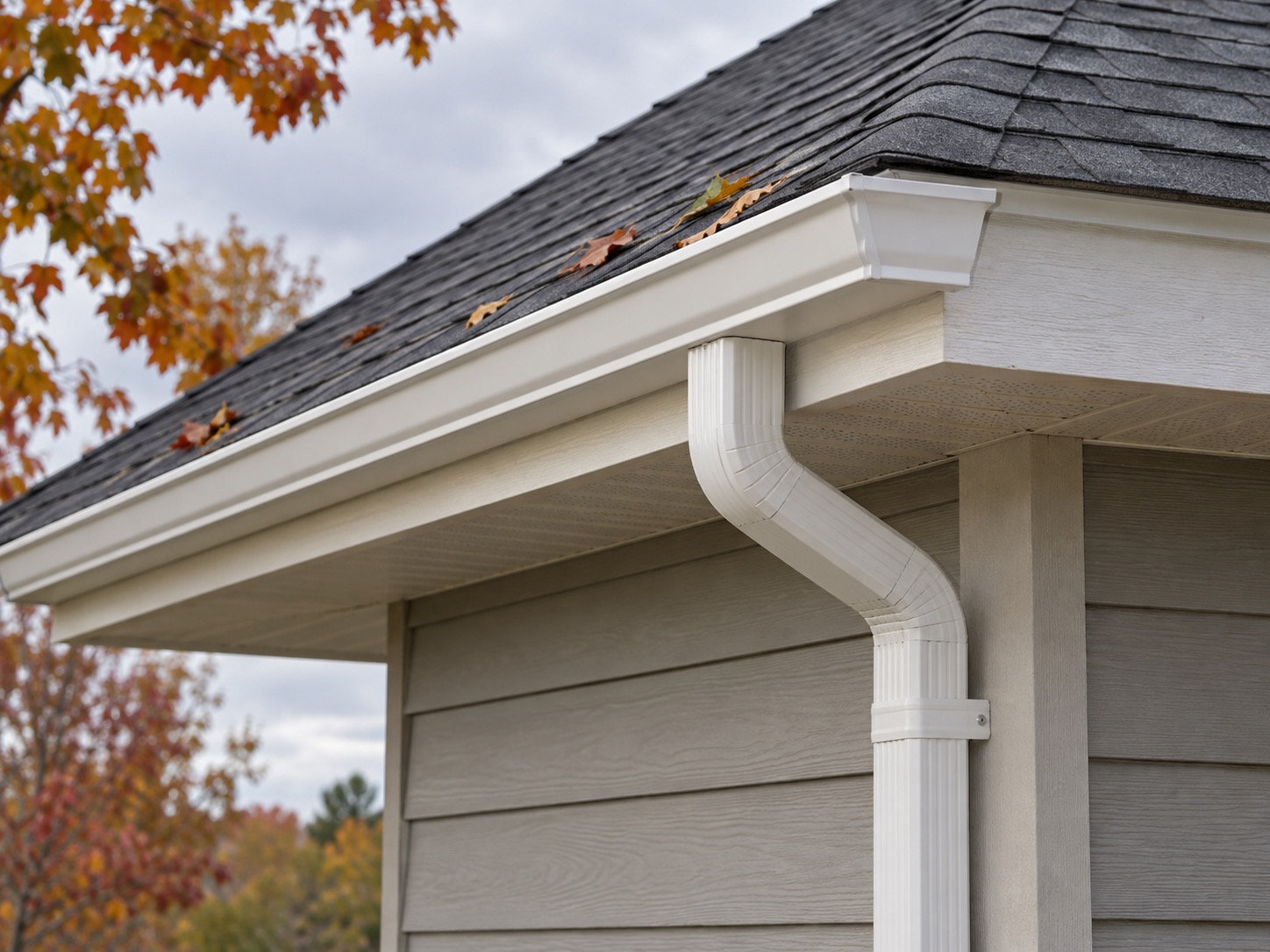
Gutters and drains: give rain a complete route away
Seamless gutters, leaf guards and buried drains solve different parts of a water-management problem.
Our articles are a starting point, not a professional assessment of your home.
DraftA work in progress, prepared by the HouseIQ.pro team.Editorial and professional review are not yet complete.
The Big Picture
A gutter is the start of a route, not the destination. Trace rain from the roof all the way to a place that can safely receive it.
A roof collects more water than it appears to
A roof acts like a large collection tray. As a simple illustration, 10 millimetres of rain over 100 square metres represents about 1,000 litres before losses or storage. Concentrating that water at a corner can overwhelm a small outlet even when the rest of the gutter looks spacious. Roof area and local design rainfall matter more than choosing a size because it is common nearby.
Look at where valleys and upper roofs concentrate runoff. An overflow in one place may be a local bottleneck, not evidence that every gutter needs replacement. Ask the installer to explain the roof areas feeding each downspout and how the outlets, corners and downstream pipes will handle the expected flow.
Seamless describes the lengths, not the whole system
Seamless aluminum gutters are formed in long runs, reducing the number of joints along the eave. Corners, end caps and outlets still need sound connections. Aluminum can dent, hangers can loosen and sealants at joints can fail. A seamless label does not remove the need to inspect the system or repair the fascia that supports it.
Other materials may suit different exposures or architectural needs. Compare the complete installed arrangement: material and finish, support, expansion details, outlet locations and how damaged sections will be repaired. Avoid treating a promised lifespan as independent of trees, corrosion exposure, snow movement and maintenance. Ask what the warranty covers and what conditions are excluded.
Water needs an unobstructed path
Gutters need the intended fall toward outlets without low pockets caused by sagging. Too little drainage can leave water and debris sitting in a run; a blocked outlet can make even a well-sloped gutter overflow. Connections at the roof edge also matter, because water passing behind a gutter can wet fascia rather than entering the channel.
Observe from the ground during ordinary rain when it is safe. Note whether water pours over a front edge, drips from a joint or runs behind the gutter. Those are different clues. Photograph the location and conditions for the contractor. Do not climb a wet ladder or roof to diagnose the fault during a storm.
Leaf guards change maintenance rather than ending it
Screens and covers aim to admit water while excluding debris. Their usefulness depends on the trees, pollen, needles and seeds around the home, as well as roof geometry and rainfall intensity. A product that handles broad leaves well may still collect fine material or develop a mat on its upper surface.
Ask how the system is cleaned, how an outlet is accessed and what happens at roof valleys. Inspect after leaf fall and major storms even when guards are fitted. In wildfire-prone areas, accumulated dry debris is also a fuel concern; a cover is not a reason to ignore the roof edge. Keep any cleaning or service warranty separate from claims that the gutter will never need attention.
Check the last few metres
A downspout can carry water neatly down a wall and still release it in the wrong place. An extension should lead to ground or drainage designed to take the flow away, without returning it toward the house. A splash block may reduce erosion but does not by itself make a flat or reverse-sloping yard drain correctly.
Consider paths, entrances and winter icing. Avoid routing water onto neighbouring land or assuming an existing underground pipe leads somewhere useful. Have its destination established. A rain barrel needs a planned overflow route when full; during prolonged rain, that overflow may carry most of the incoming water. Storage capacity and drainage capacity are separate questions.
A French drain collects water in the ground
A French drain generally uses a gravel-filled trench, often with perforated pipe, to intercept and move water within the soil. It differs from a solid pipe carrying concentrated downspout flow. It also differs from a surface swale, which guides water across the landscape. The right choice depends on whether the troublesome water is arriving over the surface or through the ground.
Picture a drain as a route with an entrance and an exit. Gravel alone is not an unlimited sink, particularly in saturated or slow-draining soil. A buried system needs a suitable outlet or engineered disposal arrangement and access for maintenance. Excavation near foundations, utilities or retaining walls requires professional planning and service-location checks before digging.
Do not overload foundation drainage
Roof water and footing drains serve different roles. Sending concentrated roof runoff into perforated pipe beside a foundation can deliver water precisely where you are trying to keep the ground drier. The DOE’s drainage guidance separates roof-water conveyance from foundation drainage. A contractor should explain how the proposed layout preserves that separation.
Local rules determine connections to storm systems, combined systems or other outlets. Never assume a sanitary connection is acceptable because a pipe is conveniently nearby. Confirm approval before disconnecting or reconnecting an existing arrangement, especially in dense neighbourhoods where a short extension may create a new problem for someone else. A lawful destination is part of the design, not paperwork to settle afterward.
Use the season to choose the next check
Before freezing weather, look for debris, standing water and loose parts. In snowy regions, gutter icing may accompany broader roof or attic problems; cleaning a gutter does not cure heat-driven ice dams. In heavy-rain climates, watch overflow patterns. In dry areas, occasional intense storms still deserve consideration even though the gutter is quiet most of the year.
Keep a short record of wet-weather observations and repairs. If basement dampness continues after obvious roof-water faults are corrected, investigate grading, foundation drainage and other entry paths rather than installing more accessories at random. Renters can document and report the symptoms without attempting roof work. The objective is a reliable route for water, not the longest possible list of drainage products.
Questions worth asking
- Where does every downspout actually discharge?
- Is this surface runoff or groundwater?
- How will the proposed system be inspected and cleaned?
Sources
- US DOE / PNNL Gutters and Downspouts
- US DOE / PNNL Final Grade Slopes Away from Foundation
- US DOE / PNNL Footing Drain Pipe
- City of Milwaukee Downspout Disconnection Program