

Energy IQ / Comfort IQ
Heat pumps: air-source, cold-climate and ground-source systems
Understand what −30°C operation really means, how to read HSPF2 and SEER2, and when a heat pump and furnace can make a useful team.
Our articles are a starting point, not a professional assessment of your home.
DraftA work in progress, prepared by the HouseIQ.pro team.Editorial and professional review are not yet complete.
Can a heat pump work at −30°C?
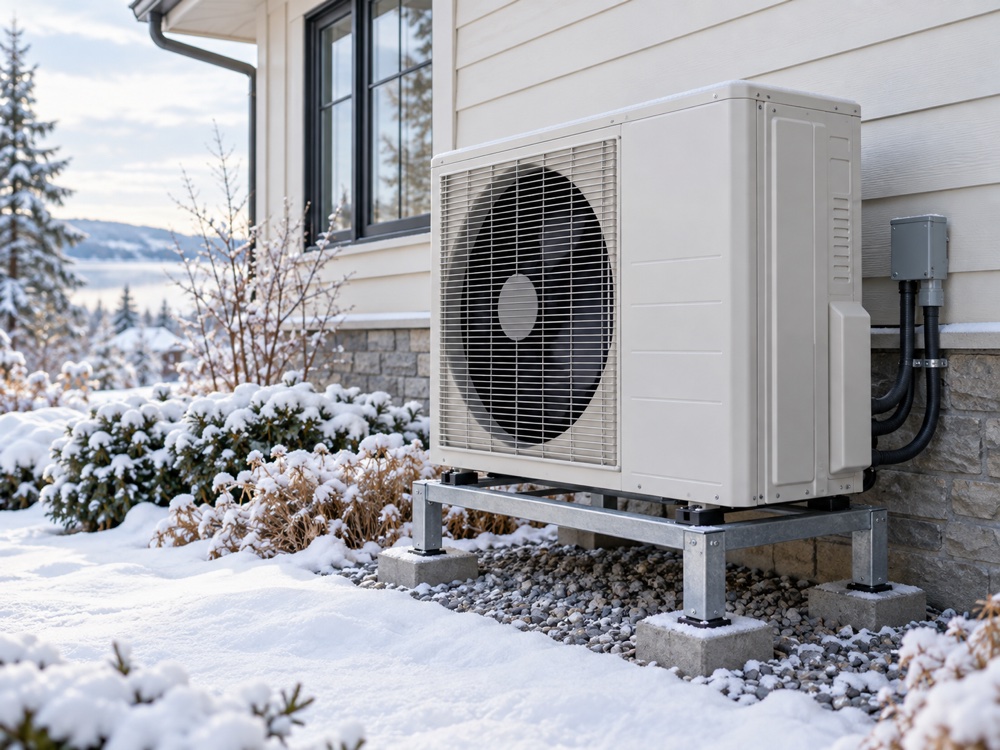
Some cold-climate air-source models can operate at temperatures that low. BC Hydro specifically identifies equipment designed for operation down to −30°C, while noting that supplemental heat may still be needed. That is a qualified yes—not a promise that any heat pump can heat any Canadian home through that weather.
Three questions sit behind the claim: will this model run, how much heat will it deliver, and how much electricity will it use? A minimum operating temperature answers only the first. Ask for documented heating capacity and efficiency at your location’s winter design temperature, together with the home’s calculated heating requirement.
A cold-climate label is useful evidence, but check what it tests. ENERGY STAR’s cold-climate criteria include performance at 5°F (−15°C). The designation alone does not certify the output at −30°C. Your proposed indoor and outdoor equipment combination needs its own supporting data.
Moving heat explains both heating and cooling
A heat pump moves thermal energy. Its refrigerant absorbs heat in one place and releases it in another. Changing the refrigerant’s pressure changes the conditions at which that exchange happens. The electrically driven compressor raises the pressure and temperature so heat can be delivered where it is wanted.
In winter, an air-source system takes heat from outdoor air and transfers it indoors. Air below freezing still contains thermal energy. The refrigerant can be colder than that air and absorb heat from it. In summer, the direction of heat transfer reverses: the equipment carries heat from the home to outdoors, much as an air conditioner does.
This is why heat delivered can exceed the electricity used to run the machine. The additional energy comes from the source. It also explains why outdoor conditions matter: the same equipment is doing a different job on a mild autumn afternoon and a bitter January night.
Sources: [3]
Start with the heat source, then the distribution
The names describe different choices. An air-source heat pump exchanges heat with outdoor air. A cold-climate air-source heat pump, often shortened to ccASHP, is an air-source design intended for colder conditions. Ground-source equipment exchanges heat with the ground or an appropriate water source.
Ducted and ductless describe how comfort reaches the rooms. A central ducted system distributes conditioned air through ducts. A ductless system serves rooms through indoor units connected to an outdoor unit. One outdoor unit may serve one indoor unit or several. Existing ducts can sometimes be reused, but their suitability still needs assessment.
Treat these as two separate conversations when comparing proposals: where does the system exchange heat, and how does each room receive heating and cooling? A familiar product name is less informative than that complete explanation.
What “geothermal” means at home
Residential geothermal heat pumps use the relatively steady temperatures underground. They do not require a hot spring or volcanic source. In winter, the ground is a source of heat; in summer, it receives heat removed from the building. Electricity still operates the heat pump.
The U.S. Department of Energy illustrates several ways to make that exchange, including deep vertical collectors, shallow horizontal collectors and a pond collector. These arrangements help explain why ground-source proposals involve both equipment inside the home and a carefully designed outside heat exchanger.
HouseIQ comparison prompts: ask what site information supports the proposed collector, what land or water access it needs, and which parts of the installation the quotation includes. Request an explanation of the long-term heating and cooling assumptions. An attractive indoor equipment rating is only one piece of the proposed system.
Sources: [6]
Size for the house and the weather
Capacity is a rate of heating or cooling, usually expressed in kilowatts or Btu per hour. Efficiency describes the energy used to deliver it. Neither tells the whole story alone. Compare the selected system’s output at the local design temperature with the home’s calculated load, rather than treating a nominal equipment size as its output in every season.
Variable-capacity equipment can adjust its output within a range. That range matters on ordinary days too: equipment whose minimum output exceeds the current load has to cycle off and on. NEEP’s sizing guidance considers both the cold-day maximum and how well the system can modulate through the season.
Illustrative example: imagine a home needing 9 kW of heat at a specified outdoor temperature. If the proposed heat pump delivers 6 kW at that same condition, 3 kW remains to be supplied. A statement that the unit is still running has not closed that gap. These invented numbers explain the comparison; they are not a sizing recommendation.
Sources: [5]
Read COP, HSPF2 and SEER2 as different measures
COP, the coefficient of performance, compares heat delivered with electricity used at specified operating conditions. An illustrative COP of 3 means three units of heat delivered per unit of electrical energy. It is not a promise of the same performance at every outdoor temperature.
HSPF2 describes seasonal heating efficiency. SEER2 describes seasonal cooling efficiency. Both express useful heating or cooling in Btu per watt-hour under a defined test method. Higher values mean greater efficiency within a comparable rating basis; they do not directly state annual cost or cold-day capacity.
ENERGY STAR’s HSPF2 definition uses a standardized Region IV heating season. A rating season is a comparison framework, not your house’s actual Canadian or Florida weather. Ask which climate basis is being quoted. The “2” also matters: HSPF2 and SEER2 use a different test procedure from older HSPF and SEER ratings. Compare like with like rather than interpreting a lower-looking new number as proof of poorer equipment.
Sources: [4]
When a dual-fuel system deserves consideration
A dual-fuel arrangement pairs a heat pump with fuel-burning equipment such as a furnace. It can be worth comparing when useful existing heating equipment is retained, or when a proposed air-source system needs another source for colder conditions. All-electric systems can instead use electric resistance backup.
The thermal balance point is where the heat pump’s available output matches the home’s heating need. Below it, another source may need to contribute or take over. The economic balance point concerns the relative cost of delivered heat. It depends on electricity and fuel prices and the equipment’s efficiency; it need not be the same temperature.
There is no universally best switchover setting. Request a comparison using your rates, including relevant time-of-use periods, and a written control sequence. It should explain when each heat source operates, what happens below the heat pump’s operating limit, and how the system maintains comfort.
Sources: [1]
Defrost belongs in the cold-weather conversation
Frost can collect on an air-source unit’s outdoor coil during heating. A defrost cycle removes it, temporarily changing operation. Ask how the proposed system maintains indoor comfort during defrost and how any supplemental heat is controlled.
Sources: [1]
In Florida, ask about moisture as well as temperature
A heat pump in cooling mode also removes moisture as water condenses on its cold indoor coil. But reaching the thermostat’s temperature does not prove that enough moisture has been removed. UF/IFAS emphasizes that equipment selection should address both sensible load, which changes air temperature, and latent load, which concerns moisture removal.
Oversizing can make this harder: equipment may satisfy the temperature setting quickly and stop before providing adequate moisture removal. UF/IFAS recommends calculated loads rather than selection based only on floor area. A high seasonal cooling-efficiency number is not, by itself, a humidity-control specification.
For a Florida home, ask how the selected equipment handles humid days with modest cooling demand, not only the hottest afternoon. Discuss whether separate dehumidification is needed and how controls work together. If the property is seasonal, include its occupied and away conditions in that discussion. The winter heating question still matters, but a Canadian cold-weather equipment choice should not simply be copied into a Florida proposal.
Sources: [7]
Make the next conversation concrete
HouseIQ planning exercise: put two proposals beside each other and highlight the evidence behind their recommendations. Record the exact indoor and outdoor model combination, the rooms served, the assumed weather, the calculated loads and the proposed backup arrangement. Leave a blank wherever an answer is missing; that blank becomes a useful question.
Then describe the result you want in everyday terms: a comfortable upstairs bedroom, dependable heat through winter, less summer clamminess, or a clearer understanding of bills. Ask each contractor to connect the technical choices to those priorities. A good comparison should leave you understanding why the design fits your home, not merely recognizing more abbreviations.
Questions worth taking with you
- What are this home’s heating and cooling loads, and which outdoor design conditions were used?
- Can you show capacity and COP for this exact equipment combination at the relevant cold temperatures?
- What share of the design load and seasonal heating will the heat pump serve, and how will backup operate?
- Are the quoted efficiency figures on the same test and climate basis?
- How does the design handle each room, defrost, and humid weather with little cooling demand?
- What assumptions, controls, commissioning checks and maintenance responsibilities will be documented at handover?
Sources
- Natural Resources Canada Heating and cooling with a heat pump
- BC Hydro Heat pumps
- ENERGY STAR / U.S. Environmental Protection Agency How Does a Heat Pump Work?
- ENERGY STAR / U.S. Environmental Protection Agency Heat Pump Equipment Key Product Criteria
- Northeast Energy Efficiency Partnerships Cold Climate Heat Pump Sizing Support Tools — User Guide (February 2024)
- U.S. Department of Energy What are Geothermal Heat Pumps? (DOE/EE-2679, March 2026)
- University of Florida IFAS Extension Energy Efficient Homes: Air Conditioning (FCS3262/FY1026)