

Drainage / Outdoors
Landscaping that gives rain somewhere to go
Follow water from roof to ground before choosing grading, a swale, a rain garden or a retaining wall.
Our articles are a starting point, not a professional assessment of your home.
DraftA work in progress, prepared by the HouseIQ.pro team.Editorial and professional review are not yet complete.
The Big Picture
Good drainage has a beginning, a route and a lawful destination. A handsome garden still needs all three.
Watch the water before changing the yard
During ordinary rain, observe from a sheltered, safe location. Where does roof water land? Does a driveway send flow toward the garage? Where does water remain after the storm? Photographs taken from the same place can help separate a one-off blocked outlet from a recurring site problem. Stay away from floodwater, unstable ground and electrical equipment.
Sketch the roof, downspouts, hard surfaces, low spots and neighbouring elevations. Mark what you know and what is uncertain. The aim is to understand the route, not to diagnose every underground condition from the lawn. Give this sketch to a drainage professional if the cause is unclear.
Positive grading keeps surface water moving away
Positive grading means the ground near the building falls away from it; negative grading directs water back toward it. Soil around an older excavation can settle, and later paving or garden beds can change the original drainage pattern. A low strip beside the wall may become a collection point even on a property that looks broadly level.
Do not simply pile soil against siding, brick drainage openings, vents or window wells. A grading repair must preserve the building's required clearances and a usable route beyond the first few feet. The appropriate slope and details depend on local requirements and site constraints. PNNL describes grading as one part of a coordinated foundation-water strategy, not a stand-alone waterproofing guarantee.
A swale is a shallow route through the landscape
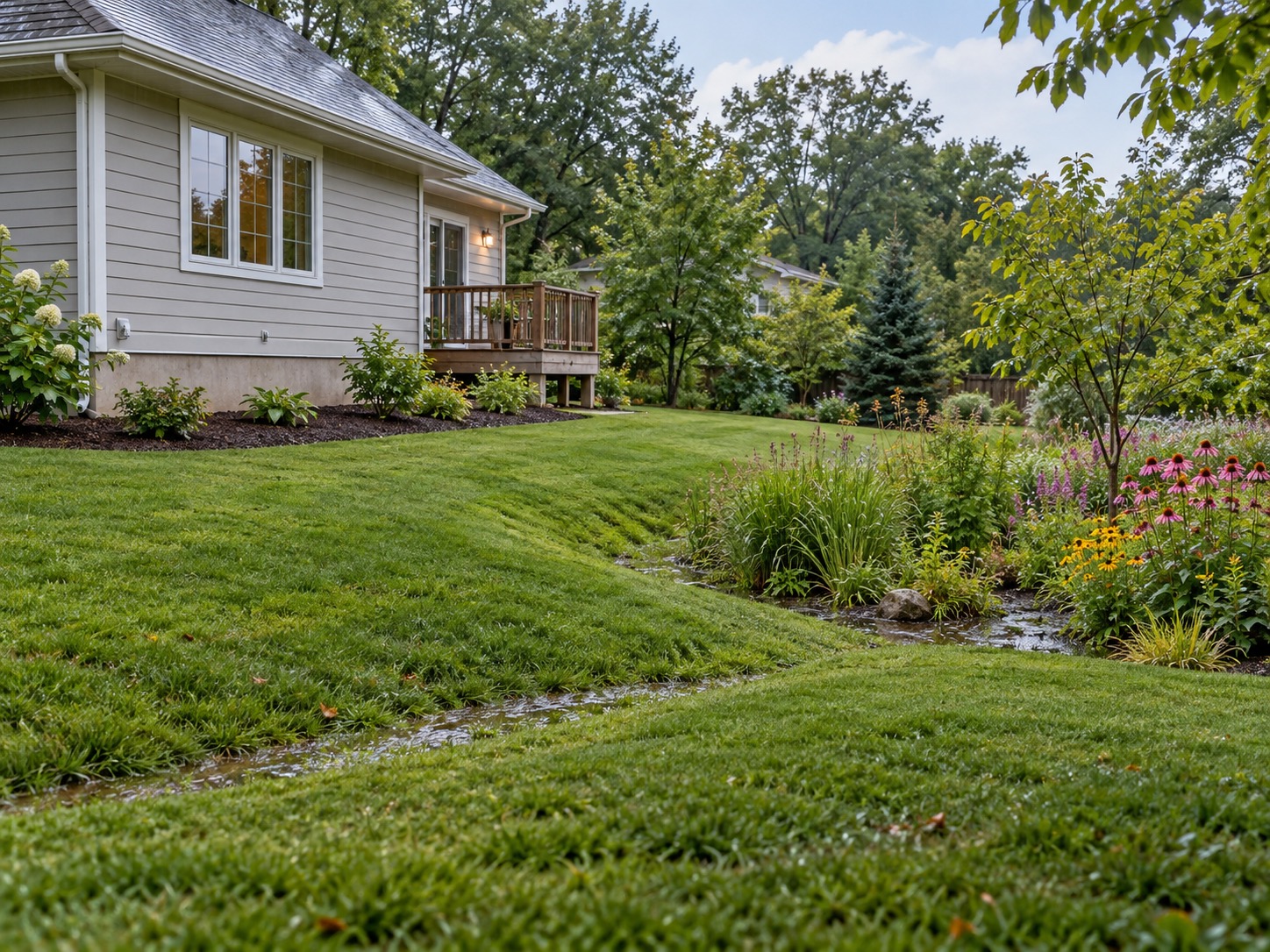
A swale is a broad, shallow channel that guides surface runoff. It may look like an almost ordinary dip in a lawn. Unlike a narrow trench, a gently shaped vegetated swale can fit naturally into a yard, but it still needs suitable grades, erosion resistance and a planned outlet.
Do not fill an existing low corridor merely because it makes mowing awkward: it may be part of the neighbourhood drainage plan. Likewise, a new path, shed pad or raised bed can act like a small dam. Before changing it, establish what area drains through it and where larger storms overflow. The everyday appearance is only one part of how it works.
A rain garden temporarily holds water
A rain garden is a planted depression that receives runoff and allows it to soak into suitable ground. It is not a permanent pond and it is not simply a hole dug into the wettest place you can find. Planting can make stormwater management attractive while providing habitat, but the soil and siting must allow the system to function.
A rain garden close to a foundation, above a septic system or in unsuitable groundwater conditions may create a new problem. University of Connecticut guidance considers contributing drainage area, slope, soil and separation from structures. Use regional design advice and utility locating before digging. Where infiltration is poor, an engineered alternative may be needed.
Size the job for the water arriving
A small flower bed receiving one downspout is a different assignment from a low yard receiving several roofs and a driveway. The contributing area matters, and so does the rate at which water can enter and leave. A system can work in light rain yet overflow during an intense storm.
Ask the designer to explain the normal flow and the overflow route in plain language. Where will water go when the soil is saturated, the ground is frozen or the design storm is exceeded? An overflow must not point toward the basement or create a new hazard on a walkway. A landscaped depression is useful only when its limits are understood.
A retaining wall is a structure
A retaining wall holds back soil, which makes it different from a decorative border. Height is only one consideration. Soil type, water pressure, slope above and below, nearby buildings, vehicles and fences can change the forces on it. A wall that looks modest may still need engineered design.
The drainage and foundation behind the visible face are critical. Do not excavate at the foot of an existing wall, remove supports or stack another course to gain height without assessment. Permits and design thresholds differ by municipality; Washington, DC's permit process is one example, not a rule for every location. A leaning, bulging or newly cracked wall needs professional evaluation and people kept away from the affected area.
Water does not respect the property line
Before regrading, establish boundaries, easements and approved drainage routes. Moving a puddle onto a neighbour's land does not make it a successful repair. Ask the municipality what discharges and alterations are permitted, and whether a site plan or permit is required. Do not connect a yard drain to a sewer without approval.
A survey, drainage plan and utility locate can prevent expensive mistakes. Local locating services may not identify every private line, including irrigation or wiring added by an owner, so ask what the locate covers. On shared or condominium property, responsibility may belong to an association. Get the right decision-maker involved before hiring excavation equipment.
Design something you can maintain
Leaves, sediment and vigorous plants can obstruct inlets and overflow paths. Walk the garden after storms once conditions are safe, and note erosion, standing water that lasts longer than expected and places where flow bypasses the intended route. Establish plants suited to local wet-and-dry cycles rather than assuming any moisture-loving plant will do.
Keep a simple record of the installation and the maintenance it requires. Avoid repeatedly adding soil or mulch until the designed depression disappears. If performance changes, look for the cause before deepening the excavation. A blocked outlet, new upstream paving or settled ground may be the real issue.
Know when landscaping is only part of the answer
Grading helps manage surface runoff; it cannot by itself solve every source of basement water. High groundwater, failed below-ground drainage, cracks, plumbing leaks and sewer backup are different problems. If water keeps returning, describe its timing, location and appearance to a qualified professional rather than buying another generic drainage product.
For a quotation, ask for the diagnosed source, proposed water route, legal outlet, overflow provision and responsibility for permits. Include restoration of planting and paving. Request photos of concealed work before it is covered. Those records make future maintenance and an eventual sale easier, even when the finished garden hides almost all of the engineering.
Questions worth asking
- Where does water go in normal rain and in a larger storm?
- Does the plan preserve building clearances and neighbouring drainage?
- What soil, groundwater and utility checks are needed?
- Who maintains the outlet, plants and overflow route?
Sources
- US DOE / Pacific Northwest National Laboratory Final grade slopes away from foundation
- US EPA Soak up the rain: rain gardens
- University of Connecticut NEMO Rain gardens: siting and sizing
- University of Connecticut NEMO Rain gardens: design and installation
- District of Columbia Department of Buildings Retaining wall permit