

Plumbing
Plumbing vents and AAVs: protecting the water in the trap
Vents balance drainage-system pressure. Air admittance valves can solve some routing problems, but they do not universally replace an outdoor vent.
Our articles are a starting point, not a professional assessment of your home.
DraftA work in progress, prepared by the HouseIQ.pro team.Editorial and professional review are not yet complete.
The Big Picture
A drain needs a working pressure-balancing system as well as a clear path for wastewater.
The small pool of water does a big job
The curved trap beneath a sink retains water between uses. That water seal helps separate the room from gases in the drainage system. The drain carries wastewater away; the venting system helps control pressure so normal discharge does not pull or push the trap seal out of place. These parts work together, even though only the sink is visible during everyday use.
Think about pouring liquid from a closed container: air movement affects how smoothly it leaves. A house drainage system is more complicated than that analogy, because many fixtures may discharge into connected pipes. The useful lesson is that a clear drain and appropriate venting are both necessary, not that every slow sink needs another valve.
An open vent can move air both ways
A conventional vent connects the drainage system to outdoor air in the approved arrangement. It can admit air and provide a route for positive pressure to dissipate. Roof penetrations also need proper weather protection, but that does not make removing them a harmless way to simplify a renovation. The vent is part of the building's drainage design.
The International Code Council's discussion of the 2021 IPC and IRC explains that at least one vent must extend outdoors in those systems to relieve positive pressure. That is a model-code example, not a statement that every jurisdiction uses the same details. Have the plumber identify the adopted requirements and the role of the existing outdoor vent before changing anything.
An AAV admits air when pressure drops
An air admittance valve is a one-way mechanical device. It opens when the drainage system needs incoming air under negative pressure, then closes to limit gas escape into the room. It is not an exhaust outlet for positive pressure. That distinction is the reason an AAV cannot simply replace every open vent in a building.
Where permitted, an AAV can help serve a fixture that is difficult to connect to conventional vent piping, such as some island or retrofit arrangements. It is one design option for a qualified plumber to evaluate. Ask what the valve serves, how it is sized and how positive pressure is handled elsewhere in the system.
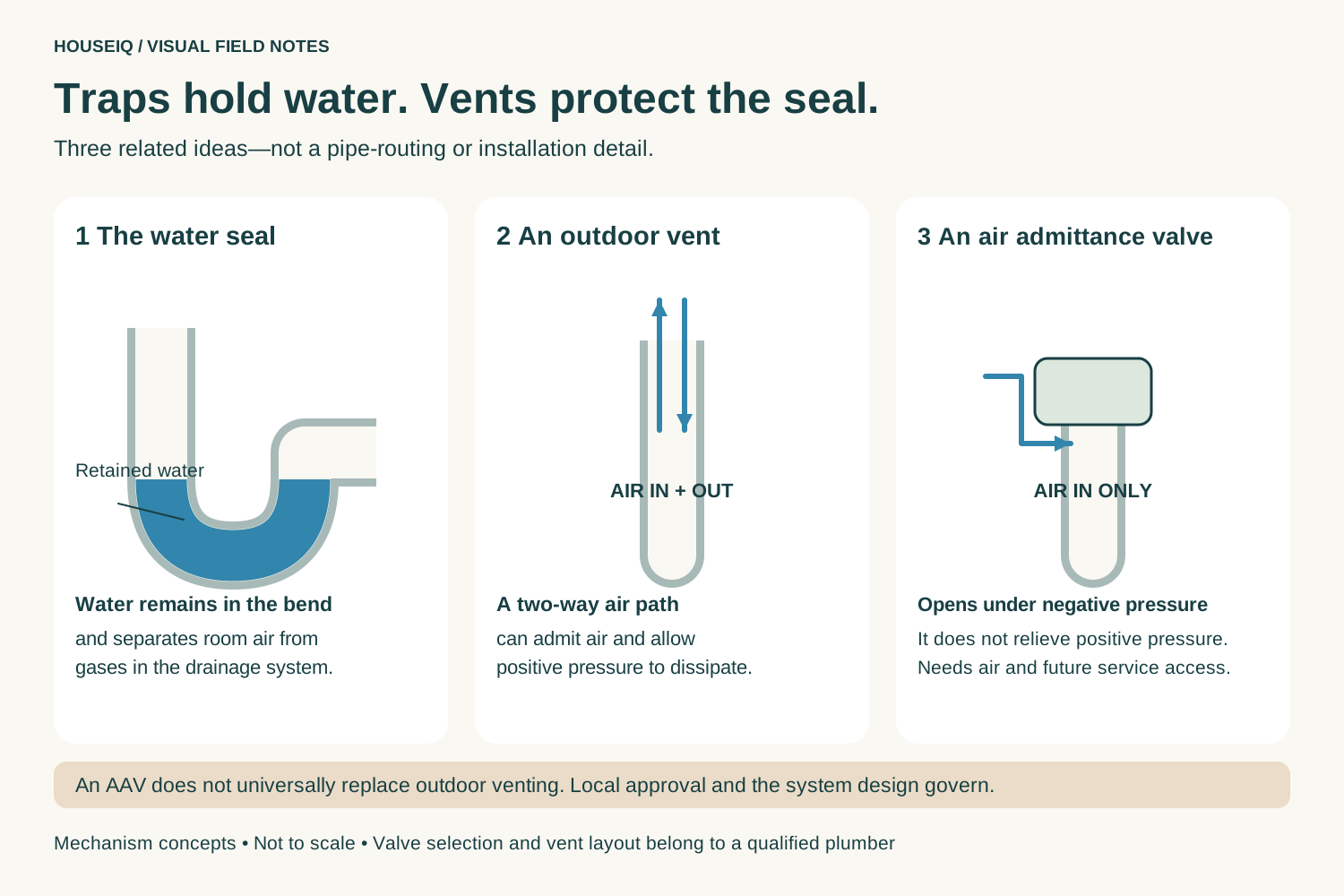
The three symbols explain separate functions, not a connected pipe layout. AAV openings and internals vary. Local approval, the drainage-system design and manufacturer instructions govern valve selection and placement.
A familiar product is not universal approval
Valves have listings, capacity ratings and intended applications. A product suitable for a particular branch arrangement is not automatically suitable for a stack, tank or different set of fixtures. Local acceptance may also be more restrictive than a manufacturer's general description. The word approved on a package needs to be matched to the actual installation and jurisdiction.
Ask the plumber which code provision and product instructions support the proposal, whether a permit or inspection is required, and whether a conventional vent connection remains practical. Do not choose an AAV only because someone calls it a cheater vent. That nickname explains neither its legitimate uses nor its limitations.
The valve needs air and future access
An AAV is a serviceable component. It needs access for inspection and replacement and an arrangement that permits air to reach it. Position and orientation matter; the correct height depends on the application, the adopted code and the product. A valve buried inside a sealed wall is not made accessible merely because it was reachable during construction.
Ask to see the proposed access location before cabinetry or drywall is finished. It should remain usable after shelves, drawers and stored items are in place. Keep product information with the home record and show the location to the next occupant. Do not paint over the air openings or pack the valve tightly with insulation or belongings.
A slow drain is a symptom, not a vent diagnosis
A slow fixture can have a blockage, an unsuitable drain arrangement or another fault. Gurgling and changing trap-water levels can provide clues, but they do not identify the cause on their own. Record which fixtures are involved, whether the problem is new and whether another fixture's use triggers it. A short description of the sequence is valuable to the plumber.
Do not add a valve to compensate for an uninvestigated restriction. Repeated chemical treatments can also complicate safe servicing; tell the plumber if anything has been poured into the drain. If several fixtures are backing up or wastewater is appearing where it should not, stop using the affected plumbing and arrange prompt assessment rather than continuing to test it.
Treat recurring odour as a reason to investigate
A rarely used trap may lose its water through evaporation, but odour can also arise from leaks, defective seals, drainage faults or a valve that is not closing properly. Record the location and circumstances without assuming that every smell is sewer gas. A plumber can check the trap, fixture connections, vent arrangement and valve as a system.
Do not climb onto a roof or dismantle piping to investigate an odour. If the smell may be fuel gas, leave the area and contact the gas utility or emergency service from a safe location; do not try to distinguish it by further testing indoors. Persistent or strong unexplained odours deserve prompt attention even when the sink still drains.
Plan the vent before finalizing the cabinet
Moving a sink changes more than its water-supply hoses. Drain and vent routing, structural constraints, access and cabinet layout need coordination. Ask the plumber to review the plan before the island or vanity is ordered. A small layout adjustment may make a conventional route feasible, while another layout may require an approved alternative.
Have the proposal identify the fixtures served and the work that remains concealed. Confirm responsibility for opening and restoring finishes, testing, inspection and any roof work. Keep the design explanation understandable: which pipes carry waste, which provide venting and where future service happens. A drawing is particularly useful when several trades are working in the same cabinet or wall.
Keep a simple drainage record
At completion, ask the installer to demonstrate normal operation and identify the cleanouts, service access and any AAV. Keep the valve model, instructions and approval records with photographs taken before the work was concealed. Do not assume a new owner will recognize a small plastic fitting hidden behind cleaning supplies.
If symptoms return, note what changed rather than replacing parts at random. A new appliance, blocked drain or altered pipe can change the behaviour of connected fixtures. The aim is a system that drains reliably and retains its trap seals, with accessible components and a clear route for professional maintenance when something stops working as intended.
Questions worth asking
- What protects each trap seal in the proposed arrangement?
- Is this AAV approved for the application under local rules?
- Where does the system relieve positive pressure outdoors?
- Will the valve remain accessible and able to admit air?
Sources
- Oatey What Are Air Admittance Valves and When Do You Need Them?
- International Code Council CodeNotes: Installation of Air Admittance Valves
- Oatey Air Admittance Valves Installation