

Ownership / Heating / Plumbing
Rental water heaters and HVAC: understand the equipment and the agreement
Compare ownership, payments, service coverage and exit terms without assuming one arrangement fits every household.
Our articles are a starting point, not a professional assessment of your home.
DraftA work in progress, prepared by the HouseIQ.pro team.Editorial and professional review are not yet complete.
The Big Picture
A useful comparison separates the equipment you need, the service you receive and the financial and contractual commitment you accept.
Separate the equipment from the agreement
Renting a water heater, furnace, air conditioner or heat pump combines an equipment decision with a continuing service-and-payment relationship. Neither the word rental nor the word purchase establishes which arrangement fits a household. Compare the equipment, the obligations and the total commitment separately. A manageable monthly payment and a suitable machine answer different questions.
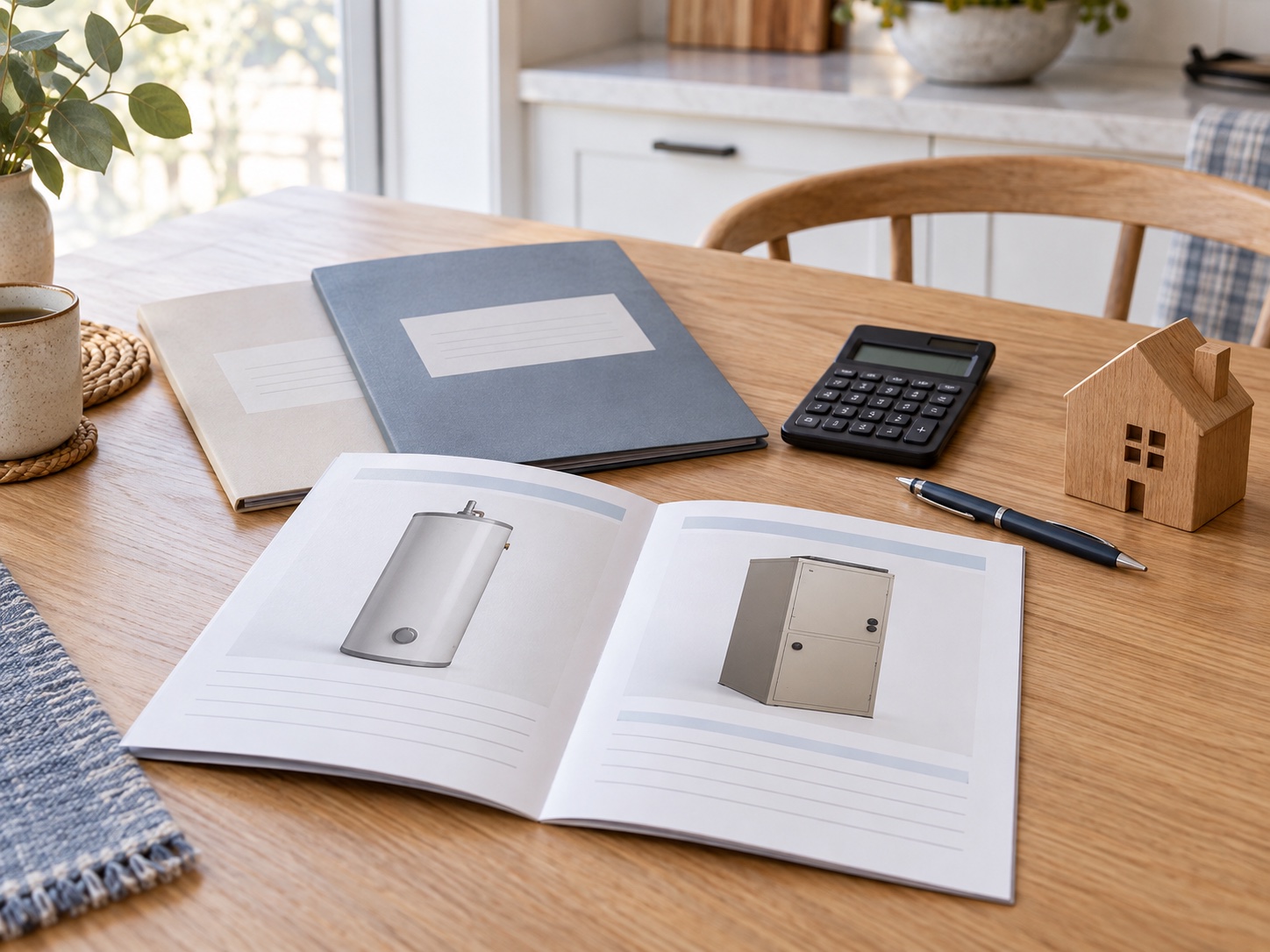
Think of two folders on the table: one describes what will heat the water or house; the other describes who owns it, who maintains it and what happens when circumstances change. Keep both. This article uses Ontario examples reviewed on October 14, 2026. Provider examples illustrate clauses to examine; they are not HouseIQ recommendations or terms that apply to every customer.
Rental, financing and a service plan are different products
Under a rental agreement, the supplier generally retains ownership while you pay for use under its terms. Purchasing outright buys equipment and installation under a sale contract. Financing spreads a purchase cost over time, with borrowing terms that need their own review. A protection or maintenance plan buys specified services; it does not necessarily supply equipment or replace an entire failed system.
For example, Reliance's Ontario/Manitoba protection-plan document distinguishes repair coverage from plans that add maintenance, and excludes complete heating-unit replacement. That is a service-plan example, not a description of every rental. Ask each seller to identify the legal owner, payment recipient, maintenance provider and any lender. One brand on the brochure can still involve several agreements.
Turn the monthly amount into a comparison
Build a comparison over the same period of ownership or occupancy. For each option, add scheduled payments, installation and setup charges, taxes, expected uncovered maintenance, and the applicable cost of leaving at the comparison date. Record assumptions about repairs and future prices instead of presenting them as known expenses. Keep energy use in a separate line so an efficiency improvement is not mistaken for a benefit of the payment arrangement.
Ask whether the payment is fixed, indexed or otherwise adjustable. Reliance's published 84-month minimum-term example includes an annual escalation formula; its non-term example permits changes with advance written notice. These are different mechanisms. Request a payment schedule and a clear explanation of how future increases would be calculated for the agreement actually offered.
Read service coverage as a list of jobs
Translate a service promise into ordinary situations: a failed component, a blocked drain connection, a maintenance visit, a problem caused by water quality, or a required alteration to the house. Mark each as included, excluded or unanswered. Ask about labour, parts, diagnosis, travel, emergency attendance and work on neighbouring equipment. A telephone line open overnight does not itself establish a guaranteed repair time.
Reliance's non-term water-heater example includes standard installation and repair or replacement, but identifies extra-charge circumstances such as certain plumbing or venting upgrades and water-quality work. Read those boundaries alongside the benefit. Keep the service telephone number and contract together, and establish who may authorize repairs before hiring someone independently and expecting reimbursement.
Replacement can change the relationship
Find out what happens when the rented equipment cannot be repaired. Who makes that determination? What equipment is offered? Does replacement continue the present agreement, create a new one, change the payment, or restart a minimum commitment? Ask for the answer before a breakdown makes the choice urgent. Also distinguish a necessary replacement from an optional upgrade to different capacity or technology.
Enercare's Ontario furnace-rental page says an unrepairable, non-operational unit is replaced under a new agreement, subject to terms and exceptions. Its page also describes maintenance every two years. Those details demonstrate why replacement and maintenance language deserve separate questions. They do not establish what an older contract or another supplier must provide. Request the applicable written agreement, not just the current sales page.
Choose the right equipment before choosing a payment
For heating and cooling, request a sizing assessment based on the home's actual characteristics, together with an evaluation of ducts, airflow and installation requirements. ENERGY STAR explains that oversized equipment can cycle too frequently and that poor airflow undermines performance. Paying monthly does not correct those problems. Record the proposed model, capacity, controls and efficiency ratings so competing proposals can be compared on equivalent work.
For water heating, ask the contractor to document household hot-water demand, the proposed technology, available space and the necessary utility connections. Ask what changes to venting, electrical service, drains or other supporting systems are included. If a proposal bundles several appliances, obtain a separate description and price basis for each, rather than judging the bundle only by its combined payment.
Understand the end before the beginning
An agreement's minimum term, the equipment's physical life and the date ownership transfers are three different things. Do not infer that a term ending means the equipment becomes yours or that payments automatically stop. Reliance's published seven-year example describes an indefinite rental with an initial 84-month minimum period and a buyout route. Its non-term document describes a different termination arrangement. Read your own version and commencement date.
Ask for written examples of leaving now, at the minimum-term date and later. Separate buying the equipment from returning it: these may involve different procedures and amounts. Get the current buyout calculation, notice requirements and removal arrangements. Have qualified people handle disconnection and installation; a contract comparison is not a reason to attempt gas, electrical or plumbing work yourself.
Bring the agreement into the home sale
When selling, assemble the contract, recent bill, equipment identification and any available buyout quote before negotiating the sale. Ask your real-estate lawyer how rented equipment should be identified in the purchase agreement and who will satisfy any remaining obligations. When buying, request the actual documents rather than accepting a monthly amount as the complete description. Include the commitment in your household budget.
Transfer is something to verify, not an assumption that the equipment simply stays with the house. Provider conditions can include disclosure, notice, purchaser acceptance and payment of outstanding amounts. Obtain written confirmation of the intended outcome and the effective account-transfer or closure date. This also makes a useful handover record if the first bill after closing does not match the arrangement.
Check Ontario protections and the current rules
Ontario's consumer guidance, reviewed October 14, 2026, restricts unsolicited home sales of water heaters, furnaces and air conditioners, with specified exceptions. It describes a ten-day cancellation period for covered in-home agreements after receiving the written contract. Coverage depends on the transaction; this is not a universal cancellation rule for every agreement or province. Contact Consumer Protection Ontario promptly about the specific circumstances and required notice.
The same guidance flags Ontario's prohibition on registering Notices of Security Interest for consumer goods. Do not rely on older rental-contract registration language as a statement of current law. Equally, a title-registration issue does not settle every question about an underlying contract or balance. Ask an independent lawyer about title, disputed obligations or a proposed settlement; use your own province's regulator elsewhere.
Make the decision reviewable
Before signing, put the competing options on one page: equipment and installation scope, ownership, scheduled payments and increases, service coverage, replacement process, exit terms and sale arrangements. Add the cash-purchase and financed-purchase alternatives where available. Note how much responsibility you want to retain for arranging maintenance and unexpected repairs, and how long you expect to keep the home. There need not be one winner for every household.
Resolve blanks in writing and save the final version, including any promised concession. Record when you received the agreement and keep notices, service records and account changes with it. If replacing existing rented equipment, confirm how that earlier agreement ends so a new installation does not leave an overlooked obligation. A clear comparison makes the eventual choice easier to explain and manage.
Questions worth asking
- Who owns the equipment, and is this rental, financing or a separate service plan?
- How can payments change, and what would the total commitment be over my expected time in the home?
- Which service visits, components and supporting-system changes are excluded?
- Does replacement start a new agreement or change the payment or minimum term?
- What are the written buyout, return and home-sale arrangements for this exact contract?
Sources
- Government of Ontario / Consumer Protection Ontario Door-to-door sales and home service contracts
- Reliance Home Comfort Water Heater Terms and Conditions — Ontario non-term rental agreement
- Reliance Home Comfort Water Heater Terms and Conditions — Ontario 84-month minimum rental term
- Reliance Home Comfort Comfort Protection Plan Terms and Conditions — Ontario and Manitoba
- Enercare Furnace Rental — Ontario
- U.S. Environmental Protection Agency / ENERGY STAR HVAC Quality Installation