

Plumbing and maintenance
Water-heater anodes and flushing: maintenance that fits the tank
Learn what an anode protects, what flushing removes, and why the right schedule depends on your water and equipment.
Our articles are a starting point, not a professional assessment of your home.
DraftA work in progress, prepared by the HouseIQ.pro team.Editorial and professional review are not yet complete.
The Big Picture
Corrosion protection and sediment removal are different jobs. Plan both around the tank you own rather than a promise to double its life.
Find out what kind of tank you have
A storage water heater is more than the visible outer jacket. Inside are the water-containing vessel, heating components and protective features specific to the design. Many steel tanks have a lining and an anode system, but not every water heater uses the same materials or service arrangement. A tankless heater does not have the same stored-water sediment problem.
Locate the model and serial number from an accessible label, then obtain the matching manual. Record its installation date if known and whether it is owned or rented. For rented equipment, ask the provider who performs maintenance and what authorization is needed. This small identification step prevents buying a part or scheduling work intended for another model.
The anode protects vulnerable steel
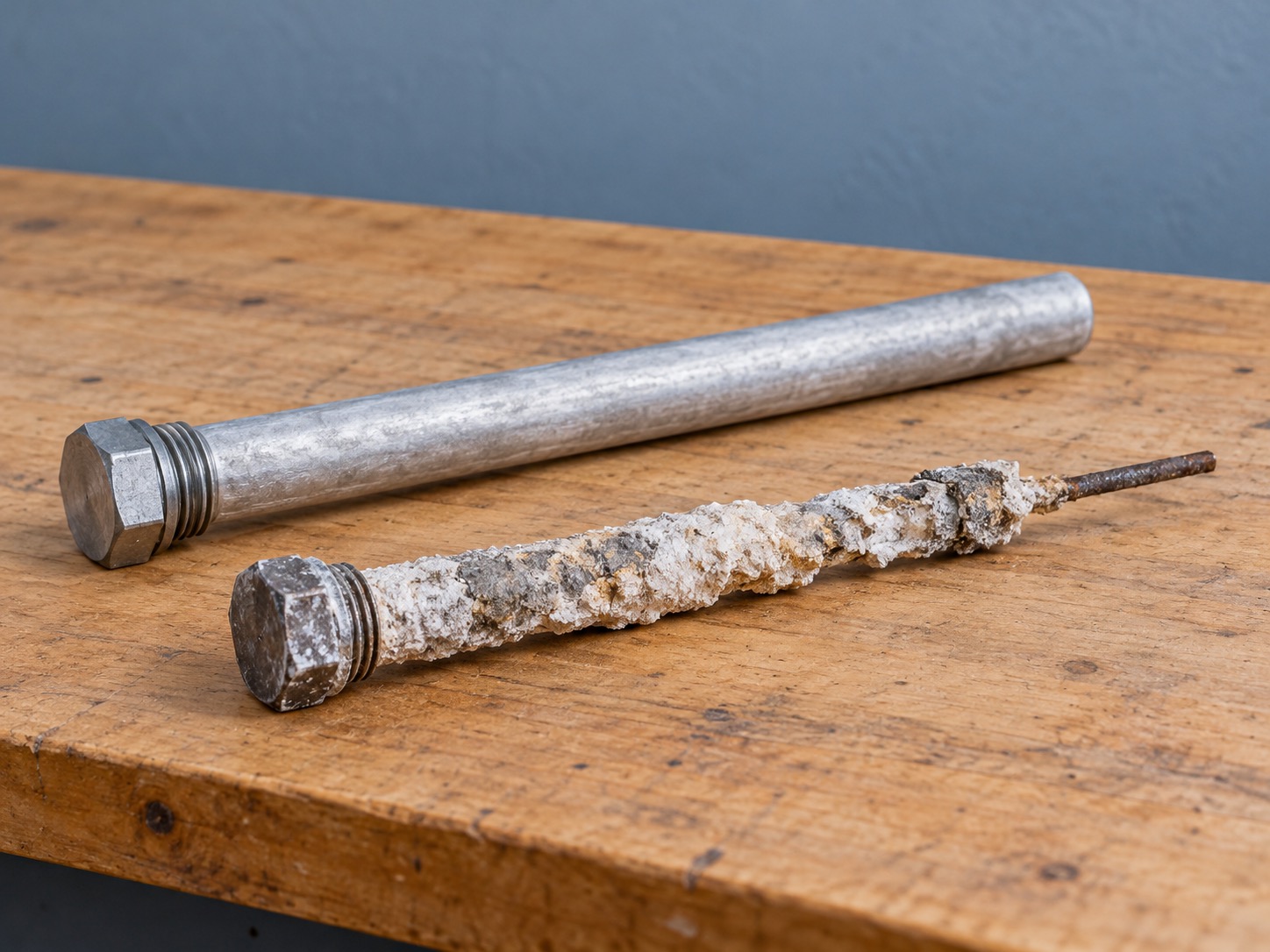
The lining inside a steel tank is not a reason to forget corrosion. A sacrificial anode is an additional form of protection: its metal is selected to corrode preferentially in the tank's electrochemical environment, helping protect exposed steel. The anode gradually becomes consumed while doing that job. Think of it as a replaceable protective component rather than a permanent structural part.
It does not repair a leaking vessel or reverse damage already present. Its condition also cannot be judged from the tank's shiny exterior. Ask the service provider whether this model has a replaceable anode, how its condition is assessed, and what findings would trigger replacement. Keep the inspection finding rather than only a receipt saying service completed.
Magnesium, aluminum and powered designs differ
Sacrificial rods commonly use magnesium or aluminum-based materials. Choosing between them involves the manufacturer's approval and the local water chemistry; it is not simply a ranking from cheap to premium. A compatible replacement must suit the tank's construction and its intended corrosion protection.
A powered anode uses an electrical supply and control system to provide protective current, often with a titanium electrode. It is a different approach from consuming a sacrificial rod. The manufacturer's compatibility, installation and monitoring instructions still matter. Ask how loss of power or a fault is indicated, whether the tank manufacturer accepts the change, and what warranty conditions apply. Do not treat a powered product as a cure for every water-quality problem.
Your water helps set the inspection schedule
Two identical heaters can have different maintenance needs because their water and use differ. Water treatment, mineral content, temperature and consumption patterns can affect conditions inside the tank. A. O. Smith specifically discusses faster anode consumption in some softened-water situations. That makes the presence of a softener useful information for the service technician.
Bring water-test or treatment records if you have them. Tell the technician about changes such as a new softener or a switch in water source. Ask for an initial inspection plan and whether the next interval should be adjusted after seeing actual anode wear. A calendar reminder is useful, but evidence from your own tank is more informative than assuming every household needs the same replacement cycle.
Flushing addresses deposits, not corrosion protection
Minerals and other material can accumulate inside a storage tank. Flushing is intended to remove loose deposits through the appropriate service process. Sediment can interfere with performance and contribute to noise or component problems, but noise alone does not identify the cause. A technician should assess new symptoms rather than assuming a flush will solve them.
An anode replacement does not remove accumulated deposits, and flushing does not renew a depleted anode. These are separate entries on a maintenance plan. Ask what the proposed service includes, what was observed, and whether the result suggests another problem. A completely clear drain sample is also not a guarantee that all internal surfaces are clean or undamaged.
Use the manual, then refine the plan
Annual flushing is frequently recommended, including in manufacturer consumer guidance, but it should not be presented as a universal prescription for every heater and water supply. Read the maintenance requirements for your exact equipment and discuss water hardness, usage and prior findings with the service provider. Some situations need closer attention; others call for a different procedure.
Create a record with the date, work performed, observations and next recommended check. Include the reason for any changed interval. For a newly purchased home with unknown maintenance history, ask for an assessment before making assumptions about the tank's condition. A service plan should be understandable enough that a new contractor can pick it up without guessing why earlier decisions were made.
Hot water and stored energy need controlled service
Draining and servicing a heater involves hot water, pressure and a source of heat or electricity. The process must safely control all of them and restore the equipment correctly. An electric element can be damaged if energized without the required water coverage. Gas equipment also has specific shutdown and restart requirements. This article is not a step-by-step service procedure.
Use qualified help when access is difficult, the history is unknown, a drain is blocked, or you cannot confidently follow the manufacturer's requirements. Do not force a seized anode fitting or blocked valve. Ask where discharged water will go and how nearby finishes will be protected. Safe access and a suitable discharge route are part of the job, not afterthoughts.
Separate maintenance from a developing failure
A puddle, changing hot-water supply, unusual sound or odour deserves diagnosis. Water near the heater may come from a connection or another component rather than the vessel itself, so document what you can see without touching hot parts or opening electrical covers. A leaking tank requires a different decision from an otherwise sound tank with a worn anode.
Odour can involve water chemistry and other causes. Do not permanently remove the anode as a casual solution, and do not assume an advertised odour-control product addresses every cause. Describe whether the issue affects hot water, cold water or both, and when it began. Those observations help a professional choose the appropriate investigation rather than replacing parts blindly.
Maintenance improves the odds, not the guarantee
There is no defensible promise that one rod change or an annual flush doubles every heater's life. Manufacturing, water conditions, installation, service history and unrelated component failures all influence replacement timing. Good maintenance can preserve intended protection and reveal developing problems; it cannot turn an aging vessel into a new one.
Compare the proposed repair with the tank's condition, warranty, access and the consequences of a leak. Ask whether nearby drainage or leak detection deserves attention as part of a broader protection plan. Keep funds available for eventual replacement even when maintenance findings are reassuring. The useful outcome is fewer surprises and an informed decision, not a lifespan number that no one can substantiate.
Questions worth asking
- Does this model use a serviceable sacrificial or powered anode?
- How do our water treatment and inspection findings affect the schedule?
- What is included in the service, and what conditions require repair instead?
- Is the proposed replacement anode approved for this tank?
Sources
- A. O. Smith Water heater maintenance
- A. O. Smith How to drain and flush a water heater
- A. O. Smith Technical Bulletin 43: Cathodic protection
- A. O. Smith Technical Bulletin 44: Water softeners
- Corro-Protec Powered anode rod