

Comfort IQ / Energy IQ / Build IQ
Whole-house fans: when night air can help
Learn how whole-house fans cool occupied rooms, why humidity can outweigh a cooler night, and what makes a savings comparison credible.
Our articles are a starting point, not a professional assessment of your home.
DraftA work in progress, prepared by the HouseIQ.pro team.Editorial and professional review are not yet complete.
The air passes through the living space
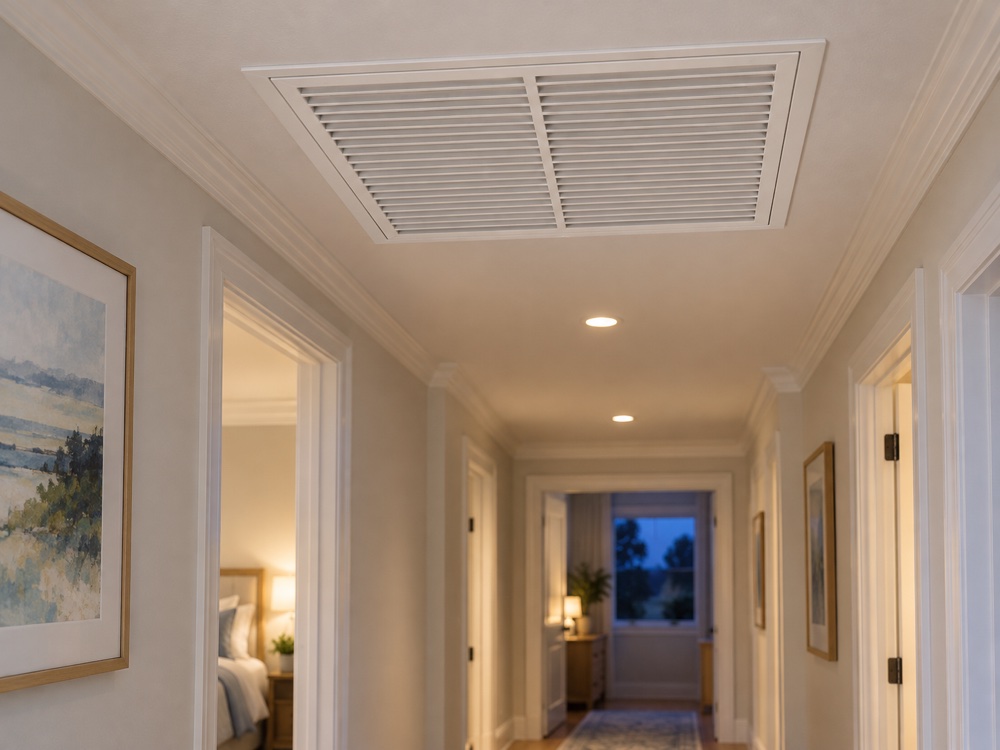
A whole-house cooling fan draws outdoor air through planned openings, commonly open windows, moves it through occupied rooms and exhausts the warmer indoor air. A typical installation discharges into a vented attic and then outdoors; some designs discharge directly outdoors. The entire path matters.
When outdoor air is suitable, the exchange can lower room temperature and cool interior materials that would otherwise release stored heat later. Moving air can also improve comfort while the fan runs. The fan does not refrigerate the incoming air or remove its water vapour.
The name is easy to confuse with other equipment. Identify the proposed airflow path before discussing savings. In particular, a cooling fan used on suitable evenings is a different service from ventilation designed to provide outdoor air throughout the year.
| Equipment | Usual purpose |
|---|---|
| Whole-house cooling fan | Exchange indoor air for suitable outdoor air during cooling opportunities. |
| Attic exhaust fan | Move air from the attic; it does not intentionally draw cooling air through rooms. |
| HRV or ERV | Provide planned ventilation with energy recovery; not a replacement for all heating or cooling. |
Count usable evenings, not just hot days
A hot climate is not automatically a good whole-house-fan climate. The opportunity depends on nights or shoulder-season periods becoming cool enough to provide useful relief. If outdoor air remains near the indoor temperature, there is little temperature difference available to cool the building.
Dry climates with a pronounced day-to-night temperature swing often offer more opportunities than humid coastal climates. PNNL specifically notes limitations in the southeastern United States. Texas also contains very different climate conditions; one statewide claim is not a weather analysis.
Canadian homes may have useful summer windows of operation, but the number will vary with local weather and household schedules. Ask for an estimate based on the actual location and the times someone can operate the system, rather than a savings percentage borrowed from another city.
A cooler night is not necessarily a drier night
Relative humidity changes with temperature. An outdoor RH percentage alone does not reveal whether the incoming air contains more moisture than the indoor air. Dew point provides a more useful comparison: at similar pressure, a higher dew point indicates more water vapour.
A fan can therefore bring cooler air into a house while increasing the moisture that must later be removed. In a recently air-conditioned home, humid incoming air can also encounter cool surfaces. A simple temperature-only decision misses these effects.
Compare indoor and outdoor temperature and dew point when discussing suitability with the HVAC professional. This is a way to understand the load, not a universal control setting. The home’s surfaces, equipment and moisture goals still matter; there is no single outdoor RH percentage that makes all fan operation appropriate.
A Florida study illustrates the tradeoff
FSEC published a study in 1992 of one occupied concrete-block house in Cocoa Beach during summer 1991. The house was not air-conditioned during that summer test; researchers compared natural ventilation with later evening use of a whole-house fan. It was an investigation of natural-cooling potential, not a modern fan-versus-air-conditioner trial.
The reported evening interior temperatures were 3–6°F lower with the fan, while nighttime relative humidity rose from 74% to 83%. These are observations in that particular home and study period. They are neither a recommended humidity range nor a prediction for another house.
The useful lesson is that temperature and moisture can move in different directions. A comfort or energy proposal should evaluate both. A fan’s ability to make the thermometer fall does not establish that it delivers the same conditions as air conditioning.
Sources: [3]
Windows and exhaust capacity are part of the system
The fan can move only the air its whole path permits. The design needs enough intended outdoor-air intake and an appropriate discharge route. Where discharge passes through a vented attic, that attic must accommodate the fan flow; a passive attic-ventilation ratio alone does not establish this.
Ask for the required openings and exhaust capacity at the intended fan speeds, using the actual equipment data. Screens, louvers and restrictions affect usable area. The nominal size of a window or roof vent is not necessarily its open or net free area.
The proposal should also explain how airflow reaches the rooms you want cooled. Closed interior doors and a poorly located intake can change the path. These details belong in the professional design and operating instructions, not in an assumption that one open window serves every layout.
Pressure effects need a qualified assessment
A strong exhaust fan lowers indoor pressure relative to its surroundings. If the intended intake is inadequate, replacement air can come from unwanted places such as an attached garage or crawlspace. A fan exhausting into an attic also increases pressure there and can expose weaknesses in the ceiling separation.
Fuel-burning equipment deserves particular attention. Natural-draft appliances and appliances that take combustion air from the room can be vulnerable to pressure-induced spillage or backdrafting. The presence of an open window is not, by itself, a complete combustion-safety assessment.
Before recommending equipment, a qualified professional should consider the actual appliances, fireplaces, other exhaust devices and building connections. Do not experiment with combustion settings, dampers or improvised interlocks to make a fan proposal work. The assessment may conclude that this home needs a different cooling approach.
Outdoor air quality can close the cooling window
Outdoor air is not always suitable air. EPA explains that wildfire smoke enters through open windows and mechanical air exchange. When local smoke guidance calls for keeping windows closed, a whole-house fan drawing large amounts of outdoor air conflicts with that protection strategy.
Include local air-quality information in the operating plan, along with the household’s sensitivity to pollen or other outdoor pollutants. A basic window insect screen should not be treated as smoke filtration. If the home cannot remain comfortably cool with windows closed, the plan needs another cooling option.
Noise and security matter too. A theoretical cooling opportunity has little value if occupants cannot sleep with the selected speed or cannot safely leave the required openings available. Ask to hear comparable equipment where practical and discuss which rooms and windows the design depends on.
“Free cooling” still has a cost
The outdoor air is available without a cooling compressor, but the fan uses electricity and the installation costs money. Savings depend on cooling electricity actually avoided, less fan use and any extra later cooling or moisture removal. A low motor wattage is only one part of that comparison.
HouseIQ invented arithmetic: suppose an assessed evening strategy avoids 4.0 kWh of air-conditioning electricity. Suppose the fan draws 200 watts for four hours: 0.200 kW × 4 h = 0.8 kWh. The initial difference is 3.2 kWh, before any later drying, cooling or other effects.
Those inputs are not measurements or typical savings. The avoided 4.0 kWh must be established independently; it cannot be inferred from the fan rating. If little cooling was needed anyway, or incoming humidity requires substantial drying afterward, the net benefit could be much smaller or disappear.
Compare useful airflow and the closed condition
HVI’s current directory includes Whole House Comfort Ventilators and identifies products tested under its certification procedures. Use the exact model listing and manufacturer’s data when comparing proposals. Rated airflow, electrical input and sound information should refer to comparable operating conditions, rather than mixing one model’s low speed with another’s high speed.
Ask how the selected unit seals and insulates when it is off. A ceiling opening can otherwise add unwanted heat transfer and leakage during winter heating or summer air conditioning. That matters especially for a Canadian home that uses the fan for a limited part of the year.
Request an explanation of the damper or cover, maintenance access and normal seasonal operation. Include those features in the installed price. A cheaper fan body is not necessarily a cheaper completed system that performs well throughout the year.
Choose an operating plan the household can use
In humid climates, repeatedly switching between air conditioning and whole-house-fan operation can add a moisture burden. PNNL advises against simultaneous use and highlights the limits of alternating the two in humid weather. Discuss a seasonal strategy and clear conditions for fan use rather than assuming nightly operation always helps.
A seasonal Florida home needs a separate away plan. UF/IFAS emphasizes keeping outdoor moisture out, maintaining equipment and arranging property checks during an absence. That is different from occupied night cooling through open windows; a whole-house fan is not a general method for keeping an empty home dry.
For owners, the next step is a location-specific assessment with an installed cost and realistic usable hours. Tenants should raise the comfort problem with the owner or manager before proposing permanent equipment or changes to shared attic and ventilation systems.
Questions worth taking with you
- How many local hours offer cooler, sufficiently dry air when we would actually use the fan?
- What intake and exhaust paths are required at each operating speed?
- Has the design been assessed with our fireplaces, fuel-burning appliances and other exhaust equipment?
- Does the savings estimate include fan electricity, later moisture removal and losses while the fan is off?
Sources
- Pacific Northwest National Laboratory / U.S. Department of Energy Whole-House Fans
- U.S. Department of Energy / Oak Ridge National Laboratory / Southface Whole House Fan: Technology Fact Sheet
- Florida Solar Energy Center, University of Central Florida Measured Natural Cooling Enhancement of a Whole House Fan
- National Weather Service / NOAA Dew Point vs. Humidity
- U.S. Environmental Protection Agency Wildfires and Indoor Air Quality
- Home Ventilating Institute HVI-Certified Products Directory
- Pacific Northwest National Laboratory / U.S. Department of Energy Whole-House Ventilation Strategies for New Homes
- University of Florida IFAS Extension Closing Your Seasonal Home
- U.S. Department of Energy / Alliance for Residential Building Innovation Measure Guideline: Ventilation Cooling