

Interiors & finishes / Owning & renting
Drywall repairs: small patches, sound walls and rental permissions
A tidy repair starts by identifying the damage, the wall assembly and who is authorised to change it.
Our articles are a starting point, not a professional assessment of your home.
DraftA work in progress, prepared by the HouseIQ.pro team.Editorial and professional review are not yet complete.
The Big Picture
A nail hole is a surface repair. Wet, moving or extensively damaged wallboard is a reason to find the cause before reaching for filler.
Identify the wall and the damage
Drywall is gypsum board with facing material, commonly paper, fixed to framing. It is not the same as a plaster wall, masonry or a tile backer assembly. Before selecting a repair, distinguish a shallow dent, a small hole, a torn paper face, a broken-through area and a crack that keeps returning. These need different preparation and support.
Think of filler as a finish, not a replacement for missing structure. Spreading a thick mound across an unsupported opening may look promising while wet and crack or slump later. Photograph the damage and note its cause. A door handle strike suggests adding a suitable stop; a recurring crack may require diagnosis before another cosmetic patch.
Check what sanding or cutting would disturb
Old paint, joint compounds and textured finishes can contain hazardous substances. Their appearance is not a reliable test. EPA’s lead guidance specifically addresses older US housing, while dates and regulatory rules differ elsewhere. Before sanding or cutting an older or uncertain finish, establish whether lead or asbestos assessment is needed using an appropriate local professional.
Do not treat a dust mask as permission to disturb suspected hazardous material. Avoid dry sanding or demolition until the situation is understood. Keep children and pets away from the work area, protect belongings and use the dust-control and cleanup methods appropriate to the identified material. A small visible hole can require a larger safety decision than its size suggests.
Small nail holes need a small, careful repair
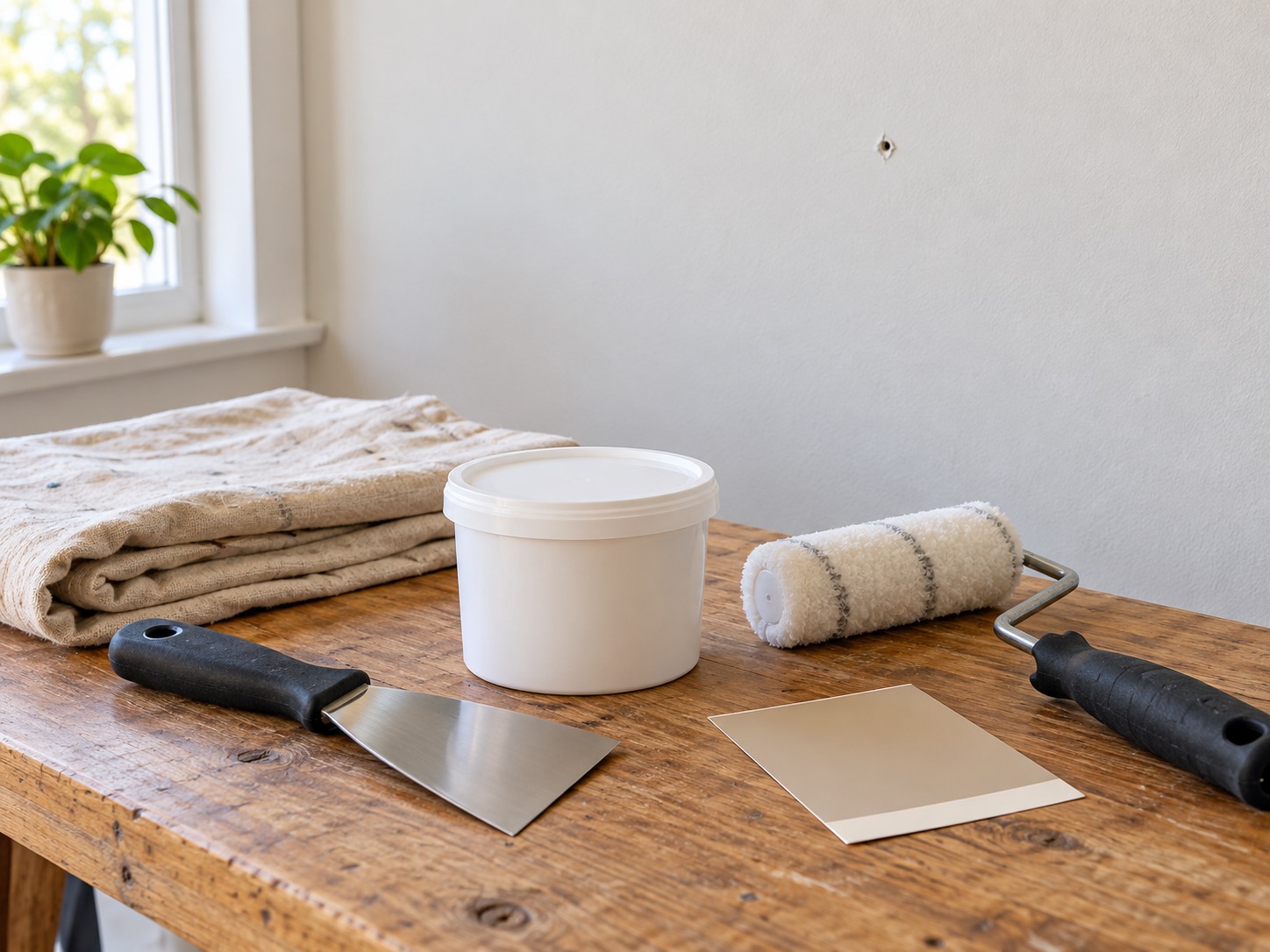
For sound, dry drywall with hazards ruled out and permission in place, use a filler intended for the defect and follow its instructions. Remove only loose material without enlarging the hole unnecessarily, apply a modest amount with a clean knife and remove excess from the surrounding surface. Allow it to dry as directed; deep applications and humid conditions can take longer than expected.
If the product shrinks, a second thin application is often easier to blend than one thick mound. Finish only as much as needed using the specified method, control dust and remove residue before coating. Do not use toothpaste or other improvised fillers. They may look acceptable briefly but are not a durable wall-repair system.
Larger holes need backing and reinforcement
Broken-through board usually needs a supported patch or a repair system rated for that opening. A proper patch restores the board surface, and its joints are treated with compatible tape and compound. The layers are feathered beyond the joint so the transition becomes gradual. Mesh, paper tape and different compounds are not automatically interchangeable; follow the selected system.
Before cutting, identify likely wiring, pipes and other concealed services. Do not blindly plunge a saw into the wall. Where the assembly is unknown, near services, on a ceiling or extensive, use a competent repairer. A quick patch kit is not permission to ignore how the wall was built or what lies behind it.
Some walls do more than divide rooms
Walls between units, around certain service spaces or separating a house from an attached garage may form part of a fire-resistance assembly. Sound isolation and moisture-control layers can also be affected by a repair. Matching the visible paint does not establish that those functions have been restored.
USG offers specific repair components with defined assembly applications, illustrating why the details matter. Board thickness, layers, fasteners and joint treatment must suit the actual assembly; do not generalise one manufacturer’s approved detail to every wall. In apartments and other managed buildings, ask management to identify the wall and approve the repair method before opening it. A professional should document any required rated repair.
Repair the water problem before hiding the stain
Soft, swollen or crumbling board, recurring stains, musty odours and visible mould need investigation. Painting or filling over them can hide evidence while the cause continues. Determine whether water comes from plumbing, rain, condensation or another source and have the source corrected. A dry-looking face does not prove the cavity behind it is dry.
EPA emphasises prompt drying and moisture control; water-damaged porous materials may need removal rather than surface cleaning. Larger contamination, sewage exposure, concealed mould or health concerns call for experienced help. Avoid opening a suspect cavity just to see what is inside. For a tenant, document the condition and notify the responsible party promptly instead of accepting repeated repainting as the solution.
The finish can show even when the hole has gone
Fresh filler and existing paint may absorb coating differently. A suitable primer helps even out the repaired area before the finish coat. Match the product, sheen and colour where possible, but expect that aged paint, application texture and lighting can make a spot repair visible. Sometimes repainting a complete wall gives a more consistent result than endlessly touching up one square.
Use a small test area and inspect after drying in both daylight and the room’s normal lighting. Keep paint details in the home record, including sheen and colour code. For rented homes, agree on the acceptable finish before repainting; an apparently similar colour is not necessarily an agreed restoration. Do not assume a full repaint is always required either.
Agree on changes before making them
Rental rules are local. In Ontario, the Landlord and Tenant Board distinguishes maintenance obligations, ordinary cleanliness and responsibility for undue damage; other jurisdictions use different tests and procedures. A lease clause or a landlord’s preference also needs to be read alongside applicable law. This article cannot determine who pays for a particular mark or whether a deposit deduction is valid.
Before hanging heavy art, drilling, painting or making a large patch, ask for written permission and agreed restoration expectations where required. Save move-in photographs and report existing damage. Adhesive hooks are not guaranteed to be damage-free: surface condition, load, humidity and removal technique matter. Follow the product’s limits and never rely on a light-duty adhesive for a heavy object over a bed or seating.
Judge the repair after it has dried
Check that the repair is firm, the edges blend and the original cause has been addressed. A patch that cracks again, becomes soft or develops another stain is information, not simply a reason to apply more compound. Record when it happened and arrange assessment of moisture or movement as appropriate.
For a move-out or contractor handover, use dated photographs and a brief written record of the agreed work. Keep product information if a fire-rated detail or specialised system was involved. Good wall care is often quiet and modest: prevent impacts, hang loads with suitable support, clean finishes gently and respond early to water. The aim is a sound wall that stays sound.
Questions worth asking
- Is the damage cosmetic, wet or recurring?
- Could the finish contain lead or asbestos?
- What permission and repair detail does this wall need?
Sources
- USG Sheetrock Brand Drywall Repair Clips
- USG Sheetrock Brand Dust Control Patch and Repair Compound
- US EPA Lead-Safe Renovations for DIYers
- US EPA Protect Your Family from Exposures to Asbestos
- US EPA A Brief Guide to Mold, Moisture and Your Home
- Ontario Landlord and Tenant Board Maintenance and Repairs