

Plumbing
Private wells: pumps, pressure tanks and water you can trust
Separate water pressure from available supply, understand the tank’s role, and choose testing and treatment for the actual water.
Our articles are a starting point, not a professional assessment of your home.
DraftA work in progress, prepared by the HouseIQ.pro team.Editorial and professional review are not yet complete.
The Big Picture
A reliable well system needs a sound source, suitable pumping and pressure controls, and evidence about water quality—not just clear water at the tap.
A private well makes you the water-system owner
A private well supplies groundwater through a system that the owner must understand and maintain. There may be no utility routinely checking the water reaching your tap. Clear, pleasant-tasting water is encouraging, but it is not a laboratory result and cannot establish that the water is safe.
Begin with the well record: location, construction, depth, pump information, available yield information and previous test results. Distinguish the well from the pump and from household treatment. Each has a separate job. A new filter cannot repair a damaged casing, and a larger pump cannot create groundwater that is unavailable. This guide covers the supply and pressure system; the related treatment article explores softeners, filtration and reverse osmosis in more detail.
A submersible pump pushes water upward
A submersible pump sits within the well below the water level and pushes water toward the house. Other arrangements, including jet pumps, exist. The right equipment depends on the well and the required delivery conditions, not simply on choosing the most powerful motor.
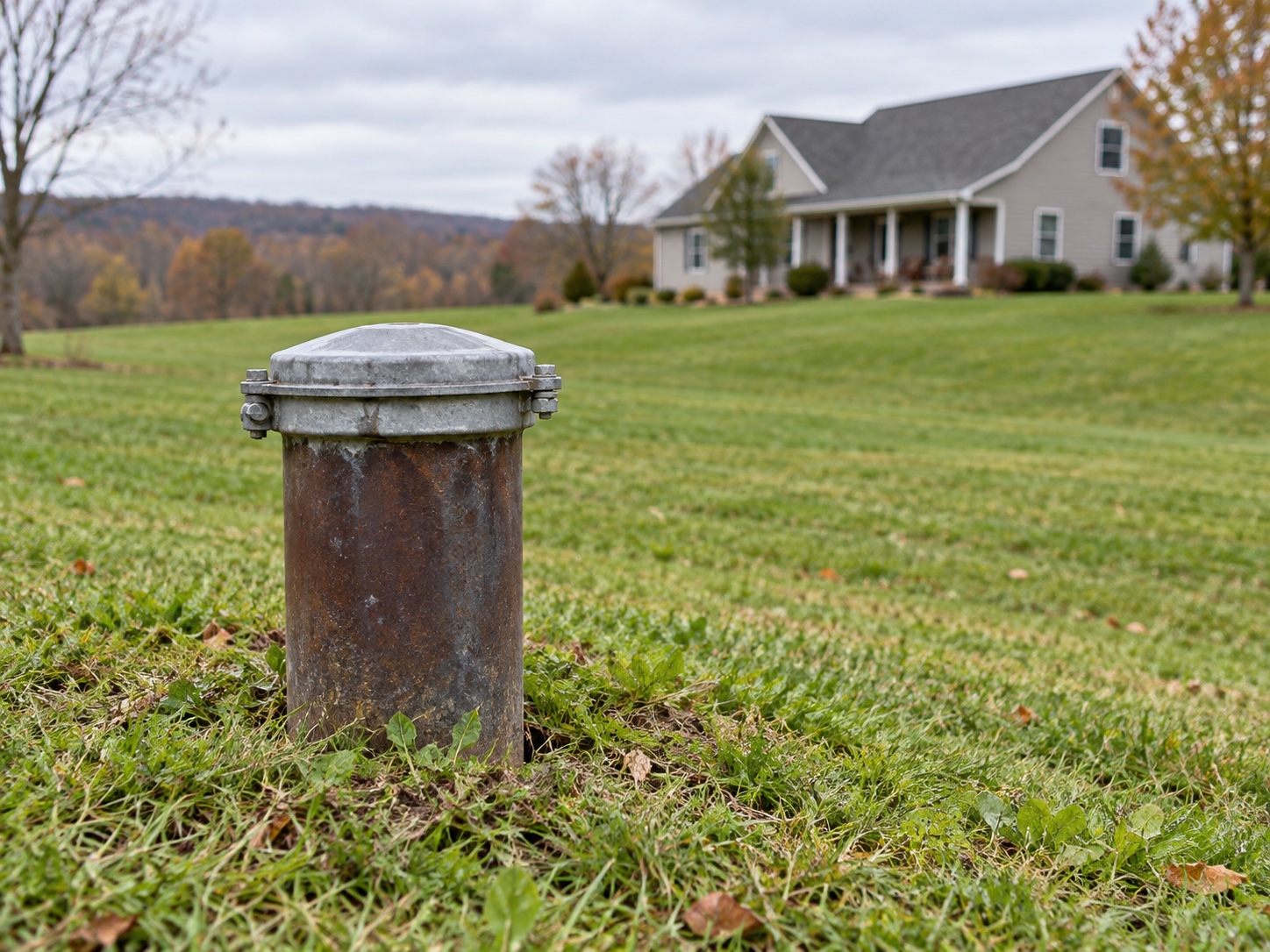
The casing, cap and sanitary seals help keep unwanted material out of the supply. In cold climates, buried connections and protected piping also need to accommodate freezing conditions. Observe accessible exterior conditions without removing the well cap or opening electrical equipment. A damaged cap, disturbed ground or new surface-water ponding should prompt a professional check. Ask the well contractor to explain which parts are visible, which are below ground and where the construction record documents them. That orientation makes later service discussions much clearer.
The pressure tank is a buffer
In many conventional systems, a pressure tank uses compressed air, often separated from water by a bladder or diaphragm, to hold a usable reserve. As water is drawn, pressure falls; a pressure switch calls for the pump, and the pump replenishes the supply until the stopping pressure is reached. Variable-speed and other control arrangements work differently.
Think of the tank as a small buffer that reduces frequent pump starts, not as the source of the well's water. Its nominal tank volume is not the same as the usable drawdown between operating pressures. Ask the contractor to document the actual controls and intended performance. Do not adjust the pressure switch or air charge by trial and error; settings, component ratings and pump capability must work together.
Pressure, flow and well yield are different
Pressure is the driving force at a point in the system. Flow is how much water arrives over time. Well yield concerns the water the source can sustainably supply under the relevant conditions. A satisfactory pressure reading with every tap closed does not prove that the system can support several simultaneous uses.
Record when a problem appears. Does one shower weaken when laundry starts, or does the entire house lose water after prolonged use? Does performance recover after a rest? These observations help a professional distinguish restrictions, control problems and supply limitations. A larger pressure tank can buffer some short demand, but it cannot permanently overcome inadequate source or pump delivery. Ask for a diagnosis before authorizing replacement of whichever component is easiest to see.
Test for health risks on a local schedule
EPA recommends annual testing for total coliform bacteria, nitrates, total dissolved solids and pH, with additional testing based on local conditions. Your public-health authority may specify a different or more frequent schedule and additional parameters. Obtain a sampling plan appropriate to the area, well and household.
Testing is especially important after flooding, repairs, a change in appearance or taste, or another event that could affect the source. Use the laboratory's sampling instructions and an accredited or otherwise appropriately certified drinking-water laboratory. A badly collected sample can produce a misleading result. Keep the full report, including the sample location and date. Ask the health authority how to interpret an adverse result and what water source to use while the problem is investigated; do not rely on taste as the deciding test.
Sediment and iron filters are not automatic requirements
Treatment should match measured water quality and the intended purpose. A sediment filter captures particles within its specified capability; it does not automatically remove dissolved chemicals or disinfect the water. Iron treatment depends on the iron's form and concentration, associated water chemistry and the chosen process. A generic cartridge is not a universal iron solution.
Likewise, a softener targets hardness and is not a complete drinking-water safety system. Ask what contaminant the proposed equipment addresses, what test establishes the need, and how performance will be verified. Check the exact product's independently certified reduction claims where applicable. If tests do not identify a problem requiring treatment, adding equipment can create needless maintenance and pressure loss. Choose a treatment train with a clear purpose rather than a row of impressive-looking tanks.
Maintenance includes both supply and treatment
A professional well-system check can examine output, controls, tank condition and sanitary integrity, as well as water quality. Between visits, watch for a new change in pump cycling, visible leakage, corrosion, unusual noise or reduced delivery. Frequent starts deserve attention rather than becoming background sound.
Maintain installed treatment according to its instructions. Filters, disinfecting equipment and media systems have different service tasks and replacement schedules. A neglected device can impair performance even when the well itself is unchanged. Keep a service list with dates and the correct consumables. Ask the contractor to explain what homeowners can safely check externally and what requires service. Do not open pressure-switch covers or electrical control boxes as part of a casual inspection; live electrical parts may be present.
Protect the wellhead and respond to flooding
Keep potential contaminants away from the well and maintain drainage that carries surface water away. Do not bury the casing to improve the lawn's appearance, build over access, or use the area for fuel, chemical or waste storage. Required separation distances and construction details are local design matters, not universal numbers copied from a diagram.
After flooding or suspected contamination, use the public-health authority's guidance for safe water and professional inspection. Stay away from flooded electrical equipment. A well that begins producing clear water again has not necessarily passed a safety test. Cleaning, disinfection and follow-up sampling may be needed under professional direction. Record the event and the return-to-service advice. This creates a useful history if a later sample or performance change raises another question.
Keep an operating plan for outages and ownership changes
A private water supply often depends on electricity. During an outage, the pressure tank may provide only a limited amount of water; it is not a substitute for an emergency water plan. If backup power is proposed, have the electrical and well professionals coordinate actual starting and running demands and the approved connection arrangement.
Keep the well location, construction record, pump and tank models, test reports, treatment manuals and contractor contact in one accessible home record. Include any seasonal limitations or known changes in yield. Before buying a property, ask what testing and performance evaluation were completed and under what conditions. A useful handover demonstrates how the system normally behaves and where to seek help, rather than simply assuring the next owner that the water has always been fine.
Questions worth asking
- Where are the well construction record, pump details and previous water tests?
- What explains the pressure or flow symptom before equipment is replaced?
- Which tests and frequency does the local health authority recommend?
- What measured problem does each proposed treatment device address, and how is performance verified?
Sources
- US EPA Learn About Private Water Wells
- US EPA Protect Your Home’s Water
- National Ground Water Association / Wellowner.org Water Pressure
- National Ground Water Association / Wellowner.org Annual Inspection
- US Centers for Disease Control and Prevention About Home Water Treatment Systems