


Plumbing
Septic care: protect the tank, the drainfield and the treatment process
Understand how wastewater moves through the system, why pumping intervals vary, and which warning signs need attention.
Our articles are a starting point, not a professional assessment of your home.
DraftA work in progress, prepared by the HouseIQ.pro team.Editorial and professional review are not yet complete.
The Big Picture
The tank and soil treatment area work together. Routine records and sensible loading protect both; pumping alone cannot fix every failure.
Your yard contains part of the treatment system
A conventional septic system is a small wastewater treatment arrangement serving the property. The tank separates and partially processes wastewater; the drainfield and suitable soil provide further treatment. The tank alone does not turn everything entering it into clean water, and the drainfield is not simply a place to hide liquid.
Imagine a settling area followed by a carefully sized treatment area. Both must work. This helps explain why a larger tank does not automatically solve an overloaded or damaged field. Start by obtaining the as-built plan, permit and service records. Know where the tank, treatment components, field and any replacement area are located before landscaping or building. The system may be shared or more complex than the conventional arrangement described here.
Follow the water through the tank
Inside a typical tank, heavier solids settle into sludge and floating material forms scum. Liquid between those layers moves onward through the outlet arrangement. Microorganisms break down some organic material, but solids still accumulate. The tank normally contains liquid during operation; “full of water” is not by itself evidence that it needs pumping.
Baffles, outlet filters and other components help keep material from reaching downstream treatment. Their condition belongs in a professional inspection. Ask the service provider to explain which compartments and components your system has and what was checked. A useful report distinguishes the liquid level, accumulated solids and component defects. Do not open or enter a tank yourself. Covers, hazardous gases and confined spaces make this work unsuitable for a homeowner inspection.
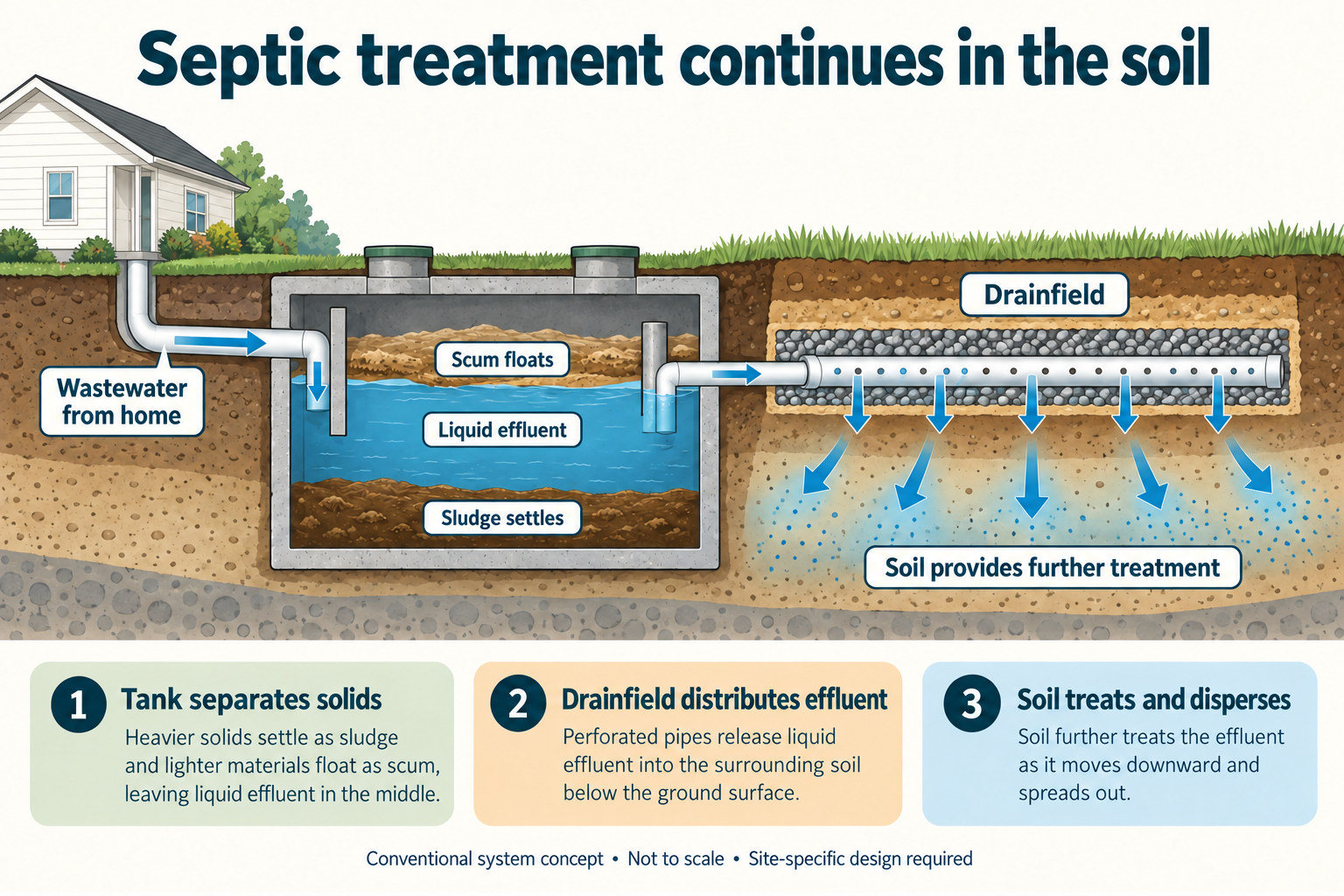
Conventional gravity-system concept, not to scale. Compartments, outlet filters and distribution arrangements vary. No tank-entry or installation procedure is shown.
The drainfield needs suitable soil and room
Effluent is distributed into a designed area where soil and biological processes continue treatment. Performance depends on the site, system type and loading. A lawn above it may look ordinary, but it is part of working infrastructure. Compacting that soil or damaging the pipes can undermine the treatment process.
Keep vehicles, heavy equipment and unapproved structures off the field and reserved replacement area. Discuss planting with the system designer; roots, excavation and irrigation can create problems. Do not send roof runoff or sump discharge toward it. Before adding a patio, pool, shed or driveway, check the system drawing and local requirements. The cost of protecting an invisible working area can be much smaller than the cost of discovering it beneath a finished project.
Pumping follows accumulation and use
There is no single pumping interval for every house. EPA gives three to five years as a common range for household tanks, while emphasizing tank size, occupancy, water use and accumulated solids. Some systems require more frequent service, and pumps or advanced treatment components can have their own inspection schedules.
Have a qualified provider measure and record sludge and scum, inspect the relevant components, and recommend the next visit for your system. A large family, frequent guests or substantial food waste can change the schedule. Ask what the pumping fee includes and whether inspection is a separate service. Keep the findings, not just a receipt. A calendar reminder based on documented conditions is more defensible than either pumping blindly every year or waiting until drains back up.
Protect capacity with everyday water habits
The system must handle wastewater over time. Repair a running toilet, spread heavy laundry use through the week and avoid concentrating unnecessary water into a short period. Efficient fixtures help, but they do not authorize adding unlimited occupancy or a new suite to an existing approved system.
Picture a treatment process with a steady workload rather than a storage bin that can accept any amount at once. Before changing how a property is used, ask whether the design flow remains suitable. Record unusual high-use periods when discussing symptoms with a service provider. A problem after several days of guests may reveal a loading issue that is absent during a quiet weekday. Avoid treating the absence of symptoms during light use as proof of spare system capacity.
Be precise about chemicals and bacteria
A septic tank already receives the microorganisms needed for ordinary domestic treatment. EPA does not recommend adding bacterial or chemical products as a routine substitute for maintenance. A packet labelled septic treatment does not remove accumulated solids or repair a failing drainfield.
Avoid dumping solvents, paint, fuels, pesticides, oils or concentrated chemical waste into the system. The useful distinction is appropriate household use versus disposal of chemicals down a drain. Do not repeat the simplistic claim that any bleach use automatically destroys all septic bacteria. Follow product directions and system-specific professional guidance, and ask about unusually heavy disinfectant use. Never mix cleaners. If a large chemical release has occurred, tell the service provider the product and approximate amount rather than trying to counteract it with another additive.
Warning signs deserve investigation
Multiple slow drains, sewage backup, unusual odours, an alarm, or persistently wet and spongy ground near the field can indicate trouble. An isolated slow sink can have a local plumbing cause; the pattern across the house and yard helps direct the investigation. No single symptom identifies the failed component by itself.
Reduce unnecessary water use and contact the septic provider promptly when the system appears unable to accept wastewater. Keep children and pets away from suspected sewage and avoid contact. Do not silence an alarm and assume the problem is resolved. Record when it began, recent weather and household water use. After flooding, professional assessment is especially important. Pumping a tank is not a universal repair for saturated soil, broken distribution components or an undersized treatment area.
Different systems need different service
A pump chamber, raised bed, aerobic treatment unit or other alternative system can change the maintenance tasks and failure modes. Electrical controls and alarms may be essential to operation. The absence of a simple gravity drainfield does not mean the property lacks a septic system or that conventional advice covers it completely.
Ask for the manufacturer's operating manual and any required service contract. Establish what to do during a power outage and whom to call for an alarm. If purchasing the home, request a system-specific evaluation rather than relying only on a general home inspection or a recent tank pumping receipt. Clarify whether the assessment includes the treatment area, controls and records. The right professional should be able to explain both what was inspected and what remained inaccessible.
Keep a record that survives the next owner
Store the permit, plan, component models, service reports, pumping history and emergency contacts together. Note approved occupancy or design assumptions and any restrictions on the reserve area. Give household members clear guidance about what belongs in the drains, and pass the same information to tenants or guests when relevant.
Local authorities set approval, inspection and alteration requirements. Confirm responsibilities for a shared system and any sale-related inspection rules rather than assuming they match another town. A private well nearby makes the relationship between wastewater management and drinking-water protection especially important. Septic care is not just a periodic truck visit: it is preserving the treatment path from the house through the tank and soil, with enough evidence to notice when that path changes.
Questions worth asking
- What type of septic system is installed, and where are the treatment and replacement areas?
- What did the last inspection find about solids, components and treatment performance?
- What pumping and inspection schedule fits our actual use?
- Who responds to an alarm, backup or wet field, and what should we do while waiting?