

Plumbing
Smart leak detection and automatic shutoff: know what each device can do
Compare moisture sensors, flow monitoring and pressure tests, then plan the automatic and human response to a leak.
Our articles are a starting point, not a professional assessment of your home.
DraftA work in progress, prepared by the HouseIQ.pro team.Editorial and professional review are not yet complete.
The Big Picture
Detection, notification and water shutoff are separate capabilities; make sure the chosen system and response plan cover the risk you care about.
Decide whether you need an alarm, an action or both
A water sensor can tell you that something is wrong. An automatic shutoff can also limit the continuing water supply. Those are separate functions, even when sold in one package. Start with the consequence you want to avoid: an unnoticed laundry leak, a burst pipe while travelling, or persistent unexplained water use.
Think of an alarm as a smoke detector for unwanted water and a shutoff as an additional response mechanism. Neither finds every possible source of moisture. A household with someone usually at home may respond effectively to a local alarm, while an empty vacation property needs a different plan. Make a simple list of vulnerable locations and who would respond. That list is more useful than choosing whichever device has the most impressive app.
Point sensors only know what reaches them
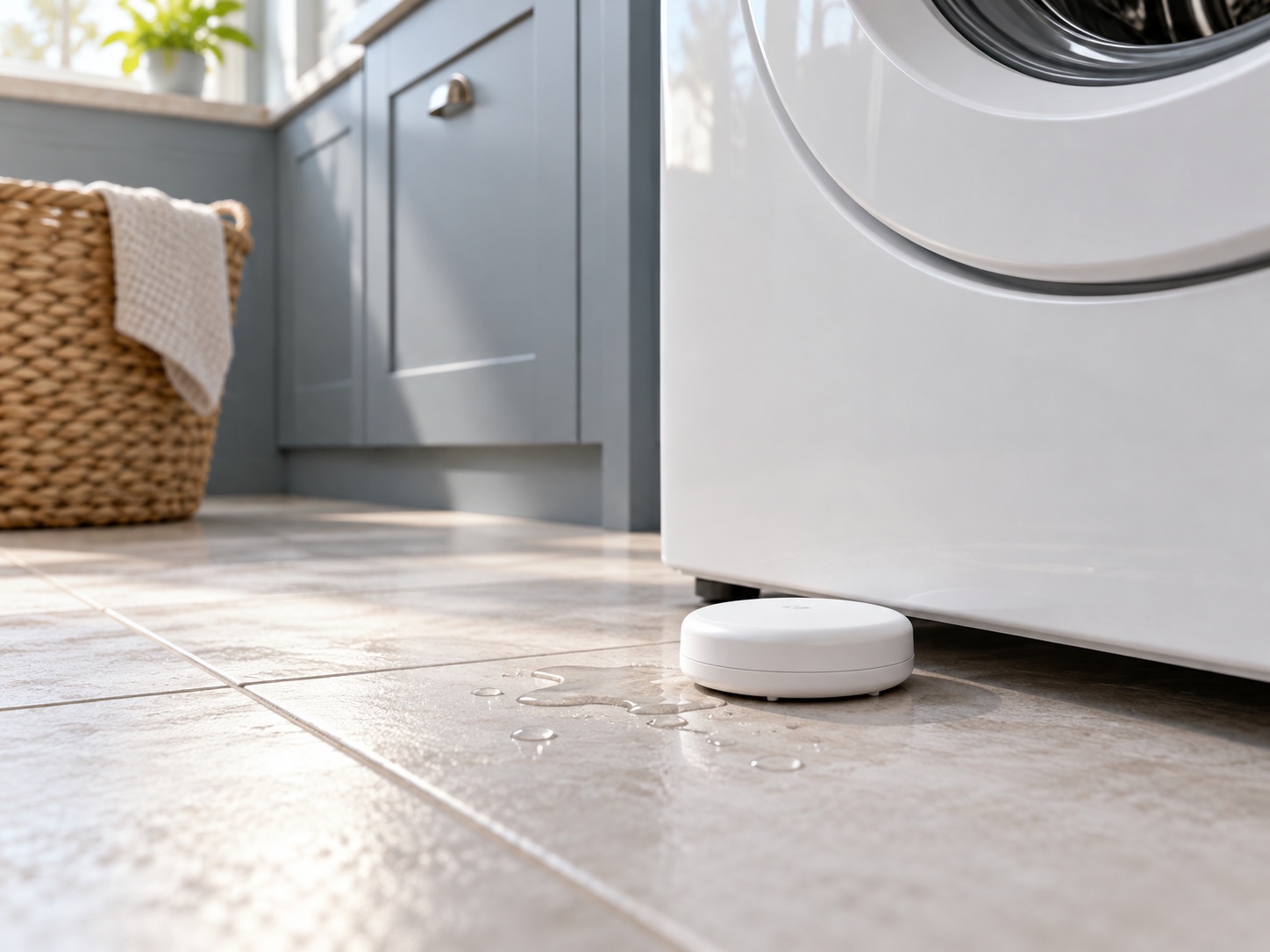
A small moisture sensor detects water at its contacts or sensing cable. Placement therefore matters. A sensor beside a washing machine, water heater or under-sink area can provide early warning when water reaches it, but cannot see through a wall or monitor every room.
Look at the floor slope and likely leak path without disturbing equipment. A sensor on a raised shelf may remain dry while water damages the cabinet below. Conversely, routine splashes can cause nuisance alarms if the placement is unsuitable. Some sensing cables cover a wider local area than a puck. Follow the device's instructions and keep it accessible for testing and cleaning. Point sensors can also reveal condensate or drain leaks that do not appear as abnormal supply flow through a whole-home monitor.
Flow monitoring watches a different signal
A point-of-entry monitor observes water passing a location on the supply. Depending on the product, it may use a mechanical meter, ultrasonic measurement, pressure information or another sensing method. Software then looks for patterns such as unexpectedly continuous use. Ultrasonic flow measurement is not the same as a microphone locating a pinhole in a wall.
Ask exactly what the device measures and its stated detection limits. Very small leaks can fall below a flow sensor's threshold. Some products add a pressure test during a period without use. Moen's Microleak test, for example, temporarily closes its valve and observes pressure stability. That is one documented product method, not a feature to assume in every smart detector or a guarantee that the location of a hidden leak will be identified.
Automatic shutoff reduces supply, not all water damage
When a compatible controller identifies an event that meets its rules, it can command a motorized valve to close. A main-line valve generally isolates the downstream supply rather than locating and closing only the failed branch. The water already in the downstream system can still escape, and detection plus valve movement takes time.
A device does not repair a pipe, remove wet materials, or stop rain and groundwater. Ask what remains upstream of the valve, whether irrigation is included, and what happens to a separate building or unit. The phrase whole-home should be tested against the actual pipe layout. Have a plumber show you that boundary on a simple sketch. It makes the difference between an understandable protection plan and a reassuring icon on a phone.
Learn normal use without ignoring abnormal use
A long shower, irrigation cycle, visiting family or a water treatment regeneration cycle can look unusual to a monitoring system. Conversely, a familiar recurring leak may be mistaken for ordinary consumption unless someone investigates it. Learning features still need accurate household settings and a response to alerts.
Use the first weeks to understand the reports and correct known leaks. Compare an unexpected overnight event with toilet refilling, appliance operation and other plausible uses. EPA's leak guidance describes checking meter movement during a period without intentional water use and looking for ordinary fixture leaks. Record the time and pattern before calling a plumber. Do not repeatedly dismiss an alert simply because there is no puddle; the water could be going into a drain or escaping somewhere you cannot see.
Check power and internet as separate dependencies
A working internet connection, a powered valve and a powered sensor are different requirements. Ask which functions happen locally, which need a cloud service, and whether a hub is involved. Moen's documentation states that its shutoff can still act automatically offline, while remote alerts and control are limited. That behaviour must not be assumed for another system.
Power loss introduces a separate question. An optional battery may keep a valve operating only for a stated duration and within specified conditions. Check whether the router also needs backup for remote communication. Write a short scenario test into the handover: internet unavailable, utility power unavailable, and phone unavailable. Have the installer explain each outcome without improvising a shutdown test on equipment that serves a critical household function.
Fit the valve to the plumbing and its responsibilities
A plumber should check the pipe size, pressure and flow requirements, installation environment, accessibility and compatibility with the rest of the system. Water treatment equipment, recirculation, a private well or multiple supply branches can change the arrangement. A device that physically fits a pipe is not necessarily suitable for the complete installation.
Fire sprinklers require particular attention. An automatic domestic water shutoff must not inadvertently disable the fire-protection supply; the design needs appropriate professional coordination. In a condominium or shared building, establish authority over the line before proposing a valve. Also ask how household members can operate the approved manual control when needed. Make the instructions accessible to the people who would actually be present during a leak, rather than keeping them only in the installer's account.
An alert needs a safe response plan
Decide who receives alerts, who has authorized remote access and who can reach the property. If water is near electrical equipment, do not enter the wet area or handle electrical controls there. Arrange appropriate emergency help. For an accessible plumbing leak, use the known safe shutoff procedure and contact a plumber; do not force an unfamiliar or seized valve.
After an automatic closure, investigate before casually reopening the supply. Note the alert, visible damage and whether any water-dependent equipment needs attention. A trusted neighbour may be able to observe from a safe area, but should not be asked to diagnose concealed wiring or dismantle plumbing. The system's value depends on this human handoff. An unanswered notification can remain only a record of damage that continued elsewhere.
Keep the system working after installation
Save the model numbers, valve location, warranty, app ownership and installer contact in the home record. Follow the manufacturer's test and battery schedule, check that sensors have not moved during cleaning, and verify connectivity after changing a router or password. Confirm that alerts reach the intended people before leaving for an extended absence.
Ask about subscriptions, data handling, software support and account transfer when the home is sold. Revisit settings after plumbing changes or a new occupancy pattern. Include the annual cost of consumables and any service in your comparison. The most useful system is one you can understand, maintain and respond to. It supplements sound pipes, accessible shutoffs and routine leak repairs; it does not make those basics optional.
Questions worth asking
- Does this product detect moisture, measure flow, test pressure or combine methods?
- Which leaks and upstream areas remain outside its coverage?
- What still works with no internet, no utility power or an unavailable phone?
- Can the valve be installed without compromising fire sprinklers or other essential water uses?