

Insulation / Comfort / Renovation
Wall insulation types: batts, blown fibres, boards and spray foam
Recognize common insulation forms and compare their advantages, limitations and place in the complete wall.
Our articles are a starting point, not a professional assessment of your home.
DraftA work in progress, prepared by the HouseIQ.pro team.Editorial and professional review are not yet complete.
Start with the product and the wall
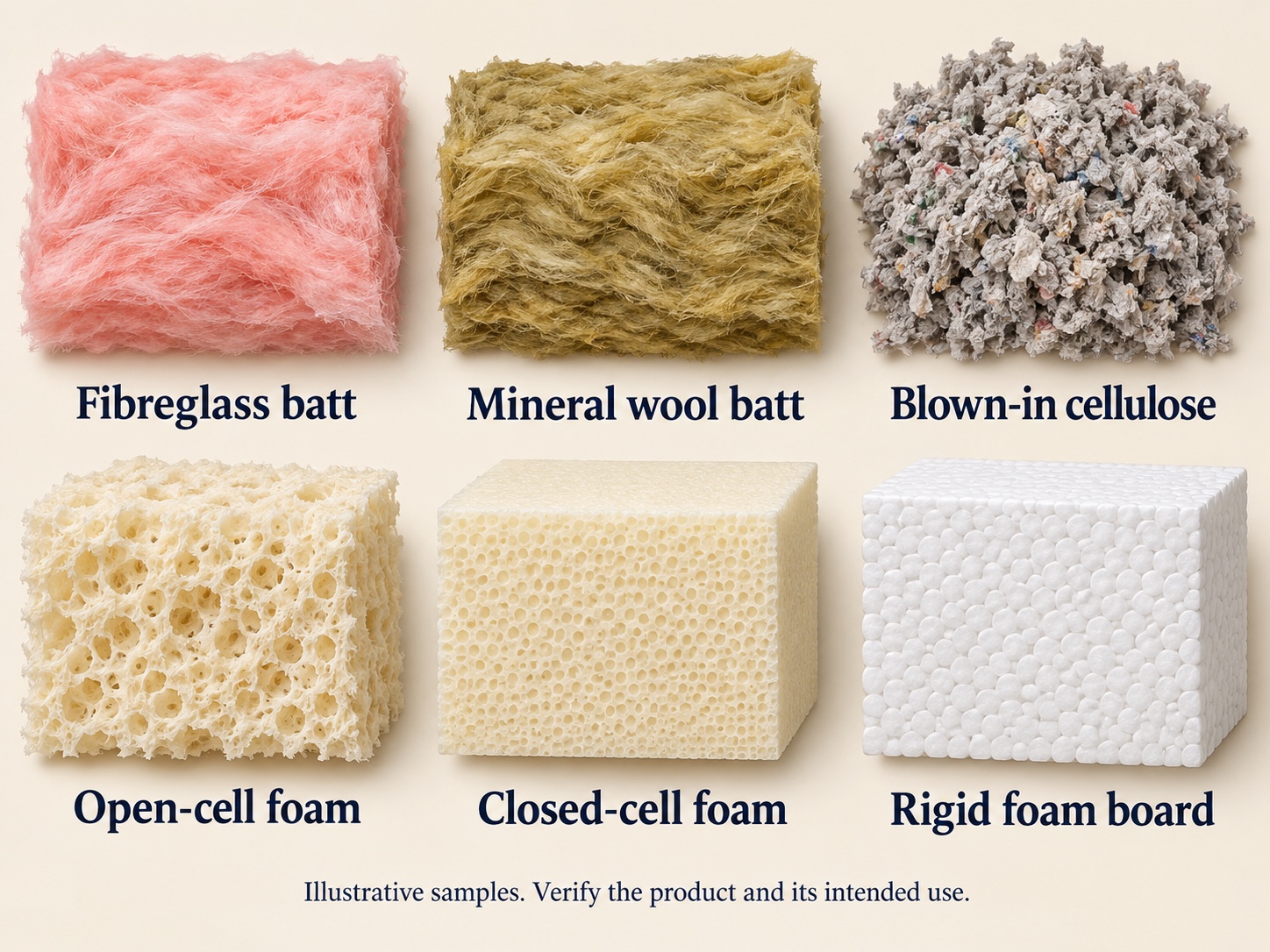
The illustration compares material forms, not a complete wall. Foam textures are schematic and exaggerated. Colour and a photograph cannot reliably establish product identity, density, R-value or fire classification. Do not open a finished wall just to identify its insulation.
First establish whether the wall is framed construction, a foundation wall or solid masonry. Brick-veneer drainage space is not an empty insulation bay. The related wall-retrofit guide explains these differences and whole-wall performance.
Sources: [7]
Illustrative samples of fibreglass batt, mineral-wool batt, blown cellulose, open-cell foam, closed-cell foam and EPS rigid board. Foam textures are schematic. Colours and apparent cell sizes are illustrative. Do not disturb existing insulation to compare it with these samples.
Fibreglass batts: an accessible-cavity option
Fibreglass batts look like fibrous blankets, sometimes with paper or foil facings. They provide a practical option for open, regular stud bays where the installer can see and fit around services.
Check fit before the wall is covered, including edges and obstructions. A filled-looking bay is not proof of complete coverage. Fibrous insulation does not provide the wall’s air seal, and any facing must suit its moisture design.
ROXUL / ROCKWOOL: batts and boards have different jobs
Stone-wool batts are relatively firm fibrous mats. Comfortbatt is one example of a thermal batt for framed cavities; its noncombustibility and shape retention can be useful. Check the exact product rather than assuming a sound-control batt has the required thermal specification.
Comfortboard is intended for continuous exterior insulation. It sits outside framing as part of the cladding and rain-control assembly. It is not siding or waterproofing. The fastening, air-control layer, drainage and window details belong in the design.
Cellulose and blown fibreglass: use a wall installation method
Cellulose is paper-based fibre; blown fibreglass is glass fibre in loose form. They may suit an assessed existing cavity that can be filled without removing all the finishes, or suitable open-wall systems.
An attic loose-fill specification cannot simply be reused vertically. Product-specific wall density and methods address settlement and voids; blocking and existing insulation complicate filling. Damp-spray products need an appropriate drying check before enclosure. Ask how concealed coverage will be verified and access holes repaired.
Spray foam: open-cell and closed-cell are distinct choices
Open-cell foam is lower-density and more vapour-permeable. Closed-cell foam is denser and generally gives more thermal resistance per unit thickness. These differences matter where space or drying is constrained. Air- and vapour-control performance depend on the product and installed thickness.
Spray foam is formed on site, so workmanship is part of the result. Request product information, applicator qualifications and installation records. Agree on occupant exclusion, isolation, ventilation and written re-entry guidance before work; there is no universal waiting period for every product and job.
Ask what protective covering is required for fire safety and how the finished wall will dry. Neither foam type repairs a rain leak.
Rigid boards: EPS, XPS and polyiso
EPS commonly shows fused beads; XPS has a more uniform fine-cell appearance; polyisocyanurate boards often have facers such as foil. These are visual clues, not identification tests. Continuous boards can reduce heat flow through framing that cavity insulation leaves exposed.
Compare the actual product’s thermal data, approved location, moisture behaviour and temperature limitations. Facers and thickness affect drying. Joints and edges require assembly-specific details, and foam plastic needs appropriate protection. A quote saying only ‘foam board’ is incomplete.
Sources: [1]
Older walls: assess risks before opening them
Insulation is only one material a renovation can disturb. Health Canada identifies asbestos concerns in older building materials and in vermiculite insulation, including in walls. Seek qualified advice before opening a suspect assembly; the absence of visible vermiculite is not an asbestos clearance.
Request a wall section and written scope covering retained layers, insulation, air and vapour control, drainage, finish repairs and inspection points. Keep contractor photographs before concealment, product labels and completion records.
Sources: [2]
Useful reading and printable guidance
The sources include Health Canada’s printable infographic, its current vermiculite advice, and NRCan’s free Keeping the Heat In. Manufacturer links illustrate specific products and intended uses; they are not HouseIQ product endorsements.
Sources
- Natural Resources Canada Keeping the Heat In — Materials and insulation
- Health Canada Asbestos and your health — including vermiculite insulation
- Health Canada Asbestos in the home — printable infographic (PDF)
- ROCKWOOL Comfortbatt — applications and product data
- ROCKWOOL Comfortboard — continuous exterior insulation
- U.S. Environmental Protection Agency — archived guidance Safer Workplace Practices for Spray Polyurethane Foam Installation
- ENERGY STAR Choosing the Appropriate Insulation Type