

Comfort IQ / Energy IQ / Build IQ
Window coverings: warmth, shade and a clearer view
Compare curtains, cellular shades, solar screens and film by the comfort problem they solve—and by the performance the whole window can deliver.
Our articles are a starting point, not a professional assessment of your home.
DraftA work in progress, prepared by the HouseIQ.pro team.Editorial and professional review are not yet complete.
Start with the discomfort you want to change
A chair beside a cold window can feel chilly even when the thermostat is satisfied. A west-facing room can become unpleasant in late afternoon while the rest of the home feels fine. Curtains and shades can help both situations, but their jobs differ: reducing heat transfer through the window, managing incoming sunlight, and changing the surfaces and light you experience.
Before comparing products, note the window, season and time of day involved. Include whether you want a view, daylight, privacy or a dark bedroom. These observations are a HouseIQ planning exercise, not an energy audit. They help a supplier explain a tradeoff in terms of your room rather than offer one treatment for every window. Start with the existing glazing and the covering together.
R-value does not measure solar rejection
R-value describes resistance to heat flow; higher resistance helps slow heat loss. U-factor measures heat transfer; lower is better for insulation. Ask whether a quoted value describes fabric, an attachment alone or a tested window-and-attachment combination. A number without that boundary cannot establish the performance of your finished window. Metric and imperial resistance values also need consistent units.
Solar heat gain coefficient, or SHGC, addresses sunlight entering as heat. Lower SHGC generally serves a cooling goal, while useful winter sun can favour a different balance. Visible transmittance addresses daylight. These are separate properties: a shade can darken a room without being its strongest insulator, and a well-insulating shade may block a view you want to keep. Compare the relevant property rather than a single “thermal” adjective.
Curtains can improve comfort without becoming a wall
Ordinary drapes and curtains provide a warmer surface between you and cold glazing, reducing the radiant discomfort of sitting nearby. Thermal lining and a close fit can improve their contribution, but fabric weight alone does not establish a high whole-window R-value. Air moving around the edges still matters. A decorative curtain hanging well away from the opening behaves differently from a purpose-designed insulating attachment.
The Berkeley Lab/BuildingGreen guide describes conventional interior coverings as modest insulators, with different daylight and view tradeoffs. Louvered blinds offer useful adjustment of glare and sunlight; heavy curtains offer less precise control. Treat “blackout” as a light-control claim, not a standardized energy rating. Ask for evidence specific to the fabric, lining and configuration being quoted rather than assuming that a room-darkening label guarantees winter performance.
Sources: [3]
Cellular shades are a strong insulation candidate
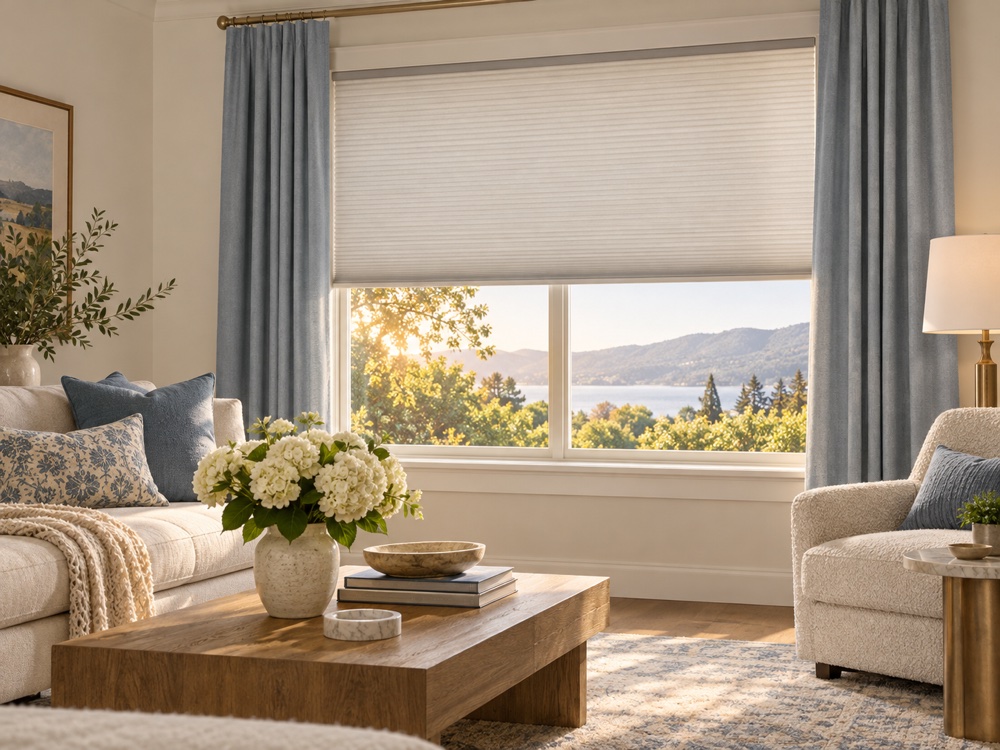
Honeycomb cells hold air within the shade. The air space beside the glass and the perimeter fit also affect the result. The Berkeley Lab/BuildingGreen guide gives illustrative added imperial R-values of about R-1 to R-2 for insulated cellular shades without side tracks, compared with about R-4 for tracked cellular products or similarly close-fitting quilted blinds. Those are educational ranges, not a guarantee for every shade sold today.
This makes well-fitted cellular or quilted products worth investigating when winter heat loss is the priority. It does not establish one universal winner. Request a rating for the exact fabric, cell construction and mounting configuration; an untracked installation cannot borrow the result of a tracked one. Consider how easily occupants can operate it and how much view disappears when it is closed. A strong closed-position rating contributes little while the shade remains raised.
Sources: [2]
For summer heat, placement and openness matter
An exterior solar screen intercepts sunlight before it reaches the glazing. An interior covering manages sunlight after it has encountered the window, so the two placements can produce different results even when they look similar. Exterior shading deserves consideration for a strongly sun-exposed opening, but the building, window operation and permission to alter the outside can limit the options.
Screen openness describes the proportion of open space in the weave. A more open fabric generally preserves more view while admitting more sunlight; colour also changes reflection and absorption. Compare documented solar performance, daylight and a sample viewed in the intended setting. Do not translate a screen’s advertised blockage percentage directly into air-conditioning savings. Fixed screens also affect winter sunlight, while movable shades let you change the balance across seasons.
Sources: [4]
Choose the property before choosing the product
No category wins every column. An attachment intended to preserve the view may sacrifice insulation; another may insulate well when closed but remove useful daylight. Use this comparison to decide what evidence to request, then compare exact products. Combining treatments can be sensible, but do not add their advertised savings percentages or assume that independent test results describe the combined installation.
| Attachment | Main strength to investigate | Important limit |
|---|---|---|
| Thermal curtains | Radiant comfort, privacy and some insulation | Fit and lining matter; not an airtight window repair |
| Cellular or quilted shade | Insulation when closed, especially with a documented perimeter system | Closed shade limits view; exact configuration matters |
| Exterior screen or shade | Control of unwanted sunlight before it reaches the glass | Exterior approval, exposure and seasonal daylight tradeoffs |
| Applied solar-control film | Solar control while retaining some view | Glass compatibility and permanent winter solar reduction |
Film is a separate glass decision
Applied solar-control film changes the optical behaviour of glazing rather than adding a thick insulating air pocket. NRCan cautions that such films may provide little added insulation while reducing beneficial winter solar gain. Some specialized low-emissivity products have different properties, so the exact product and glazing data matter. A dark tint or an infrared-rejection headline is not a substitute for whole-solar performance.
Film also needs a compatibility check for the existing glass, coatings and warranty because thermal stress can be a concern. Removable attachment does not automatically remove that concern. If film is the leading option, use HouseIQ’s separate window-film article for SHGC, visible light and infrared claims. Here, the key comparison is that adjustable curtains and shades can be opened seasonally; applied film continues to affect the window while it remains in place.
Sources: [6]
How much can coverings actually save?
Use AERC’s climate improvement ratings to compare certified attachments, with attention to the product category and intended climate. The label’s category maximum provides context, and some labels distinguish manual from automated operation. These are performance comparisons; the displayed rating is not a promise to cut your entire utility bill by that percentage. Ask the supplier which reference window and operating assumptions underlie the claim.
HouseIQ denominator example, with invented inputs: suppose a particular improvement reduced one window-related heating loss of 100 energy units to 70. That is a 30% reduction in that loss. If the home previously needed 1,000 units of heating energy overall and everything else stayed unchanged, the reduction would be 30 out of 1,000, or 3%. Real homes require climate, glazing, HVAC and operating assumptions; this arithmetic only explains why a component percentage is not a household forecast.
Sources: [1]
Use the covering with the season
DOE’s guide recommends closing curtains or shades on cold nights and admitting useful sunshine during heating periods. During cooling periods, covering directly sunlit windows helps limit unwanted gains. The right routine follows the room: a shaded north-facing opening, a sunny west-facing opening and a winter bedroom need not stay in the same position all day. Avoid blocking useful daylight simply because another room is overheating.
Watch the glass during cold weather. NRCan warns that coverings can contribute to winter condensation problems; insulation between room and glass can leave the glass colder. Persistent moisture deserves attention to humidity, ventilation and the window, not another layer concealing it. HouseIQ’s condensation article explains that investigation. Automated controls can help with timing, but the separate smart-shading article covers that decision; they do not change the underlying fabric or glazing.
Make comfort, access and safe operation part of the choice
Health Canada identifies long accessible cords as a strangulation risk and recommends coverings without them. Keep the supplied safety components intact and follow the manufacturer’s warnings. Product selection should account for children and visitors, not just the household’s current routine. An energy advantage does not compensate for unsafe operation or a covering that people cannot comfortably use.
For a rental or condominium, bring the exact proposed attachment and mounting method to the responsible owner or manager before an alteration. Record who owns it and what restoration is expected. Ask the supplier to check window operation, required access, heater clearances and glazing compatibility. A modest, usable treatment on the problem window can be a better starting point than committing the whole home before you understand the daylight, appearance and comfort tradeoffs.
Questions worth taking with you
- Is the main problem winter heat loss, summer sun, glare or privacy—and when does it happen?
- Does the rating describe this exact covering and window configuration, with clear units and assumptions?
- Will the covering be used regularly without creating cord hazards, access problems or persistent condensation?
Sources
- Attachments Energy Rating Council Reading the Residential Label
- Lawrence Berkeley National Laboratory / BuildingGreen Cellular Shade — Efficient Window Coverings
- Lawrence Berkeley National Laboratory / BuildingGreen Drapes & Curtains — Efficient Window Coverings
- Lawrence Berkeley National Laboratory / BuildingGreen Exterior Solar Screen — Efficient Window Coverings
- U.S. Department of Energy Energy Saver: Tips on Saving Money and Energy in Your Home
- Natural Resources Canada Keeping the Heat In — Section 8: Upgrading windows and exterior doors
- Health Canada Window covering safety